Tokenization’s Hard Part Has Begun: Building the Record, Money and Control Plane
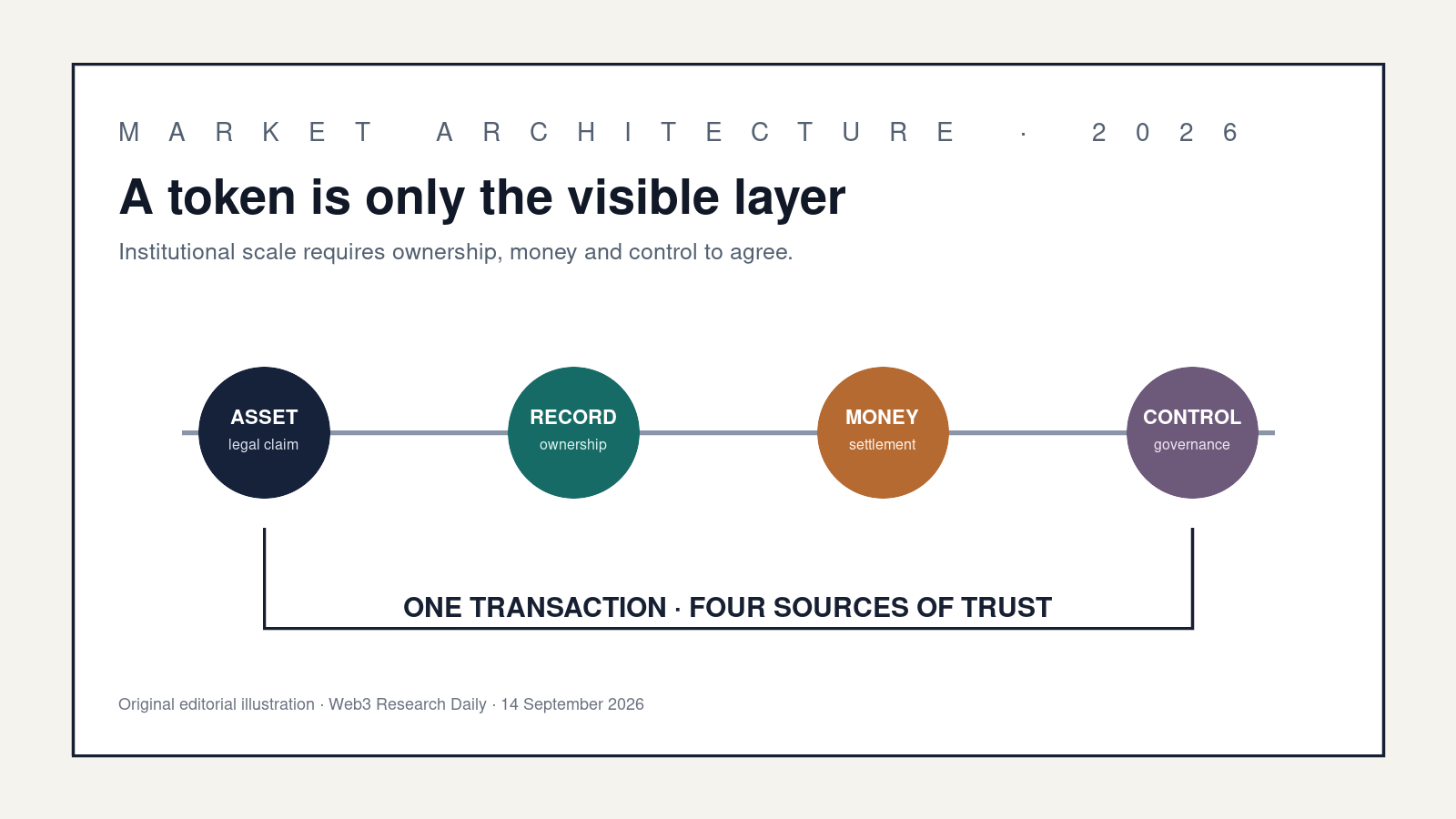
The token is the visible object; institutional trust comes from four layers agreeing. Original editorial illustration.
Executive summary
Tokenized finance has crossed an important threshold in 2026, but not the one suggested by the loudest market-size forecasts. The decisive shift is from issuing digital representations of assets to rebuilding the machinery that makes those representations legally authoritative, safely settleable and operationally governable. Recent developments in the United States, Europe, Australia and South Korea all point in the same direction: a blockchain entry is useful only when market participants know which record controls ownership, what money discharges the payment obligation, who can reverse or correct an error, and how the system behaves when a network or intermediary fails.
The market is already substantial enough for these questions to matter. Dune’s September 2026 real-world-asset dataset reports more than $32 billion of represented asset value across fixed income, credit, commodities and equities on 21 chains. Fixed income accounts for $16.5 billion, of which 88% is U.S. Treasuries; credit contributes $7.6 billion, commodities $5.5 billion and equities $2.5 billion. Yet distribution is uneven: Dune counts roughly 69,000 fixed-income holding addresses, broadly flat for a year, versus 872,000 equity holding addresses after 32-fold annual growth. Supply is expanding faster than a common institutional market is forming.[1]
The report’s thesis is that the next competitive frontier is not token issuance but institutional coherence. A viable market must keep four things synchronized: the legal claim, the authoritative ownership record, the settlement asset and the governance framework. The U.S. Securities and Exchange Commission staff’s January taxonomy makes the record problem explicit. BIS Project Agorá demonstrates that tokenized commercial-bank deposits and central-bank reserves can support atomic cross-border settlement, including controlled real-value transactions. The Eurosystem is connecting DLT assets to central-bank-money settlement and collateral operations. Australia is asking how existing real-time settlement services should support tokenized markets. South Korea is sequencing tokenized securities infrastructure ahead of legal recognition in February 2027.[2][3][4][5]
This is progress, not completion. Tokenization can reduce reconciliation, compress settlement risk and automate lifecycle events, but it can also create parallel records, new intermediary exposures, fragmented liquidity and a misleading appearance of finality. The institutions most likely to benefit will treat DLT as a redesign of the full transaction lifecycle—not as a new wrapper around an old asset.
The market has grown; its shape matters more than its headline size
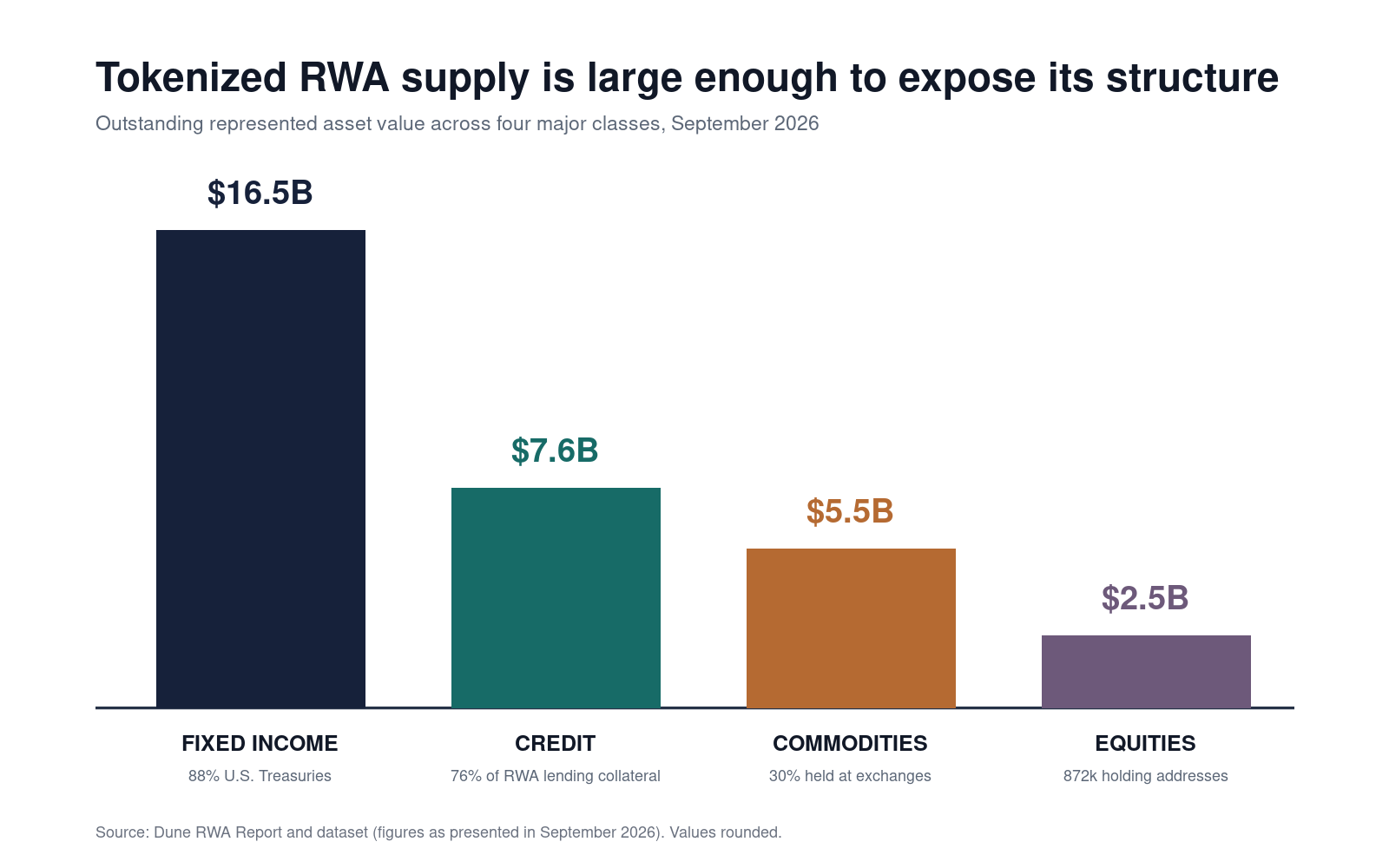
The four largest tokenized RWA classes total more than $32 billion, but their ownership and use patterns differ sharply. Source: Dune.[1]
Dune’s figures reveal several markets hiding under one label. Tokenized fixed income is the largest pool and grew 111%, yet its holder count has barely moved since August 2025. That pattern is consistent with institutionally distributed subscription-and-redemption products: a comparatively small set of wallets can hold large balances. Equity tokens have the opposite profile—smaller outstanding value, far more addresses and much faster retail-style diffusion. Credit is disproportionately important in on-chain lending, holding 76% of RWA lending collateral, while 30% of tokenized commodities sits at exchanges.[1]
The distinction between represented assets and synthetic exposure is equally important. Dune reports $2.0 billion of open interest in real-world-asset perpetual markets and says 97% of gold and equity trading volume in its measured universe clears through perpetuals rather than spot tokens. Synthetic markets can improve access and price discovery, but their holders generally own a claim on the derivative issuer or protocol—not the referenced share or bar of gold. A volume chart therefore cannot answer the institutional question: what right survives an intermediary’s bankruptcy?[1]
That question is becoming central because tokenization is broadening from funds and private credit into public securities and market infrastructure. DTCC says it has completed live production transactions using tokenized DTC-custodied assets and is targeting an October 2026 launch of its Tokenization Service, following limited production activity and an industry working group of more than 50 firms.[6] The significance is not that a new blockchain can move tokens. It is that a core post-trade utility is attempting to make tokenized positions coexist with regulated custody, corporate actions and established ownership infrastructure.
One word, three different legal objects
The SEC staff’s January 2026 statement supplies a useful discipline. It separates issuer-sponsored tokenized securities from two broad third-party forms: custodial entitlements and synthetic instruments. In an issuer-sponsored model, the issuer or its agent integrates DLT into the master securityholder file, so an on-chain transfer changes the authoritative record. A third-party custodial token instead represents an indirect interest in a security held elsewhere. A synthetic token provides economic exposure but may convey no voting, information or other rights against the referenced issuer.[2]
flowchart LR
    A[Investor acquires a token] --> B{Who created it?}
    B -->|Issuer or authorized agent| C[Issuer-sponsored security]
    B -->|Unaffiliated third party| D{What does the token represent?}
    D -->|Custodied underlying asset| E[Security entitlement]
    D -->|Price-linked obligation| F[Synthetic instrument]
    C --> G[Transfer updates authoritative holder record]
    E --> H[Claim depends on custodian and entitlement chain]
    F --> I[Exposure depends on third-party promise and terms]
This taxonomy is not merely semantic. Each branch changes the investor’s legal relationship, insolvency exposure, corporate-action path and recourse. The staff statement itself is not a Commission rule and creates no new obligations, a limitation that should temper claims of regulatory certainty. Still, it establishes a practical analytical test: before asking which chain hosts a token, ask who owes what to whom and which record a court or transfer agent would recognize.[2]
In September, the SEC also proposed modernizing transfer-agent reporting, including questions that distinguish issuer-sponsored from third-party-sponsored tokenized securities. The proposal is evidence that tokenization is entering supervisory data collection, but it remains a proposal, not a completed rule.[7] This is a recurring theme across 2026: institutional architecture is moving from speeches and sandboxes toward operational rules, while material parts of the framework remain unsettled.
Delivery is only half the transaction
A tokenized bond can move in seconds and still fail to deliver meaningful settlement improvement if the cash leg remains slow, fragmented or credit-intensive. Delivery-versus-payment requires both legs to complete together. If a securities token moves on one network while payment moves through a separate banking process, participants still face timing gaps, reconciliation and principal risk. A stablecoin may support continuous settlement, but its acceptability depends on redemption, reserve quality, legal treatment and the receiver’s willingness to hold it.
BIS Project Agorá addresses this problem at the level of the two-tier monetary system. Its design combines tokenized commercial-bank deposits with jurisdiction-specific tokenized central-bank reserves on a programmable platform. The May 2026 report concluded that atomic multi-currency settlement was technically and legally feasible in the seven jurisdictions studied, while preserving central-bank autonomy and privacy boundaries. The project then conducted controlled real-value testing in July: 28 financial institutions and central banks completed 17 scenarios in selected currencies totaling approximately CHF800,000, with individual values from CHF9,000 to CHF125,000.[3][8]
Those amounts are intentionally modest and should not be mistaken for production scale. Their importance lies elsewhere: real-value testing forced legal, operational, governance and approval processes to meet the prototype. It transformed “programmable money” from a laboratory capability into a bounded test of actual obligations. The next challenge is scaling participation and operating resilience without turning a shared platform into a new concentration point.
sequenceDiagram
    participant Buyer as Buyer bank
    participant Asset as Tokenized asset ledger
    participant Money as Deposit-money layer
    participant CB as Central-bank reserve layer
    participant Seller as Seller bank
    Buyer->>Money: Lock buyer's tokenized deposit
    Asset->>Asset: Validate title, eligibility and controls
    Money->>CB: Reserve interbank settlement funds
    CB-->>Money: Confirm final reserve transfer
    par Atomic completion
        Asset-->>Buyer: Deliver asset
        Money-->>Seller: Credit tokenized deposit
    end
    Note over Asset,Money: Either all linked legs settle, or none do
Europe is pursuing a bridge rather than waiting for a wholly new financial system. Since 30 March 2026, the Eurosystem has accepted qualifying marketable assets issued through DLT services in central securities depositories as collateral, provided they remain settleable through eligible systems reachable via TARGET2-Securities. This makes DLT issuance compatible with existing collateral operations rather than granting blanket eligibility to any on-chain asset.[9] The ECB’s Pontes initiative is intended to provide central-bank-money settlement for DLT transactions from September 2026, while the longer-term Appia work addresses interoperability and standards.[10]
Australia’s September consultation asks an analogous institutional question: how could the Reserve Bank Information and Transfer System and Fast Settlement Service support cash settlement for tokenized wholesale assets, at-par exchange among private tokenized monies, potential access for stablecoin issuers and tokenized reserves?[4] The document does not announce a settled design. Its importance is that it frames tokenized finance as an extension of the public settlement infrastructure mandate, including access and risk choices—not as a technology pilot isolated from the monetary system.
South Korea offers a revealing sequence
South Korea’s Financial Services Commission published a three-phase roadmap on 4 September 2026. Amendments to the Electronic Registration Act are scheduled to take effect on 4 February 2027, legally recognizing security tokens as a digitized form of securities. The first phase envisages private money-market funds and bonds for institutional investors, trust-based unlisted shares and publicly offered fractional-investment securities; later phases expand infrastructure and eligible instruments. The FSC also points toward an exchange-centered pilot and standardized DLT requirements.[5]
The sequence matters. Legal recognition comes with a staged build by securities firms and the Korea Securities Depository, rather than an assumption that public-chain issuance alone creates a market. The approach may appear conservative, but it targets the difficult dependencies: registry integrity, investor protection, trading rules, clearing, settlement and rights administration. It also makes the transition measurable. Policymakers can widen asset scope only after observing how the first cohort performs.
Across the United States, Europe, Australia and South Korea, institutional tokenization is therefore converging on a layered architecture even when implementation choices differ.
flowchart TB
    L1[Legal layer<br/>asset rights, insolvency and finality]
    L2[Record layer<br/>issuer, transfer agent or CSD authority]
    L3[Transaction layer<br/>trading, transfer and lifecycle automation]
    L4[Money layer<br/>reserves, deposits or regulated settlement asset]
    L5[Control layer<br/>identity, compliance, recovery and governance]
    L1 <--> L2
    L2 <--> L3
    L3 <--> L4
    L4 <--> L5
    L5 -. operational evidence .-> L1
Implications for institutions and Web3 markets
First, the authoritative record becomes a product feature. Two tokens referencing the same company can have radically different risk because one is the company’s recognized share and the other is a claim against an unaffiliated sponsor. Disclosures should identify the controlling record, the reconciliation mechanism and the treatment of forks, lost keys, court orders and corporate actions. “On-chain” is a location claim, not a rights analysis.
Second, settlement-asset quality will influence which networks aggregate liquidity. A market offering atomic delivery against central-bank money or well-governed tokenized deposits gives regulated firms a clearer path to finality than one requiring them to warehouse an unfamiliar private money. Stablecoins can remain important for access and extended hours, but institutional receivers will price issuer, reserve, redemption and depeg risk. The likely outcome is plural rather than maximalist: different money forms connected by regulated conversion and settlement arrangements.
Third, incumbents may capture much of the near-term value. Transfer agents, CSDs, central banks and custodians are not disappearing from the evidence; they are becoming programmable. That may disappoint visions of total disintermediation, but it can still reduce duplicate books, manual reconciliation and settlement latency. The economic test is whether tokenization removes processes and trapped capital, not whether it removes every institution.
Fourth, public and permissioned networks will remain in tension. Public chains offer distribution, composability and transparent state; permissioned systems offer controlled access, privacy and explicit accountability. Bridges between them can reintroduce the very reconciliation and operational risk that tokenization promises to remove. Interoperability therefore requires common legal and data semantics, not merely message passing.
Risks and counterarguments
The strongest counterargument is that the infrastructure build is elaborate relative to the current market. More than $32 billion is meaningful for an emerging segment but tiny beside global securities markets. Fixed-income holder growth is stagnant, and a high address count does not equal distinct beneficial owners. Wallets can be split, custodial addresses can aggregate many investors, and synthetic activity may amplify apparent adoption without financing issuers or transferring underlying ownership.[1]
Operational compression can also concentrate risk. Atomic settlement reduces principal risk but may increase liquidity needs because participants lose the flexibility of delayed or netted settlement. A shared programmable platform can reduce handoffs while becoming a critical node. Smart-contract defects, governance key compromise, oracle errors and inconsistent business-continuity arrangements remain credible failure modes. Privacy technology must also reconcile confidentiality with sanctions, anti-money-laundering and supervisory access.
Legal finality is jurisdiction-specific. Project Agorá’s legal analysis found a path to finality across its participating jurisdictions, but also identified the need for further technical, operational and contractual alignment.[3] A token that is final under network rules may still be challenged through insolvency or property law. Cross-border transactions multiply those conflicts.
Finally, programmability can encode bad rules efficiently. Automated eligibility, transfer restrictions and corporate actions are valuable only if data are correct, appeals exist and accountable parties can intervene. Institutions should resist both extremes: treating code as legally sovereign, or preserving so many manual controls that the new rail delivers no economic benefit.
Conclusion
Tokenization’s 2026 milestone is not a single market-cap number. It is the emergence of a common policy and infrastructure agenda around authoritative records, credible settlement assets and operational control. The SEC taxonomy clarifies why tokens carrying similar tickers may convey different rights. Project Agorá shows atomic, multi-currency settlement can reach real-value testing. The ECB is attaching tokenized assets to central-bank-money and collateral rails; Australia is evaluating how its settlement system should adapt; South Korea is sequencing market infrastructure with legal recognition.
These initiatives do not prove that all securities will migrate on-chain, nor that tokenization automatically creates liquidity. They establish a more useful standard of evidence. A tokenized market deserves institutional confidence when ownership remains intelligible through insolvency, payment achieves recognized finality, lifecycle events work, controls are auditable and the system can recover from failure. The winners will not be the platforms that mint the most representations. They will be the ones that make asset, record, money and control behave as one market.
Sources
Dune. “Real-World Assets Report.” September 2026.
U.S. Securities and Exchange Commission staff. “Statement on Tokenized Securities.” 28 January 2026.
Bank for International Settlements. “Project Agorá shows how tokenisation can improve wholesale cross-border payments.” 27 May 2026.
Reserve Bank of Australia. “The Role of RITS in Supporting Settlement in a Tokenised Ecosystem.” September 2026.
Financial Services Commission, Republic of Korea. “Policy Roadmap on Digital Transformation and Tokenization of Securities Issuance and Circulation.” 4 September 2026.
DTCC. “Tokenization Becomes a Reality.” Accessed 14 September 2026; and “DTCC Advances Development of New Tokenization Service.” 4 May 2026.
U.S. Securities and Exchange Commission. “Proposed Rule: Transfer Agent Rules.” September 2026.
Bank for International Settlements. “Project Agorá: Real-Value Testing.” July 2026.
European Central Bank. “ECB paves way for acceptance of DLT-based assets as eligible Eurosystem collateral.” 27 January 2026.
European Central Bank. “Digital assets, payment efficiency and monetary policy.” 4 May 2026; and “Appia roadmap.” March 2026.