Glamsterdam: Ethereum’s next scaling test is coordination, not a headline TPS number
Lead image: Glamsterdam reorganizes who does the work, when data moves and how persistent resources are priced. Original editorial illustration.
Research date: 12 September 2026. Ethereum’s Glamsterdam upgrade is in devnet testing, with mainnet expected in Q4 2026 but no confirmed activation date. The next published milestone is a Sepolia fork planned for 6 October. All forward-looking statements below should be read against that still-changeable delivery status.
Executive summary
Glamsterdam matters because it is not simply another increase in Ethereum’s nominal capacity. Its core package attempts to make higher capacity defensible. Enshrined proposer-builder separation, or ePBS, moves a critical block-market exchange into consensus and lengthens the effective window for propagating execution payloads. Block-level access lists, or BALs, expose what a block touched and what changed, preparing clients for parallel data access and enabling new synchronization methods. State creation and state access are repriced so that higher gas limits do not silently convert into uncontrolled database growth or worst-case node workloads.
The thesis of this report is that Glamsterdam should be evaluated as a coordination upgrade. Its success is not the largest block that a devnet can process. It is whether builders, proposers, attesters, execution clients and application developers can coordinate under new timing, data and cost rules without narrowing the set of operators able to verify the chain. The three headline mechanisms reinforce one another: ePBS buys time; BALs make work more visible; repricing constrains resource consumption. Remove any leg and “scale L1” becomes less credible.
This also explains the upgrade’s asymmetric effects. Ordinary ETH holders do not need to convert assets. Simple transfers between existing accounts are scheduled to become materially cheaper at the intrinsic-gas level. Yet some contracts with hard-coded gas assumptions may fail or degrade under state repricing, and staking infrastructure must adapt to the new block-production architecture. Institutions should therefore avoid the comforting but incomplete framing of “more throughput and lower fees.” Glamsterdam offers more capacity in exchange for a migration of operational assumptions.
What is actually scheduled
The official ethereum.org Glamsterdam overview says scope is frozen, while warning that the meta EIP remains a draft and scope can still change before mainnet. That nuance is essential. “Scheduled for inclusion” is stronger than an early proposal, but weaker than activated code. The official page currently places mainnet in Q4 2026 without a confirmed date and identifies Sepolia on 6 October as the next milestone. EIP-7773 is the canonical hard-fork meta specification for tracking the package.
The investable story is concentrated in a few changes rather than the full EIP inventory:
Component | Scheduled function | Strategic relevance | Principal watchpoint |
|---|---|---|---|
ePBS, EIP-7732 | Enshrine proposer-builder exchange and separate consensus-block and payload-timeliness checks | Longer payload propagation window; fewer mandatory off-protocol trust assumptions | New client, validator and staking-pool operational paths |
BALs, EIP-7928, plus eth/71 | Commit to block access information and distribute it between clients | Parallel reads, dependency visibility and executionless state update pathways | Additional block/network data and client implementation complexity |
State repricing, EIPs 8037/8038 | Reprice creation and access around measured resource burdens | Makes future gas-limit growth less hostile to node accessibility | Legacy contracts with fixed gas expectations |
Validator churn, EIP-8061 | Separate lanes and scale exit capacity with stake | Faster exits and consolidations | Shorter weak-subjectivity period |
Intrinsic gas, EIP-2780 | Reduce the fixed cost of a basic transaction while charging for new-account state | Cheaper simple ETH transfers without subsidizing state creation | Headline savings do not apply uniformly to complex calls |
Two points follow. First, the upgrade is broader than ePBS even though ePBS is the consensus-layer headliner. Second, its benefits are conditional. A longer propagation window can accommodate larger payloads, but it does not guarantee demand, low fees or decentralized builder markets. An access map can facilitate parallel processing, but it is infrastructure for parallelism rather than a promise that every client immediately executes every transaction concurrently.
The new block-production bargain
Today, Ethereum’s proposer-builder market commonly uses out-of-protocol software and relays to coordinate the exchange of a valuable execution payload for payment. According to the official overview and the EIP-7732 specification, ePBS brings the basic exchange into the protocol. A proposer selects the consensus block; a builder supplies the execution payload; protocol rules support the payment and determine whether the payload arrived on time. A Payload Timeliness Committee participates in the latter judgment.
flowchart LR
    B[Builder assembles execution payload] --> C[Protocol commitment and payment path]
    P[Proposer selects consensus block] --> C
    C --> A[Validators attest to consensus block]
    B --> T[Payload Timeliness Committee checks arrival]
    A --> F[Canonical block outcome]
    T --> F
    F --> N[Nodes execute and verify]
The important economic change is not that specialized builders disappear. They almost certainly remain because order flow, simulation and block optimization remain specialized activities. What changes is the settlement layer for the core hand-off. Ethereum can reduce required reliance on third-party relays for the basic exchange, while relays may survive as optional service providers for features beyond the protocol.
Timing is equally important. Ethereum’s official explanation says the payload propagation window expands from roughly two seconds to about nine seconds. That is meaningful headroom: verification networks can move more data without compressing every operation into the existing hot path. It supports bigger execution payloads and more blob capacity without treating bandwidth as free. But the “about” matters, and the gain should not be translated mechanically into a 4.5-times throughput forecast. Protocol timing includes duties other than payload propagation, and real-world limits include heterogeneous bandwidth, client performance and adversarial conditions.
For institutional stakers, ePBS changes process risk. Client readiness, builder selection, monitoring and fallback behavior deserve pre-production tests. The official roadmap explicitly notes architectural updates for staking pools to support trustless monitoring. This is not a reason to resist the upgrade; it is a reason to budget engineering and incident-response attention before activation.
Access maps turn hidden dependencies into usable infrastructure
Ethereum execution is difficult to parallelize because a node does not know which accounts or storage a transaction will touch until it runs that transaction. Conflicting state writes force careful ordering. EIP-7928’s BAL records block-wide state accesses and post-execution values, with a commitment in the block header. The accompanying eth/71 networking change lets execution clients exchange these lists.
That produces three different benefits that are easy to conflate. Nodes can prefetch data because required state is visible. They can identify non-overlapping work that is safe to process in parallel. And, because post-execution values are present, a syncing node gains an executionless state-update route rather than replaying every operation merely to reconstruct the result. Each benefit has a different maturity curve. Faster disk reads can arrive before generalized parallel execution; synchronization improvements can be valuable even if execution remains partly serial.
flowchart TD
    X[Ordered block transactions] --> M[Block-level access list]
    M --> R[Reveal accounts, storage and code touched]
    M --> V[Carry post-execution values]
    R --> G{Do state dependencies overlap?}
    G -->|No| Q[Schedule safe parallel reads or work]
    G -->|Yes| S[Preserve required ordering]
    V --> U[Executionless state update pathway]
    Q --> Z[Higher verification headroom]
    S --> Z
    U --> Y[Faster synchronization option]
This distinction matters to investors and infrastructure operators. BALs are better understood as a data-availability layer for execution dependencies than as an instant “parallel EVM.” The immediate asset is visibility. Client teams then convert visibility into performance through storage engines, scheduling and networking. Execution diversity remains important: an optimization that performs well in one client must not become an informal requirement that disadvantages others.
Scaling needs a resource budget
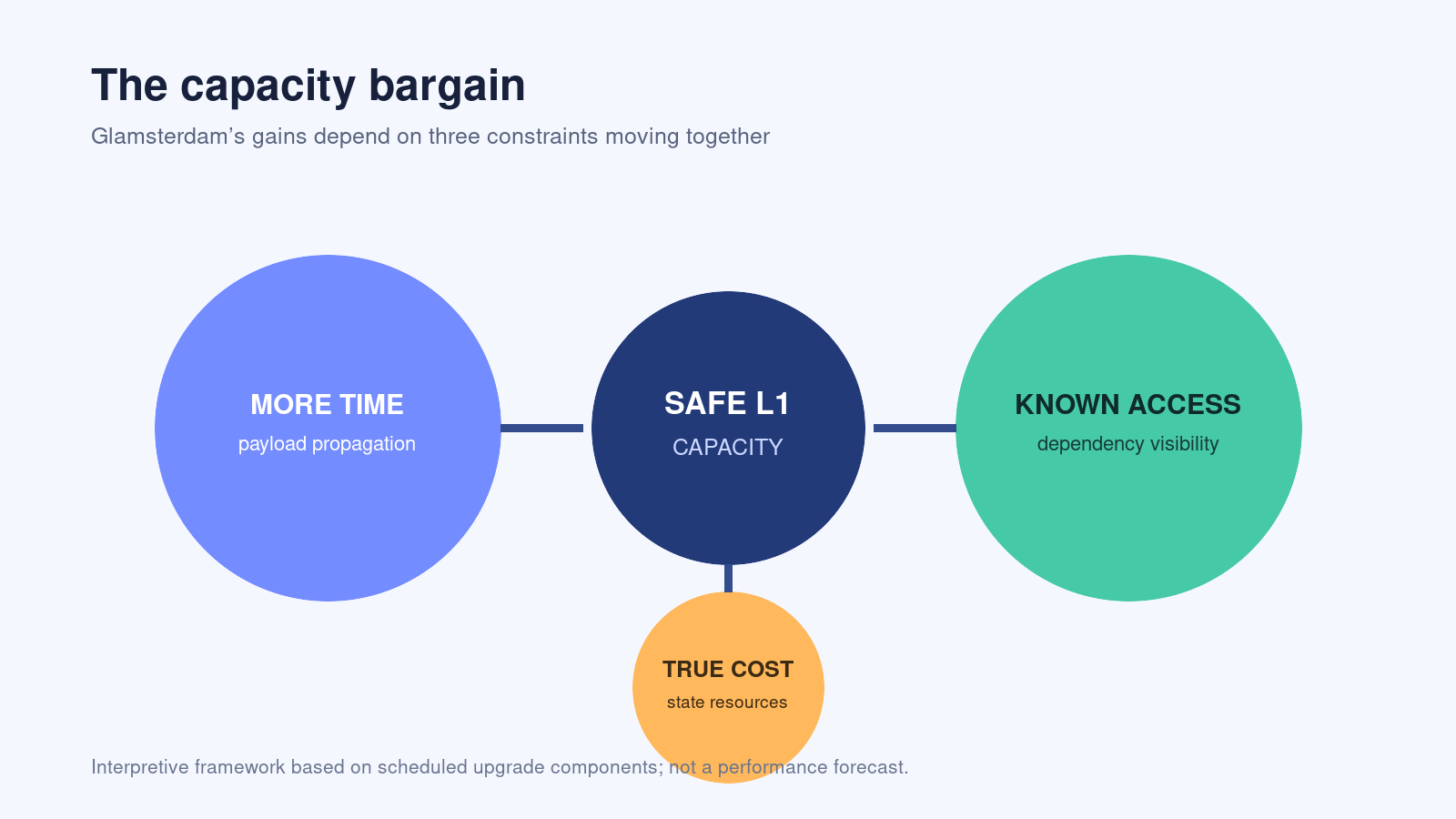
Figure 2: Capacity becomes sustainable only when timing, dependency visibility and resource pricing improve together. This is an interpretive framework, not a performance forecast.
Higher gas limits expand the amount of computation a block may contain. They can also accelerate permanent state growth and amplify worst-case database access. Glamsterdam’s state proposals are therefore not an incidental developer tax; they are the limiting mechanism that makes the headline capacity ambition plausible.
EIP-8037 harmonizes the cost of creating state and introduces separate accounting through a state-gas reservoir. Ethereum.org describes a target of 120 GiB of state growth per year and frames the work against a 200 million gas-limit floor enabled by the upgrade, with pricing tests using a 150 million reference block gas limit. These are design targets and test conditions, not a guarantee that mainnet will immediately operate at either number. EIP-8038 raises the price of state-access operations to reflect contemporary state size and hardware measurements, reducing the denial-of-service surface created by underpriced reads.
The redistributive effect is deliberate. A simple ETH payment between existing accounts is scheduled to receive up to a 71% reduction in intrinsic gas under EIP-2780. Creating a new account attracts a surcharge because it creates persistent state. State-heavy applications pay more accurately for what nodes must retain or retrieve. Users whose activity is computationally light and state-light can benefit even as some complex contracts face higher execution costs. “Fees go down” and “gas schedules rise” can therefore both be true; they apply to different resource profiles.
Migration risk is real but bounded by evidence
On 24 August, Ethereum Foundation protocol research, EthPandaOps and specifications teams published a repricing impact assessment. They replayed historical mainnet transactions under the proposed schedule. Their reported conclusion is calibrated: the large majority were unaffected; a small set diverged; most flagged issues could be fixed by increasing the transaction gas limit; and a narrower group may remain broken even after a substantial increase.
The vulnerable pattern is not “all old DeFi.” It is software that treats gas behavior as a stable application interface: fixed stipends, hard-coded call gas, branches based on remaining gas, or pre-signed transactions with fixed limits. Wallets and RPC providers also need updated estimation. The public affected-contract search and Platåberget devnet give operators a concrete testing path, but historical replay is not exhaustive. Dormant contracts, rare states and composable call paths can escape a sample.
The prudent institutional response is tiered. Map L1 contract exposure; identify systems that sign transactions ahead of execution; test gas estimators and emergency controls; and require critical vendors to state their Glamsterdam readiness. Avoid interpreting “ordinary users need take no action” as “custodians and application operators have no work.” Asset continuity and operational continuity are different questions.
Secondary changes broaden the institutional relevance
Several less celebrated items change operational quality. EIP-8061 separates activation, exit and consolidation capacity. At current staking levels, the official overview estimates roughly four times exit capacity and twice consolidation capacity, while shortening the weak-subjectivity period from about 15.7 days to about seven. Faster liquidity and a more efficient validator set come with a narrower window for an offline node to regain a sufficiently recent trusted checkpoint. Institutions should update recovery assumptions, not just celebrate shorter queues.
EIP-8045 excludes slashed validators from future proposer selection, avoiding predictably missed slots after a mass-slashing event. EIP-7708 makes non-zero ETH transfers and burns emit a standard log, improving observability for exchanges, bridges and accounting systems that otherwise depend on traces. EIP-7975 paginates large receipt lists in the peer-to-peer protocol to reduce synchronization failure risk as blocks grow. EIP-7997 creates a deterministic factory predeploy intended to support the same contract or smart-wallet address across participating EVM chains. These are not identical in economic weight, but together they show that capacity is being paired with operability.
Counterarguments and unresolved risks
The first counterargument is that enshrining PBS ossifies a market design before the builder ecosystem is mature. Protocol integration can remove a relay trust dependency while making the chosen auction and timing model harder to change. Specialization may continue to concentrate even if settlement becomes trustless. Metrics should therefore cover builder share, payload failures, missed slots and censorship behavior—not merely block size.
Second, extra propagation time and access metadata do not repeal physics. Larger blocks, BAL distribution and bigger receipt sets consume bandwidth and storage. The architecture aims to keep verification accessible, but its decentralization result must be observed across consumer hardware and geographically diverse networks. Average-case benchmarks are insufficient; tail latency is where consensus incidents live.
Third, repricing creates transition risk and political economy. Correcting underpriced operations is necessary, yet affected applications bear concentrated costs while capacity benefits are diffuse. Direct outreach and replay tools reduce surprise, but cannot prove the absence of edge cases. A delay caused by testnet findings would represent risk management, not necessarily roadmap failure.
Finally, the calendar is explicitly provisional. The official page says Q4 and “date not yet confirmed.” Sepolia is a test milestone, not an automatic mainnet countdown. Scope is described as frozen, but the meta EIP remains draft. Decision-makers should anchor preparations to client releases and public-testnet evidence, not to an assumed launch week.
What to watch from here
timeline
    title Glamsterdam evidence gates
    September 2026 : Devnet testing and repricing remediation
    6 October 2026 : Planned Sepolia fork
    After Sepolia : Client stability and interoperability evidence
    Q4 2026 : Expected mainnet window, date unconfirmed
    Post-activation : Observe builder concentration, payload timing, state growth and node performance
The most useful dashboard is conceptual rather than promotional. Before activation, track execution/consensus client interoperability, testnet finality, payload-timeliness behavior and contract remediation. After activation, track missed slots, builder concentration, propagation tails, state growth, gas-estimation failures and node resource dispersion. Fee medians alone will not tell whether the upgrade preserved the capacity bargain.
Conclusion
Glamsterdam is Ethereum’s attempt to replace brute-force scaling with structured headroom. It enshrines the core proposer-builder exchange, surfaces execution dependencies and makes persistent resources more honestly priced. That combination can support larger blocks and future parallelism while keeping verification within reach of independent operators. It can also shift operational burdens onto staking systems, client teams and contracts that encoded yesterday’s gas assumptions.
The correct institutional stance is neither reflexive optimism nor fear of change. Treat Q4 as a target, Sepolia as an evidence gate, and mainnet activation as the beginning of measurement rather than the end of the roadmap. If ePBS performs under stress, BALs translate into client-level gains, repricing incidents remain contained and node requirements stay broadly accessible, Glamsterdam will have done something more valuable than post a throughput record: it will have improved Ethereum’s ability to scale without hiding who bears the cost.