The Transparent Bridge Is Still a Bridge: What cirBTC Changes—and What It Does Not
A reserve feed can illuminate the bridge between Bitcoin and Ethereum; it cannot remove the bridge’s operators, legal claims or failure modes.
Published 11 September 2026 — Research report, not investment advice.
Executive summary
Circle’s September 4 explanation of the reserve architecture behind Circle Wrapped Bitcoin (cirBTC) deserves attention well beyond a product launch. Native bitcoin cannot directly enter Ethereum smart contracts. A wrapped token therefore combines a Bitcoin asset held on one ledger with a liability issued on another. The intellectual problem is simple—keep assets at least equal to claims—but the operational problem spans custody, issuance, oracles, redemption and market liquidity.
cirBTC’s answer is a more legible trust stack. Circle says each token is backed one-for-one by native BTC, held for holders’ exclusive benefit and segregated from corporate assets. It publishes the Bitcoin reserve addresses; Chainlink Proof of Reserve makes verified reserve information available onchain; and cirBTC supply is visible on Ethereum. At the Circle dashboard snapshot dated September 9, 08:00, supply was 40.02743077 cirBTC and reported reserves were 42.5324804 BTC, equivalent to roughly 106.26% coverage and a 2.505 BTC difference. That is strong point-in-time coverage, but Circle has not characterized the difference as a permanent buffer.
Our thesis is that machine-readable reserve evidence is a genuine improvement in wrapped-asset risk management, especially if lending venues connect it to collateral limits or circuit breakers. Yet “proof of reserves” is narrower than the phrase sounds. It can show balances at identified addresses and compare them with token supply. By itself it cannot prove that every relevant address was identified, settle the legal status of customer assets in insolvency, guarantee prompt redemption, eliminate administrator-key or smart-contract risk, or create deep liquidity. The distinction matters because cirBTC is starting at only about 40 tokens while the incumbent WBTC and Coinbase’s cbBTC each report close to or above 100,000 tokens.
The institutional question is therefore not “Is cirBTC trustless?” It plainly is not, nor does a custodial wrapper need to pretend otherwise. The better question is whether its dependencies are explicit, independently observable, legally intelligible and connected to enforceable controls. On that score, cirBTC offers a useful blueprint—but today it remains an early, issuer-led product whose adoption, integrations and redemption performance are largely untested at scale.
Why wrapping Bitcoin creates a new claim
Bitcoin and Ethereum do not share state. A Bitcoin full node cannot attest to an ERC-20 balance, and an Ethereum contract cannot natively inspect Bitcoin custody. Moving “BTC” into Ethereum finance consequently does not move the original coin. It immobilizes BTC under a custody arrangement and creates a separate token claim that applications can hold, trade or accept as collateral.
flowchart LR
    A[Eligible institution delivers BTC] --> B[Segregated Bitcoin custody]
    B --> C[Circle authorizes cirBTC issuance]
    C --> D[cirBTC on Ethereum]
    D --> E[Trading, collateral and settlement]
    E --> F[Holder requests redemption]
    F --> G[cirBTC is burned]
    G --> H[Native BTC is released]
    B -. disclosed addresses .-> I[Reserve observation]
    D -. visible supply .-> I
    I --> J[Chainlink onchain reserve feed]
    J --> K[Human or protocol risk controls]
This process creates at least five distinct dependencies. The custodian must control and safeguard the BTC. The issuer must mint no more claims than the backing permits. The oracle and underlying data process must faithfully report reserves. The token contract and its privileged roles must behave as intended. Finally, redemption must work quickly enough that arbitrage can keep cirBTC near BTC’s value. Public addresses make one crucial edge of this graph inspectable; they do not collapse the graph into a native Bitcoin payment.
Circle’s product documentation states that the BTC is held at a regulated entity in the Circle group, for cirBTC holders’ exclusive benefit and segregated from Circle’s corporate assets. Its September reserve explainer adds that reserve addresses are disclosed so counterparties can review them through a Bitcoin explorer and compare them with cirBTC supply. Circle’s public cirBTC page and dashboard describe custody at Circle National Trust Bank and list the addresses and balances.
Those representations are material. Segregation addresses a different risk from cryptographic solvency: who has the beneficial claim to the coins if an operating company fails? But readers should not conflate a public webpage with a court-tested insolvency outcome, or a regulated custodian with deposit insurance. A custody claim is governed by contracts, law and operational records as well as blockchain possession. Institutional diligence still needs the terms, eligible-customer rules and redemption agreement, not just a wallet total.
The new control plane: from disclosure to machine-readable evidence
The important innovation is not that reserve addresses are public. WBTC has long used public custody addresses and a transparency dashboard, and Coinbase now provides a similar public reserve view for cbBTC. The advance is that an onchain feed can turn a disclosure into an input for automated policy.
Chainlink’s Proof of Reserve overview describes feeds that can be tied to minting controls, circuit breakers or protocol actions when reserve thresholds are missed. Its older builder guide for wrapped tokens gives the clearest conceptual example: a mint can revert when reported reserves are below outstanding tokens. Circle says Chainlink publishes verified cirBTC reserve data onchain. This shortens the monitoring loop for an application that actually consumes the feed.
sequenceDiagram
    participant BTC as Bitcoin reserve addresses
    participant V as Verification process
    participant O as Onchain reserve feed
    participant P as Lending protocol
    participant R as Risk committee
    BTC->>V: Address balances change
    V->>O: Publish verified reserve value
    P->>O: Read reserves and compare with supply
    alt Coverage meets policy
        P->>P: Maintain collateral parameters
    else Coverage falls below threshold
        P->>P: Pause new exposure or tighten limits
        P->>R: Escalate exception
    end
    R->>R: Assess custody, redemption and liquidity evidence
The conditional language is essential. A feed is an observation layer; protection depends on how users integrate it. Circle’s public materials reviewed for this report describe reserve visibility, but do not establish that the cirBTC token’s mint function is automatically blocked by the feed. Likewise, a lending market does not gain a circuit breaker merely because one exists in theory. Its governance must adopt the feed, define freshness and failure thresholds, decide what happens during an oracle outage, and manage the risk of forced deleveraging.
Machine readability therefore improves response time and composability, not epistemic completeness. A feed may accurately report the sum of a disclosed address set while that set is incomplete. It may be stale during a chain disruption. Reserve BTC can be present while operational access is impaired. And even perfectly measured backing does not say whether a retail holder can redeem directly; Circle says direct issuance and redemption are designed for eligible institutional participants, leaving other users dependent on secondary-market liquidity and intermediaries.
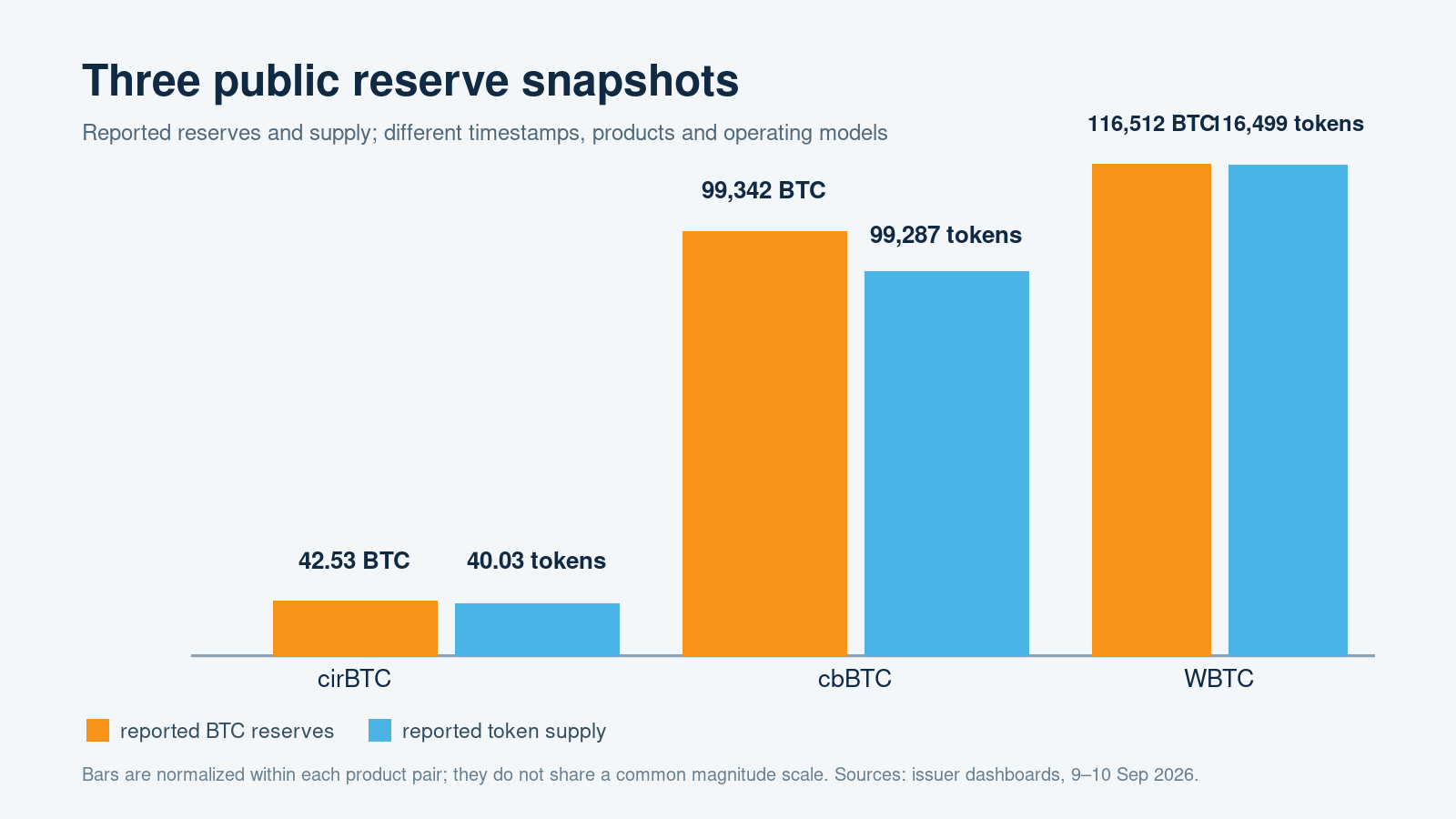
Reserve dashboards make coverage comparable in principle, but scale and timestamps differ sharply. Each pair above is normalized within the product; bar heights are not a cross-product magnitude scale.
What the snapshots say—and do not say
Public snapshots on September 9–10 show all three products with reserves slightly above reported supply:
Product | Reported reserves | Reported supply | Approx. coverage | Snapshot and scope |
|---|---|---|---|---|
cirBTC | 42.5324804 BTC | 40.02743077 cirBTC | 106.26% | Circle, Sep. 9, 08:00; Ethereum product |
cbBTC | 99,342.4 BTC | 99,286.98 cbBTC | 100.06% | Coinbase, Sep. 10, 18:28 on the cited page; four-network supply shown |
WBTC | 116,511.9929 BTC | 116,499.1917 WBTC | 100.01% | WBTC, Sep. 10, 03:56; authorized-chain aggregate |
Sources: Circle cirBTC dashboard, Coinbase cbBTC Proof of Reserves, and WBTC transparency monitor. Ratios are calculated from the displayed units and rounded. Dashboard values are dynamic; the table records the cited snapshots rather than claiming live values on publication.
The comparison yields three insights. First, cirBTC’s excess at this moment is proportionally larger, but economically small and not a contractual capital cushion. A handful of BTC transfers could change the ratio. Second, the scale gap is enormous: cirBTC supply is about 0.04% of either large competitor’s order of magnitude. Early coverage says little about operational resilience under mass issuance, volatile redemption demand or many DeFi integrations. Third, reserve ratios alone do not rank product quality. WBTC uses a custodian-and-merchant network with federated governance, cbBTC sits inside Coinbase’s multi-chain exchange and custody ecosystem, and cirBTC emphasizes a Circle-native pairing with USDC, institutional eligibility and future Arc support. Their legal, governance and distribution models differ.
The WBTC documentation says its dashboard aggregates supply across supported networks and publishes custody keys and mint/burn history. Coinbase’s dashboard likewise splits cbBTC supply across Ethereum, Base, Solana and Arbitrum at the cited snapshot. cirBTC is live on Ethereum and Circle says it plans native support on Arc when that network’s mainnet launches. Multi-chain expansion increases usefulness, but it also makes total-liability accounting more demanding: risk teams must count every authorized supply domain without double counting burned, bridged or pending balances.
A due-diligence framework beyond the ratio
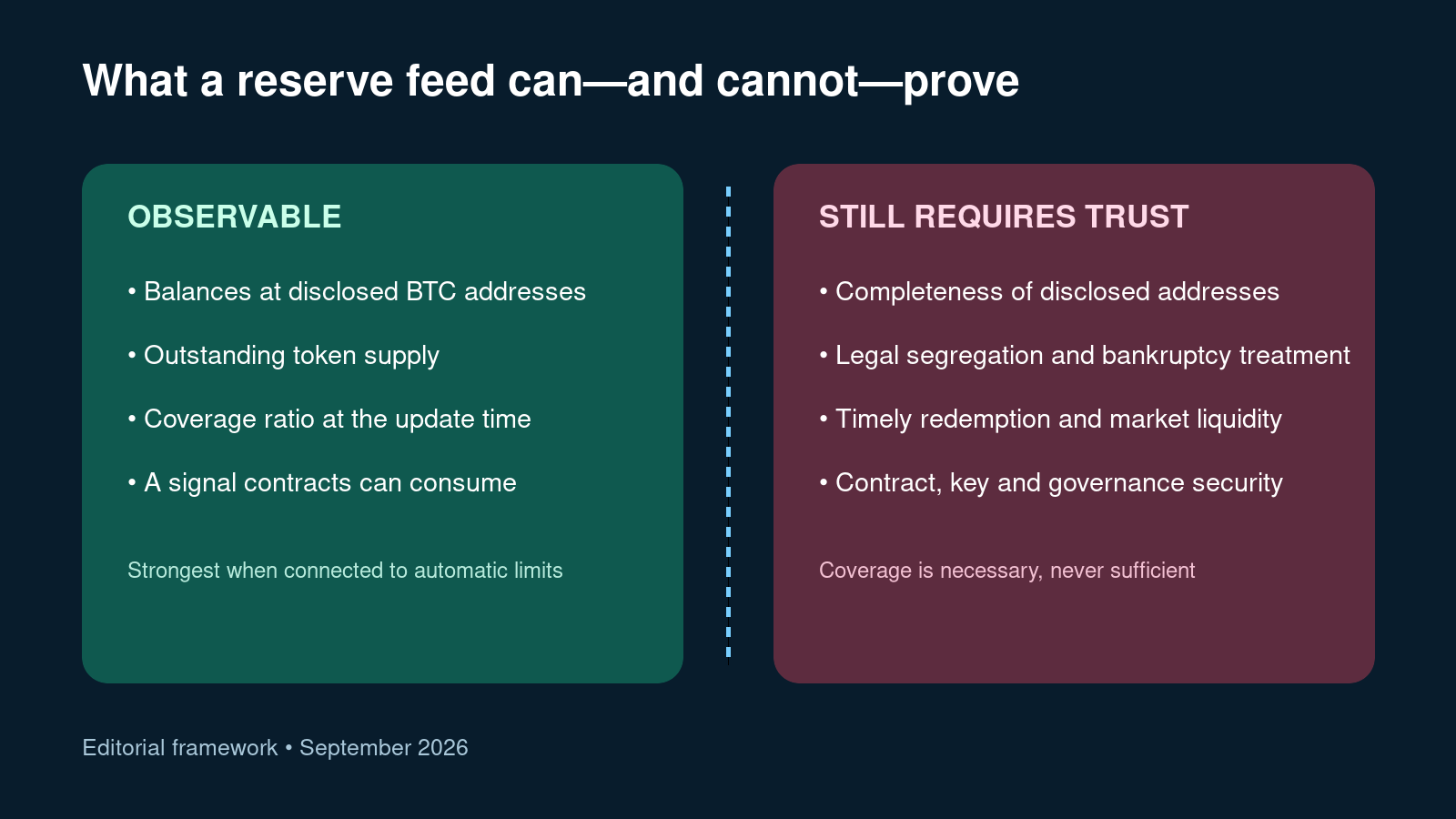
Coverage is necessary. Institutional acceptance requires evidence across the whole claim, not only the reserve side.
A useful assessment separates observable solvency from broader convertibility. We suggest five layers.
Asset evidence. Are all custody addresses disclosed, who verifies that the set is complete, how frequently is the feed refreshed, and what happens when Bitcoin or Ethereum finality is delayed? A risk policy should treat freshness as a first-class variable, not accept the last value indefinitely.
Liability evidence. Does the denominator include supply on every network and any claims awaiting mint or burn? Ethereum supply is readily inspectable, but planned multichain issuance creates reconciliation work. The system needs a canonical definition of “outstanding,” including operational queues.
Legal and custody evidence. Who is the holder’s contractual counterparty? Are assets segregated on the books as well as in addresses? Which holders can redeem directly, under what conditions, fees and timing? What stays, freezes or transfers if the issuer, custodian or an intermediary enters resolution?
Technical and governance evidence. Who can mint, pause, blacklist or upgrade? How are keys protected and roles changed? Is reserve information merely published, or enforced in issuance and in downstream collateral systems? Oracle safeguards should specify stale-data behavior and not create a single automatic liquidation cliff.
Market evidence. Reserve coverage does not guarantee a tight price. Secondary holders rely on authorized participants and market makers to turn redemption rights into arbitrage. Depth, concentration, venue support and settlement timing determine whether a wrapper trades like BTC during stress. For cirBTC, the small starting float makes this layer the least proven.
This layered view prevents two symmetrical errors. The first is dismissing custodial wrappers because they are not native BTC. That ignores the real demand for BTC-denominated collateral in programmable markets. The second is declaring a wrapper safe because a dashboard reads above 100%. That mistakes one sensor for the entire aircraft.
Implications for issuers, protocols and allocators
For issuers, the competitive frontier is shifting from periodic attestations toward continuously consumable evidence. Public addresses and onchain feeds reduce information latency and let independent parties reproduce a coverage calculation. The next credible step is explicit control binding: document whether and how issuance limits consume reserve data, publish feed-service parameters, and explain exception governance. Transparency is most valuable when it constrains behavior.
For DeFi protocols, cirBTC creates an option, not an automatic upgrade. A new collateral asset can diversify issuer exposure, but small liquidity and limited history justify conservative loan-to-value ratios, caps and isolated-market treatment. Governance should model a reserve shortfall separately from a price-oracle failure: one concerns backing, the other market value, and they may require different responses. Pausing new borrowing may be safer than instantly liquidating every borrower on a stale reserve reading.
For institutions, Circle’s ability to pair cirBTC collateral with USDC settlement is strategically coherent. A desk could retain BTC exposure while borrowing dollars or settling trades in a familiar stablecoin stack. But stack integration also concentrates dependency on one issuer group. “Neutral” in the sense of not running a competing exchange is not the same as decentralized. Counterparty limits should reflect aggregate exposure across cirBTC, USDC, custody and Circle Mint rails.
For the wrapped-Bitcoin market, competition on verification is healthy. WBTC’s September 10 monitor displayed roughly 116,499 tokens, while cbBTC’s cited page displayed roughly 99,287. Their scale proves demand but also concentrates systemic importance. cirBTC’s immediate value may be less its 40-token float than the pressure it applies: reserve provenance, liability aggregation and control integration should become standard fields in every collateral listing proposal.
Risks and counterarguments
The strongest bullish counterargument is that these caveats set an impossible standard. No financial asset eliminates custody, law, operations and liquidity; traditional securities also depend on registrars, custodians and courts. On this view, regulated custody plus public Bitcoin addresses and an onchain feed is unusually transparent, and waiting for perfect decentralization would strand useful BTC outside smart-contract markets. That argument is persuasive as far as it goes.
But transparency can create false precision. A coverage ratio displayed to four decimals looks complete even when the hard questions sit outside it. Institutions should avoid “dashboard capture”: substituting a green number for review of redemption eligibility, service-level commitments, key governance and legal segregation. The proper benchmark is not trustlessness; it is whether residual trust is bounded and priced.
There is also an adoption paradox. Deep liquidity makes redemption arbitrage effective, yet institutions may wait for liquidity before integrating. Incentives can bootstrap markets, but they can temporarily disguise organic demand and add smart-contract exposure. Conversely, slow, controlled growth leaves the product safer to operate but less useful as collateral. cirBTC’s current scale makes any conclusion about durable adoption premature.
Finally, multichain expansion can weaken a clean initial story. Circle presents a consistent reserve principle across Ethereum and future Arc issuance. In practice, every new domain adds supply accounting, contract administration, network liveness and liquidity fragmentation. A reserve feed must evolve from comparing one custody pool with one token contract to comparing a custody pool with a rigorously aggregated liability surface.
Conclusion
cirBTC marks a worthwhile shift from “trust the issuer’s backing statement” toward “observe specified reserves and make the observation usable by software.” Its September 9 snapshot showed more reported BTC than circulating tokens, and its architecture makes the core coverage claim unusually inspectable. That is real progress.
It is not the end of diligence. A wrapped bitcoin remains a cross-ledger claim whose quality depends on custody, legal segregation, controlled issuance, accurate and fresh data, secure contracts, enforceable redemption and liquid markets. Proof of reserves illuminates one of those dependencies and can power safeguards across several others, but only when the feed is connected to explicit policy.
The institutional lesson is constructive: do not ask a reserve feed to prove what it cannot. Demand it as a baseline, then evaluate the complete conversion path from BTC deposit to token issuance and back again. If cirBTC can preserve today’s legibility as it scales beyond 40 tokens and across networks, it may raise the market’s standard. Until then, it is best understood as a promising control architecture under live, small-scale testing—not as the removal of trust from wrapped Bitcoin.
Direct sources
Circle: cirBTC product and live reserve dashboard; reserve architecture explainer, 4 September 2026; launch announcement, 8 June 2026; developer overview.
Chainlink: Proof of Reserve overview; builder guide for wrapped tokens; Chainlink 2.0 whitepaper, §4.1.
Comparative primary dashboards: Coinbase cbBTC Proof of Reserves; WBTC transparency monitor; WBTC reserve documentation; WBTC whitepaper.