Ethereum Starts the Quantum Clock: Why Hegotá Is a Governance Test, Not Just Another Upgrade
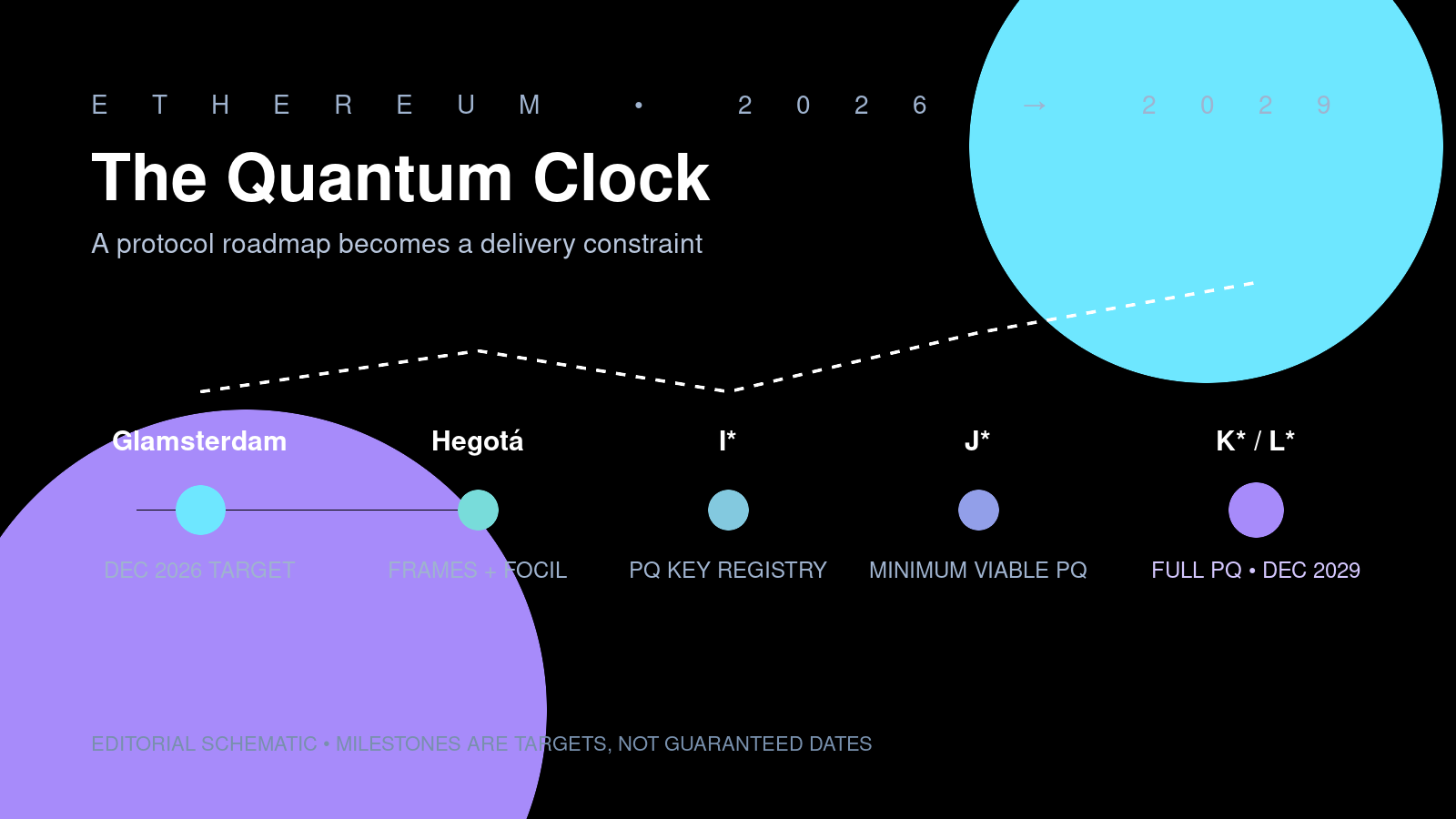
Ethereum has put a date on a risk that has no date. The resulting roadmap turns cryptographic preparedness into a near-term test of protocol governance. Editorial illustration; milestones are targets, not promises.
Published 10 September 2026. This report distinguishes confirmed upgrade scope from Ethereum Foundation (EF) preferences and longer-range research targets.
Executive summary
Ethereum’s most consequential announcement this week was not a new throughput figure. It was a clock. On 7 September, the Ethereum Foundation’s Protocol cluster said it is aiming for Ethereum L1 to be resistant to quantum attacks across execution, consensus and data by December 2029. The cluster explicitly plans around “Q-day”—the point at which a cryptographically relevant quantum computer could threaten today’s public-key systems—arriving as early as 2030, while acknowledging that credible estimates generally put it later and that it may never arrive.
The thesis of this report is that the deadline matters less as a forecast of quantum computing than as a constraint on Ethereum’s governance. It forces the network to price scarce engineering attention across several interdependent objectives: near-term scaling, censorship resistance, privacy, state sustainability, faster finality and a proof-based execution future. Hegotá, the fork now entering scope after Glamsterdam, is therefore not “the quantum fork.” It is the first credible test of whether Ethereum can build the account and inclusion machinery needed for later cryptographic migration without overloading its client teams and testing pipeline.
Three findings follow. First, account-level cryptographic agility is being treated as the practical bridge to post-quantum execution: programmable “Frame” transactions would let accounts change signature schemes without requiring a hard fork for every scheme. Second, post-quantum readiness is not a wallet-only problem. Consensus signatures and data availability require coordinated protocol changes, and the EF distinguishes a minimum viable safeguard from full resistance. Third, Glamsterdam’s gas repricing exercise shows why schedule discipline is substantive, not bureaucratic: even economically rational changes can break contracts and infrastructure that encoded yesterday’s cost assumptions.
For institutions, the relevant conclusion is neither “quantum panic” nor “problem solved by 2029.” It is that Ethereum has made migration capacity observable. Investors, custodians, application operators and risk committees can now monitor whether proposals move through research, prototypes, devnets and progressively firmer inclusion stages with evidence. The roadmap should be evaluated like a multi-year resilience program, not a product launch date.
What changed on 7 September
The EF Protocol cluster published two linked documents. The first set a north star and delivery framework through 2029. The second disclosed a unified evaluation of all 62 Ethereum Improvement Proposals submitted for Hegotá. According to the latter, nine teams and individual specialists submitted 16 contribution templates, producing 397 grades—an average of 6.4 grades per proposal. This was the cluster’s first consolidated view, and it remains an opinion rather than unilateral control over Ethereum’s fork process.
That distinction is essential. Ethereum upgrades are coordinated through open specifications, implementations and the AllCoreDevs process; the Foundation cannot decree mainnet scope merely by publishing a tier list. The tier list is still important because it reveals how a large concentration of protocol researchers and engineers intends to allocate effort. It also makes trade-offs legible: “S” proposals define the fork; “A” proposals are expected to ship unless delivery forces a cut; lower tiers face evidence and capacity gates.
The current critical path begins with a target of shipping Glamsterdam in December 2026. The EF says client teams could begin Hegotá implementation in late Q4. Under one planning sequence, full post-quantum readiness would arrive five hard forks after Glamsterdam, requiring an average 7.2-month fork cadence to reach December 2029. An alternative ordering could reach full readiness one fork earlier at an implied nine-month cadence. A less complete contingency, minimum viable post-quantum L1 (MV-PQ), is placed at the J* milestone and could be reached on a 12-month cadence.
These are planning assumptions, not consensus dates. Even the names I*, J*, K* and L* are roadmap markers whose ordering can change. The EF says it will reassess the aggressive Q-day assumption with outside experts in January 2027. That candor is valuable: the plan fixes an internal target precisely because the external threat cannot be scheduled.
flowchart LR
    G[Glamsterdam<br/>target: Dec 2026] --> H[Hegotá<br/>Frames + FOCIL]
    H --> I[I*<br/>post-quantum public-key registry]
    I --> J[J*<br/>minimum viable PQ safeguard]
    J --> K[K* / L* sequence<br/>order still flexible]
    K --> F[Full resistance across<br/>execution, consensus and data<br/>target: Dec 2029]
    H -. enables account<br/>cryptographic agility .-> J
The published “Strawmap” is a sequencing device, not a guaranteed release calendar. The uncertainty around K and L* is part of the disclosed plan.*
Why Hegotá sits on the critical path
Hegotá’s two headline proposals illuminate the wider strategy. EIP-7805, fork-choice enforced inclusion lists (FOCIL), is the consensus-layer centerpiece. Its goal is to let multiple validators require eligible transactions to appear in a builder’s block, strengthening transaction-inclusion and censorship-resistance guarantees. EIP-8141 introduces Frame transactions, making validation, execution and gas payment programmable at the protocol level.
The connection is deeper than bundling two attractive features. Frames provide a native route away from accounts controlled solely by vulnerable secp256k1 keys and allow new signature schemes to be introduced without a bespoke hard fork each time. FOCIL seeks to ensure that a transaction using the new model still has a credible path into a block rather than depending entirely on a concentrated builder market. The EF consequently says the two must be tested together.
Supporting candidates address practical edges. Keyed nonces could let multiple users share a sender for privacy without blocking one another’s transactions. Recent roots could give private transactions a verifiable view of recent on-chain state that inclusion rules can check. A proposal to begin retiring BLS withdrawal credentials tied to quantum-vulnerable cryptography is ranked as work that can start before the complete consensus design is ready. None of this makes Ethereum quantum-safe in Hegotá. It creates migration surfaces and removes architectural dead ends.
This approach correctly separates cryptographic agility from cryptographic selection. On the execution layer, flexible accounts can support a better signature system when one is ready. Consensus is harder: validators collectively depend on common signing and aggregation rules, so the cryptography cannot be swapped independently account by account. It must be specified, tested and activated through a fork. The EF therefore proposes moving slowly on the final consensus design while moving early on the account infrastructure that preserves options.
flowchart TB
    U[User or institution submits transaction] --> A[Frame account applies<br/>programmable validation and fee policy]
    A --> S{Approved signature scheme<br/>and account rules?}
    S -- No --> R[Reject]
    S -- Yes --> P[Eligible transaction enters<br/>public propagation path]
    P --> IL[Multiple validators form<br/>inclusion-list constraints]
    IL --> B[Builder assembles block]
    B --> V[Attesters verify payload<br/>and inclusion obligations]
    V --> C[Canonical chain]
    A -. future option .-> Q[Post-quantum signature scheme]
Conceptual relationship, not an implementation specification: account agility and inclusion guarantees solve different layers of the migration problem.
Glamsterdam provides the warning label
The strongest argument for disciplined Hegotá scope comes from the fork immediately ahead of it. Glamsterdam combines significant changes to block construction, execution visibility and resource pricing. Its public Platåberget testnet was announced in August as a months-long environment where validators, builders, wallets and other infrastructure could encounter breaking changes before longer-lived testnets and mainnet.
Among the most consequential changes are enshrined proposer-builder separation, block-level access lists and gas repricing. The gas work updates the cost of creating and accessing Ethereum state. The EF says state-operation prices were last comprehensively adjusted in the 2021 Berlin fork; the state has grown since then, while recent gas-limit increases accelerated growth. The new prices are derived from a performance target intended to support roughly a threefold increase in base throughput.
That prospective capacity is not free. Replays of historical mainnet transactions under the new schedule produced four outcomes: no change; success with changed execution details; failure at the old gas limit but success with a higher limit; and potential breakage even with substantially more gas. The EF says the large majority are unaffected and most flagged cases can be repaired by raising gas limits. The difficult minority includes contracts that assumed a fixed gas stipend, hardcoded gas passed to calls, branched on remaining gas, or relied on pre-signed transactions with fixed limits.
The lesson is broader than developer housekeeping. Ethereum’s gas schedule is a resource-accounting policy and therefore part of the security perimeter. Underpricing state operations subsidizes state growth and burdens node operators; repricing restores a closer relationship between fees and computation, but exposes hidden dependencies in applications. Increasing throughput safely thus consumes the same scarce assets needed for quantum migration: client engineering, realistic replay data, public testnets, application outreach and time for remediation.
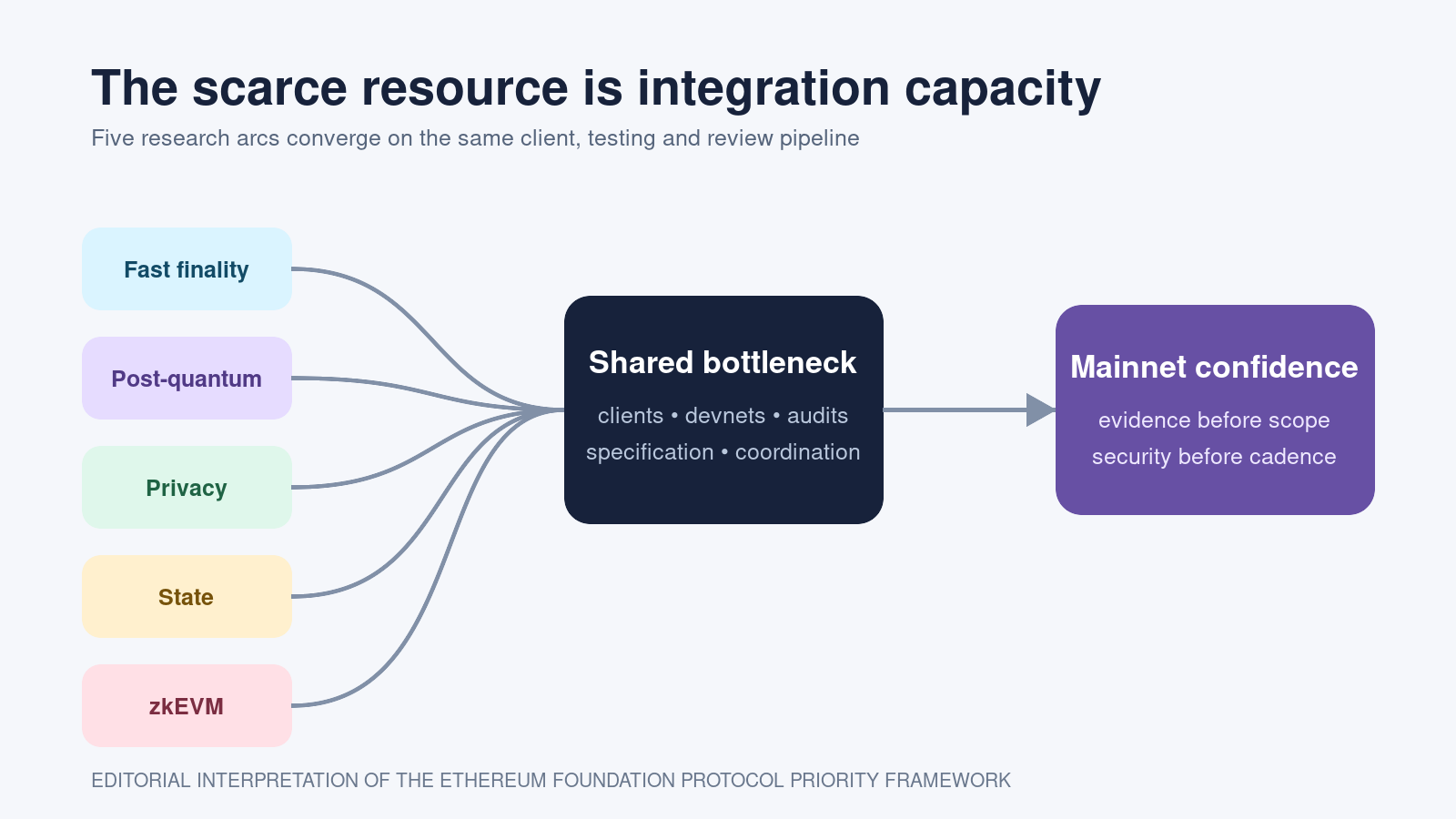
Fast finality, post-quantum security, privacy, state sustainability and zkEVM research do not arrive through independent pipes. They converge on shared implementation and assurance capacity.
The portfolio problem behind the roadmap
The EF organizes longer-term work into five arcs: fast finality, post-quantum security, privacy, state and zkEVM. Each has an intuitive constituency. Users want finality in seconds rather than minutes. Privacy advocates want transactions and balances that do not expose an entire financial history. Node operators need state growth and access costs kept sustainable. The zkEVM path would eventually let validators verify succinct proofs instead of re-executing every block. Quantum preparation protects the longevity of keys and consensus.
But the arcs share bottlenecks. A client team integrating Frames is not simultaneously free to implement a new consensus mechanism. A devnet covering FOCIL interactions cannot automatically provide assurance for state-tree migration. Cryptographers and security reviewers are especially scarce. The EF’s proposed answer is overlapping development: ship Hegotá while I* specifications mature and later research produces testable components. A purely linear sequence would miss the 2029 target.
Overlap increases organizational throughput but also correlation risk. Specification churn in an upstream component can invalidate work downstream. Multiple forks in flight complicate prioritization, review and incident response. Formal verification may reduce some risk and create reusable components, but it cannot remove integration complexity or guarantee that models reflect real deployments. The institutional reading should therefore focus on leading indicators: diversity of production clients participating, stability across devnets, independent review, clearly owned remediation, and evidence that lower-priority scope is actually cut when the critical path is threatened.
The Foundation’s maturity pipeline—research, EIP, prototype, devnet, proposed-for-inclusion, considered-for-inclusion, scheduled-for-inclusion and mainnet—is useful precisely because it resists treating a compelling paper as shipped infrastructure. Each stage is supposed to add evidence and reduce uncertainty; a devnet can send work backward. That reversibility is a feature. A roadmap credible enough to disappoint enthusiasts early is safer than one that disappoints users on mainnet.
Institutional implications
For custodians, the immediate task is inventory rather than emergency migration. Key type, signing hardware, withdrawal credentials, recovery design and upgrade authority should be mapped across hot, warm and cold storage. A programmable account can increase agility, but programmability also changes the security model: governance over upgrades, recovery and allowed validators becomes as important as the signature primitive itself. Long-dated claims and dormant accounts deserve special attention because migration may require an authorized action before legacy cryptography becomes unsafe.
For application and infrastructure operators, Glamsterdam is the nearer operational exposure. Wallets, indexers, RPC services and gas estimators that encode maximum gas limits or stale constants may fail even if user funds are not directly threatened. Contract portfolios should be evaluated by dependency pattern, not simply age or value locked. An obscure payment path with a fixed stipend can be operationally more fragile than a large, actively maintained protocol.
For allocators, the roadmap changes what “technical risk” means. Quantum exposure is a low-frequency, potentially severe tail risk; rushed migration is a nearer and more conventional execution risk. The appropriate discount cannot be inferred from a single deadline. It depends on whether Ethereum preserves client diversity and conservative activation standards while increasing fork cadence. Observable progress toward agility may reduce long-horizon cryptographic risk even before a final post-quantum scheme is selected, but ambitious parallelism could raise medium-term change risk.
For policymakers and market-infrastructure firms, the notable feature is public coordination. Proposals, rationales, testnets and disagreements are visible. That transparency creates scrutiny but should not be mistaken for centralized warranty. No institution can outsource its migration plan to the EF; nor should it interpret Foundation prioritization as a guarantee accepted by all implementers.
Counterarguments and failure modes
The first counterargument is that 2030 is an unnecessarily aggressive Q-day assumption. The EF itself concedes that most credible estimates are later. Prematurely optimizing for a speculative threat could crowd out today’s security, usability and scaling needs. The response is not that the quantum forecast is certain; it is that multi-year cryptographic migrations have option value and cannot begin after certainty arrives. Still, that option value must be weighed against measurable opportunity costs at every fork.
Second, a deadline can create unsafe cadence pressure. An average of 7.2 months per fork is not a substitute for evidence. If teams begin treating the calendar as the objective, correlated bugs or inadequate ecosystem testing become more likely. The Foundation’s statement that mainnet safety remains priority zero and that scope should yield before security is therefore the plan’s most important commitment—and the easiest one for outsiders to test retrospectively.
Third, “minimum viable” readiness may be misunderstood as full protection. The EF explicitly describes MV-PQ as a temporary safeguard with reduced guarantees still being defined. Full economic finality requires post-quantum attestations and broader protection across all three protocol layers. Marketing that collapses these states would create dangerous complacency.
Finally, flexible accounts do not solve abandoned-key risk by themselves. Users and institutions must possess a safe, authorized migration path and exercise it in time. Smart-account upgrade controls can be compromised, governance can stall, hardware support can lag, and cross-chain representations can inherit security from multiple systems. The quantum program must eventually extend beyond core protocol milestones into an ecosystem-wide migration campaign.
Conclusion
Ethereum has converted an unknowable external date into a falsifiable internal program. That is the real significance of the December 2029 target. It gives the ecosystem a way to judge priorities before a crisis: whether Hegotá protects the path to later work, whether Glamsterdam’s breaking changes receive adequate testing, whether account agility and inclusion guarantees operate together, and whether scope is cut when assurance capacity runs short.
The most constructive posture is disciplined skepticism. Treat the 2029 date as a governance commitment, not a scientific prediction; treat Hegotá as enabling infrastructure, not quantum completion; and treat testnet setbacks as information, not failure. If Ethereum can preserve safety and openness while overlapping several hard research programs, the payoff is larger than quantum resistance. It would demonstrate that a decentralized protocol can manage technological obsolescence before the emergency arrives.
Direct sources
Ethereum Foundation Protocol Cluster, “Current and Emerging Priorities”, 7 September 2026.
Ethereum Foundation Protocol Cluster, “The Hegotá EIP Opinion Post and Tier List”, 7 September 2026.
Ethereum Foundation Protocol Research, EthPandaOps and Specifications teams, “Glamsterdam Repricing Impact for Smart Contract Developers”, 24 August 2026.
Ethereum Protocol DevOps, “Announcing the Platåberget Testnet”, 17 August 2026.
Ethereum Improvement Proposals, EIP-7805: Fork-choice enforced Inclusion Lists, EIP-8141: Frame Transaction, EIP-8037: State Creation Gas Cost Increase, and EIP-8038: State-access gas cost update.