The $300 Billion Onchain Dollar Has Become a Concentration Story
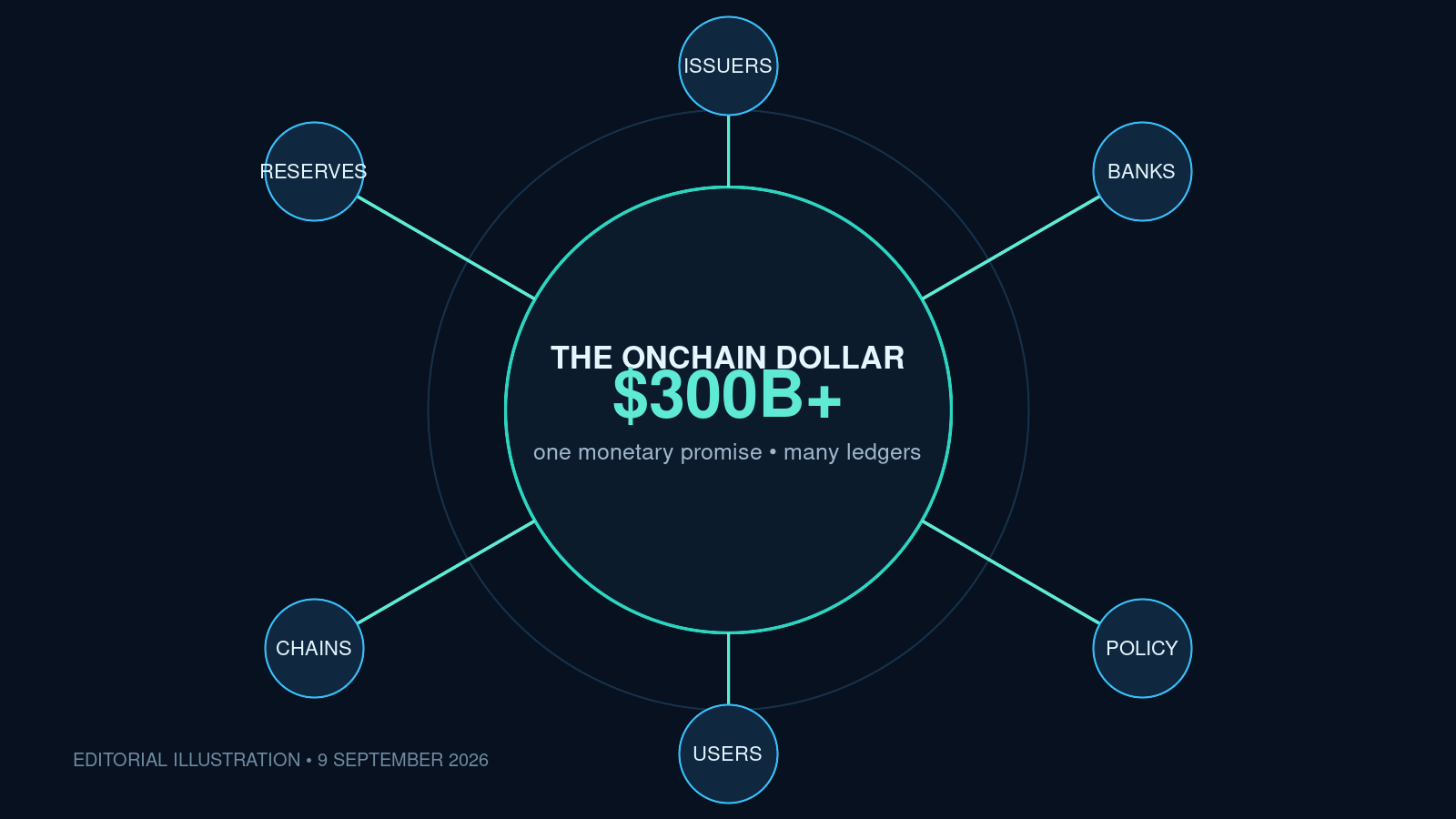
The onchain dollar is no longer a single crypto product category. It is an emerging monetary stack whose promises connect public blockchains to banks, government debt and national rulebooks. Editorial illustration.
Executive summary
Stablecoins have entered a different phase. A market snapshot compiled from DeFiLlama’s registry put global supply at $303.82 billion on 2 September 2026, while Stable Tape’s broader daily fixing recorded $311.32 billion on 7 September. These numbers are not contradictory: they use different observation dates and coverage conventions. Their shared message is more important than their difference. Dollar-linked tokens now form a monetary layer measured in hundreds of billions, and their growth is pulling crypto infrastructure into the orbit of banking supervision, sovereign debt markets and cross-border policy.
The headline scale, however, hides a more consequential structure. Axis Intelligence Research attributes 60.34% of its 2 September total to Tether’s USDT and 24.31% to Circle’s USDC. Together, two issuers account for 84.65%. Its HHI-style Stablecoin Structural Concentration Index reads 4,249 at issuer level and 3,535 across settlement networks carrying USDT and USDC. The exact index is a research construct, not an official regulatory designation, but the arithmetic makes a durable point: the system is concentrated both in the entities making the redemption promise and in the rails on which the largest tokens circulate.
This report’s thesis is that stablecoins should now be analysed as an emerging form of privately operated narrow money rather than merely as liquid cryptoassets. Their core economic loop—accept cash, invest reserves in cash-like instruments, mint transferable claims, and redeem at par—resembles a balance-sheet business wrapped in programmable settlement. Regulation is making that resemblance explicit. The United States has placed payment stablecoins in Title 12 of its banking laws; the European Union is reviewing MiCA after initial implementation; the UK is preparing its cryptoasset gateway; and Thailand has just proposed tighter controls on stablecoin transactions through licensed operators.
For institutions, the opportunity is real: continuous settlement, programmable cash, faster treasury movement and potentially cheaper cross-border payments. But the risk is not distributed merely because tokens move across many chains. Reserve custody, redemption access, compliance controls, bridges and dominant settlement layers create choke points. The investable question is therefore no longer “Will stablecoins grow?” It is: which institutions capture the economics, which dependencies become systemic, and can regulation preserve interoperability without hardening today’s concentration?
Scale has arrived, but measurement needs discipline
Stablecoin market totals are often presented as if they were accounting identities. They are estimates built from token registries, chain coverage, bridge treatment, pricing conventions and observation times. The Axis snapshot counted $303.82 billion on 2 September and traced 99.87% to 28 issuers. Stable Tape recorded $311.32 billion on 7 September, explicitly labelling that day a “level-only” record because a constituent breakdown was unavailable. Stable Tape benchmarked the total against July 2026 U.S. M2 of $23.218 trillion, producing an “Onchain Dollar Share” of 1.3408%, or roughly one stablecoin dollar for every $75 of U.S. M2.
That comparison should not be mistaken for equivalence. M2 includes physical currency, transaction deposits and other liquid deposits; stablecoins are privately issued claims with different legal, operational and liquidity characteristics. The ratio is useful because it sets scale, not because it makes a claim about monetary substitutability. Likewise, market capitalisation is not payment volume, and transfer volume is not economic final demand: exchange rebalancing, automated trading and internal movements can inflate throughput.
Even with those cautions, the direction is clear. The Bank for International Settlements’ 2026 macroeconomic working paper calls stablecoins the dominant medium of exchange within crypto and models two opposing channels from wider adoption: deposit competition can raise bank funding costs and reduce loan supply, while issuer purchases of Treasury bills can lower sovereign funding costs. That is a macro-financial transmission mechanism, not a niche token-market effect.
flowchart LR
    U[User or business cash] -->|subscription| I[Stablecoin issuer]
    I -->|holds reserves| R[Bank deposits, T-bills and repo]
    I -->|mints claims| C[Tokens on public chains]
    C --> P[Payments, trading and treasury use]
    P -->|redemption request| I
    I -->|sells or matures assets| R
    I -->|returns par value| U
    G[Supervisors and legal rules] -. constrain reserves, custody and compliance .-> I
    G -. shape access and finality .-> C
The diagram shows why “onchain” does not mean self-contained. The token leg can settle continuously, but the promise ultimately depends on offchain reserve assets, custodians, banking access and an issuer’s operational ability to redeem. Public ledgers increase observability of token movements; they do not automatically reveal reserve quality, encumbrance, intraday liquidity or the legal priority of holders.
Concentration sits at two layers
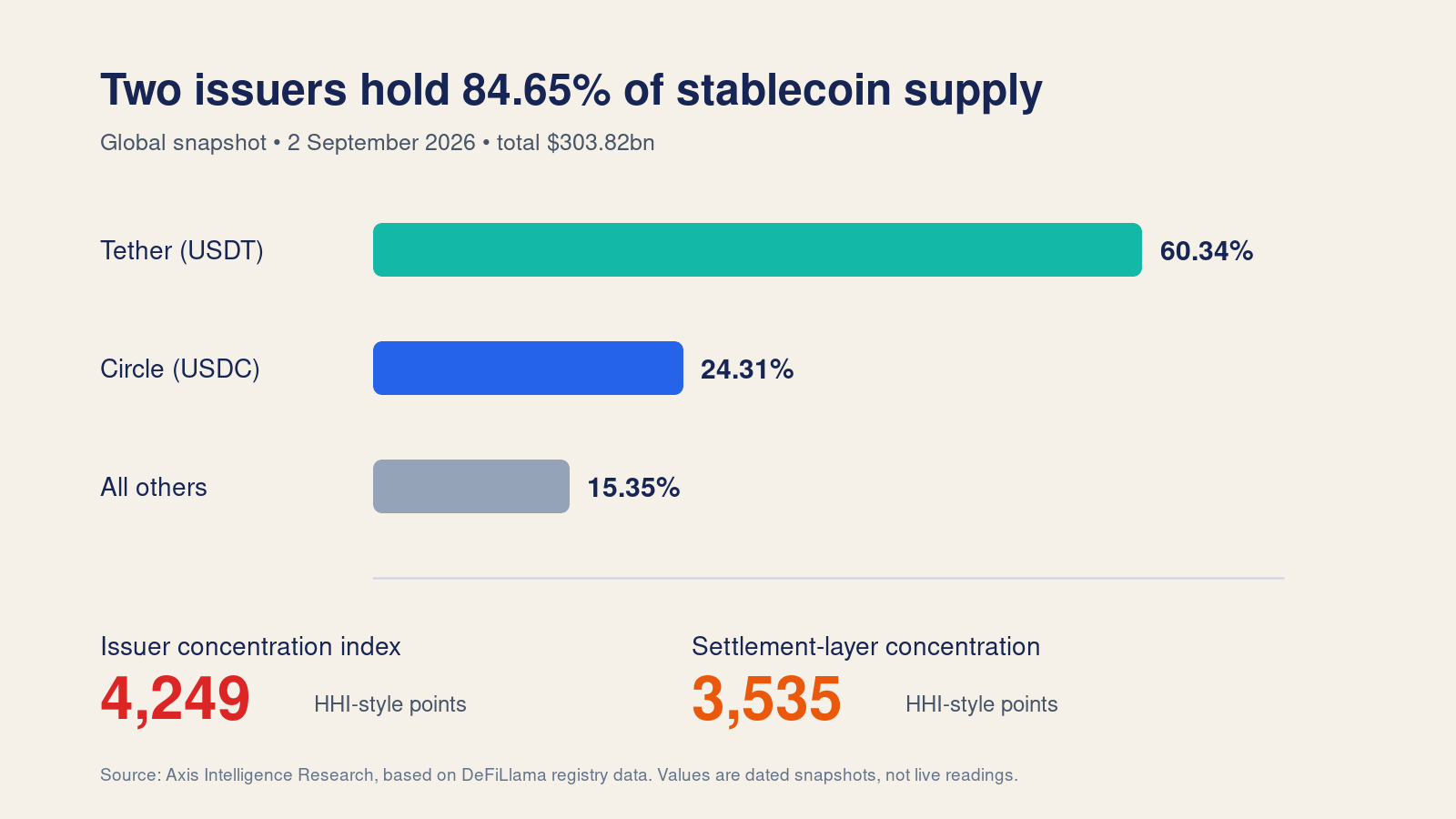
Issuer dominance and settlement concentration are separate but reinforcing exposures. Snapshot values are dated 2 September 2026; they are not live prices.
The first concentration layer is the issuer. In the Axis dataset, USDT represented $183.33 billion and USDC $73.85 billion. Every other issuer combined held only 15.35%. Circle separately reported USDC circulation of $73.3 billion at the end of Q2 2026, close enough to the later snapshot to provide a useful cross-check while reflecting a different date.
Issuer concentration matters because token holders are exposed to a common redemption policy, reserve portfolio, banking network and compliance apparatus. Diversifying USDT across several chains does not diversify the Tether promise. Similarly, thousands of wallets holding USDC do not turn one issuer liability into thousands of independent credits. A freeze, redemption bottleneck, legal order or confidence shock at an issuer can propagate across every venue where its token serves as collateral or quote currency.
The second layer is settlement infrastructure. Axis calculates that 82.77% of USDT and USDC sits on Ethereum or Tron and reports a settlement-layer concentration score of 3,535 across 136 chains. The broad chain count therefore overstates economic dispersion. Liquidity clusters because users value counterparties, exchange support, bridge routes and deep pools; those network effects create efficiency but also shared operational exposure. A chain outage, fee spike, validator incident or bridge impairment can strand liquidity even when reserve assets remain sound.
The two layers interact. Issuers decide which networks receive native issuance and redemption support. Exchanges decide which network versions are depositable. Wallets and payment processors follow available liquidity. Users then reinforce the deepest rails. Competition at the application layer can coexist with concentration underneath.
Layer | What is concentrated | Why institutions should care | What diversification does—and does not—solve |
|---|---|---|---|
Issuer | Redemption promise, reserve management, compliance controls | Common credit, liquidity, legal and operational dependency | Holding multiple issuers can reduce single-name exposure; spreading one token across chains cannot |
Reserve/custody | Banks, money-market vehicles, T-bills, repo counterparties | A token run becomes an asset-liquidity and banking-access test | More custodians may help, but legal segregation and same-day liquidity remain decisive |
Settlement | Native supply and liquidity on a few major chains | Outages, congestion and chain-specific controls can impair usability | Multichain issuance improves reach, but bridges introduce additional trust and smart-contract risk |
Distribution | Exchanges, wallets, payment processors and market makers | Access and secondary-market parity depend on a small set of gateways | Multiple venues help only if banking and redemption channels are genuinely independent |
Regulation is turning the promise into a perimeter
The U.S. framework is unusually revealing because it codifies the economic model. 12 U.S.C. Chapter 56, created by the GENIUS Act, limits issuance to permitted payment stablecoin issuers, requires permitted reserves, restricts rehypothecation, provides for custody and segregation, and addresses holder treatment in insolvency. The law’s effective date is the earlier of 18 months after 18 July 2025 or 120 days after final implementing rules. As of 9 September 2026, implementation remains important: the OCC issued a proposed rule in February, and Treasury proposed anti-money-laundering and sanctions rules in April.
That distinction between statute and implementation is critical. A law can establish eligibility, reserve and supervisory architecture before every operational detail is final. Institutions should not treat “regulated by law” as equivalent to “all transition risk has passed.” The statute also contemplates foreign issuers and reciprocal arrangements, making technological compliance with lawful orders a market-access issue, not an optional product feature.
Europe is in a different phase. MiCA already established a harmonised framework covering issuers, asset-referenced tokens, e-money tokens and service providers. The European Banking Authority explains that it assesses significant ART and EMT issuers and directly supervises those classified as significant. Yet the European Commission is now asking whether the framework remains fit for purpose. Its targeted MiCA review consultation remains open until 30 September 2026. Review so soon after implementation is not evidence of failure; it reflects how quickly product design, international rules and market scale have moved.
Other jurisdictions show that the policy issue is not only reserve safety. The UK Financial Conduct Authority says its cryptoasset gateway opens on 30 September 2026, ahead of a regime beginning in October 2027, while its stablecoin sprint focused on retail payments and remittances. Thailand’s SEC said on 3 September that it had approved principles for enhanced supervision of stablecoin transactions, citing rapid growth in USDT activity and risks involving money laundering, cybercrime and circumvention of international-transfer rules; a public hearing is planned in September.
flowchart TB
    A[Stablecoin scales beyond crypto trading] --> B{Primary policy concern}
    B --> C[Reserve and redemption safety]
    B --> D[Financial crime and sanctions]
    B --> E[Payment conduct and consumer protection]
    B --> F[Monetary sovereignty and bank funding]
    C --> G[Licensing, liquid reserves, segregation]
    D --> H[Issuer and gateway compliance controls]
    E --> I[Disclosures, complaints, operational resilience]
    F --> J[Cross-border coordination and activity limits]
    G --> K[Regulated onchain money perimeter]
    H --> K
    I --> K
    J --> K
The resulting perimeter will shape market structure. Compliance has fixed costs, reserve management rewards scale, and distribution depends on licences and bank relationships. Stronger rules can reduce run and conduct risks while simultaneously favouring the largest incumbents. That is the central policy tension: making private digital money safer may also make it more concentrated.
Transparency has improved, but it is not the same as resilience
Reserve disclosure is essential. Circle’s transparency page says it discloses reserve holdings weekly and obtains monthly third-party assurance, with reserves including bank deposits, overnight Treasury repo and Treasury securities of less than three months. That provides materially more information than token supply alone. But an attestation addresses specified balances at a point in time; it is not a guarantee that every operational and liquidity channel will function under stress.
Circle’s own Q2 filing language offers a useful institutional reminder. It identifies possible rapid redemption requests, reserve or market shocks, technology disruptions, third-party dependencies and banking-relationship risk. Those are not admissions of weakness; they are the correct categories for due diligence. The relevant tests are temporal: How quickly can reserves become cash? When are banking rails open? Who can redeem directly? What happens when a blockchain trades continuously but reserve markets and banks are closed? How are holders ranked if an issuer or custodian fails?
The BIS takes a more fundamental position. Its 2026 Annual Economic Report release acknowledges faster, programmable payments but argues current designs fall short on “singleness”—the ability to exchange different forms of money at par—and flags financial-crime resilience, cross-ledger interoperability, volatile capital flows and monetary sovereignty. One need not accept the BIS preference for tokenised central-bank and commercial-bank money to take the diagnosis seriously. Stablecoin parity is a market and legal achievement that must be continually maintained, not a property guaranteed by the token standard.
Implications for institutions and protocols
For treasury teams, stablecoin selection should be treated as counterparty and liquidity management. A policy that sets limits by issuer, chain, custodian and venue is more informative than a single “digital asset” cap. Direct redemption eligibility deserves separate weight from secondary-market liquidity: a token may trade near one dollar until the market is asked to absorb large sales without an open redemption route.
For banks and asset managers, reserve demand creates both opportunity and displacement. Issuers are structurally large buyers of short-dated safe assets; distribution, custody, cash management and tokenised-fund services can generate revenue. At the same time, the BIS model suggests household migration from deposits can raise funding costs and compress credit supply. The net effect depends on whether reserves recycle into bank deposits or government paper and how banks adapt.
For protocols, composability amplifies common exposures. If the same stablecoin underpins lending collateral, decentralised exchange pairs, derivatives margin and DAO treasuries, an issuer or chain shock can trigger correlated liquidations. Risk parameters should therefore reflect not just recent price volatility but redemption design, reserve disclosure, chain topology and administrative controls.
For policymakers, interoperability is the underappreciated competitive lever. If rules allow only a few well-capitalised issuers but also mandate workable redemption, disclosure and technical standards, concentration may be manageable. If jurisdictional requirements produce incompatible token versions and closed distribution channels, liquidity will fragment while issuer power persists. The U.S.–EU July 2026 regulatory forum statement is therefore notable: both sides discussed MiCA review and GENIUS implementation, but continued dialogue must eventually produce operational compatibility, not merely parallel updates.
Counterarguments and risks to the thesis
Concentration is not automatically fragility. Large issuers may support deeper liquidity, more professional reserve operations, better compliance and broader redemption networks. A fragmented field of thinly capitalised issuers could be less safe. HHI-style comparisons also borrow a competition metric for a hybrid monetary and technology market; they do not measure reserve quality or substitutability directly.
Nor is every stablecoin a narrow-money instrument. Crypto-collateralised, synthetic and yield-bearing designs have different risk engines. This report focuses on fiat-backed payment stablecoins because they dominate supply and because current regulation increasingly treats them as a distinct category. Investors must resist applying its conclusions mechanically to every token labelled “stable.”
Finally, supply does not prove mainstream payment adoption. Much demand remains tied to crypto trading, dollar access and savings in jurisdictions with weaker currencies. Continuous onchain transfer volume can look enormous without corresponding merchant activity. The strongest version of the thesis is therefore structural, not predictive: the market is already large enough to transmit reserve, banking, compliance and settlement shocks, even if its eventual share of everyday payments remains uncertain.
Conclusion
Stablecoins have crossed the threshold at which their architecture matters more than their novelty. More than $300 billion of circulating claims, two issuers controlling roughly 85% of measured supply, and liquidity concentrated on a few settlement networks together describe an emerging monetary system with clear efficiencies and identifiable choke points.
The next phase will be defined by implementation. U.S. agencies must translate the GENIUS Act into operating rules; Europe is already testing whether MiCA fits a changed market; the UK is opening its gateway; and Asian supervisors are sharpening transaction oversight. These regimes can make redemption promises more credible. They can also reinforce incumbency if compliance, banking access and interoperability become scarce assets.
The institutional response should be neither dismissal nor unqualified adoption. Stablecoins deserve the same questions asked of other money-like claims—who owes what, against which assets, under whose law, through which settlement rail, and with what access in stress—plus the additional questions created by public blockchains. The onchain dollar’s defining risk is not that it lacks scale. It is that remarkable technological distribution rests on a surprisingly concentrated set of promises.
Sources and methodology note
This report uses dated snapshots rather than presenting market figures as live. Principal sources are the Axis stablecoin dataset, Stable Tape, BIS Annual Economic Report 2026, U.S. Code Chapter 56, European Commission MiCA review, and official regulator and issuer disclosures linked above. Market totals differ with date, coverage, pricing and bridge treatment; no figures have been averaged to manufacture a single current total.