The Ledger Becomes the Law: Why the SEC’s Transfer-Agent Proposal Matters for Tokenized Securities
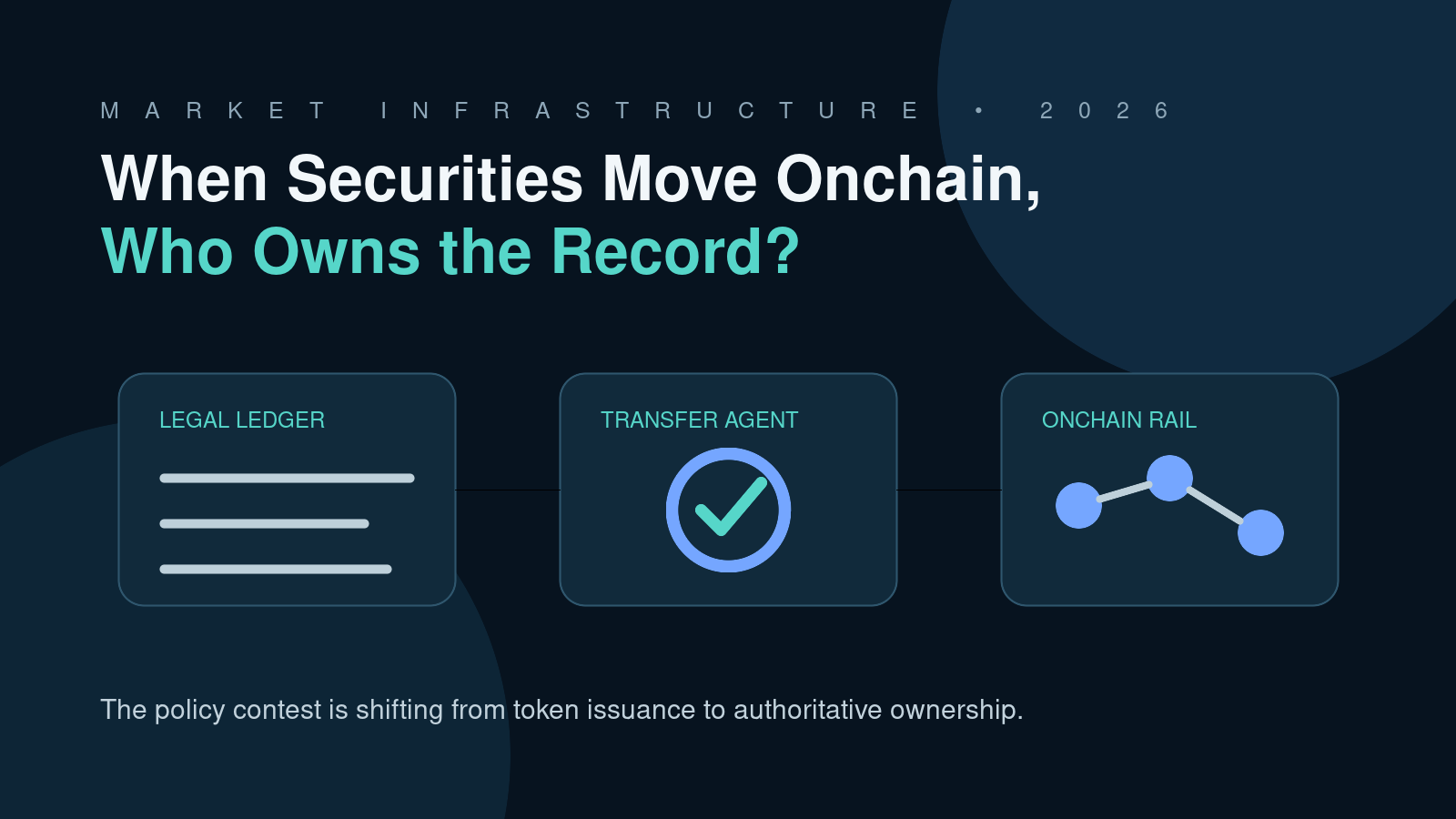
The decisive question for tokenized markets is no longer whether an asset can move onchain, but which record makes that movement legally effective. Original editorial illustration.
Executive summary
On September 1, 2026, the US Securities and Exchange Commission proposed the first broad modernization in decades of the rules governing registered transfer agents—the firms that maintain securityholder records, process transfers and perform essential issuer services. The 421-page proposal is not a crypto rule in disguise. It covers an industry-wide shift from paper and micrographics to electronic records, outsourcing and complex service models. Yet its treatment of blockchain-based recordkeeping makes it one of the year’s most consequential pieces of US tokenization policy.
The proposal’s importance lies less in endorsing a technology than in assigning accountability around it. It would update registration and reporting, impose or revise turnaround standards, strengthen recordkeeping and continuity requirements, require risk-management programs, address restrictive legends and formalize compliance obligations. When required records sit with a third party, a transfer agent would generally need a binding agreement ensuring regulatory access unless the agent maintains independent access. The SEC expressly asks whether a blockchain can provide that independent access when the agent can inspect records and furnish copies without third-party intervention.
That framing advances a crucial institutional thesis: a shared ledger does not eliminate the transfer function; it changes the evidence, controls and parties through which that function is performed. For issuer-sponsored tokenization, a blockchain may become part of the master securityholder file. But legal effectiveness still depends on the issuer’s architecture, applicable securities and commercial law, identity linkage, transfer restrictions, correction procedures, and the accountable entity behind the record. A wallet balance alone is not a universal title certificate.
The proposal remains just that—a proposal, with comments due 60 days after Federal Register publication. It neither mandates blockchain nor resolves every issue raised by 24/7 or permissionless markets. Still, it moves the policy debate from abstract claims about “putting stocks onchain” toward the operational core: authoritative ownership, examinability, resilience, error correction and investor rights. Institutions should read it as an architectural signal, not a launch permit.
A rulebook meets a different market architecture
Transfer agents occupy an unglamorous but foundational layer of capital markets. They cancel and issue certificates, maintain ownership records, facilitate transfers, distribute information and help issuers manage corporate actions. Rules designed around older media and operating practices have persisted while the business migrated to databases, cloud providers, digital communications and outsourced infrastructure. The SEC’s proposal page says the amendments are intended to reflect widespread electronic recordkeeping and the services agents now provide to issuers, investors and intermediaries. It would amend rules and forms, introduce two new rules and rescind an existing one.
The timing matters. In January, staff from three SEC divisions published a statement on tokenized securities that separated issuer-sponsored structures from third-party structures. In August, the Commission proposed a separate tailored offering regime for certain investment contracts involving crypto assets. Then, on September 1, transfer-agent modernization arrived with explicit references to electronic and blockchain-based recordkeeping. Taken together, these actions show policy moving along two distinct tracks: classification and issuance on one side; market plumbing and records on the other.
That distinction is healthy. Tokenization is often presented as a new trading interface, but securities ownership is a bundle of enforceable relationships. The SEC staff’s January taxonomy says the same underlying instrument may be represented through markedly different arrangements. In one issuer-sponsored model, distributed-ledger records are integrated into the master securityholder file, so an onchain transfer results in a transfer on that authoritative record. In another, an onchain movement merely notifies an issuer or agent to update an offchain master file. Third-party tokens may represent a custodial entitlement—or only synthetic exposure issued by someone other than the referenced company.
flowchart LR
    A[Investor instruction] --> B{Token architecture}
    B -->|Issuer-sponsored, integrated| C[Onchain transfer updates master securityholder file]
    B -->|Issuer-sponsored, indirect| D[Onchain signal triggers offchain update]
    B -->|Third-party custodial| E[Token transfers an entitlement to held security]
    B -->|Third-party synthetic| F[Token transfers exposure, not underlying rights]
    C --> G[Legally recognized ownership record]
    D --> G
    E --> H[Claim depends on custodian and entitlement chain]
    F --> I[Claim depends on third-party issuer and contract]
The practical message is that “tokenized stock” is not a sufficient product description. Investors, intermediaries and regulators must know who issued the claim, what record is authoritative, what rights travel with the token, and what happens if the sponsor fails. The interface can look identical while bankruptcy treatment, voting rights, dividends and recourse differ profoundly.
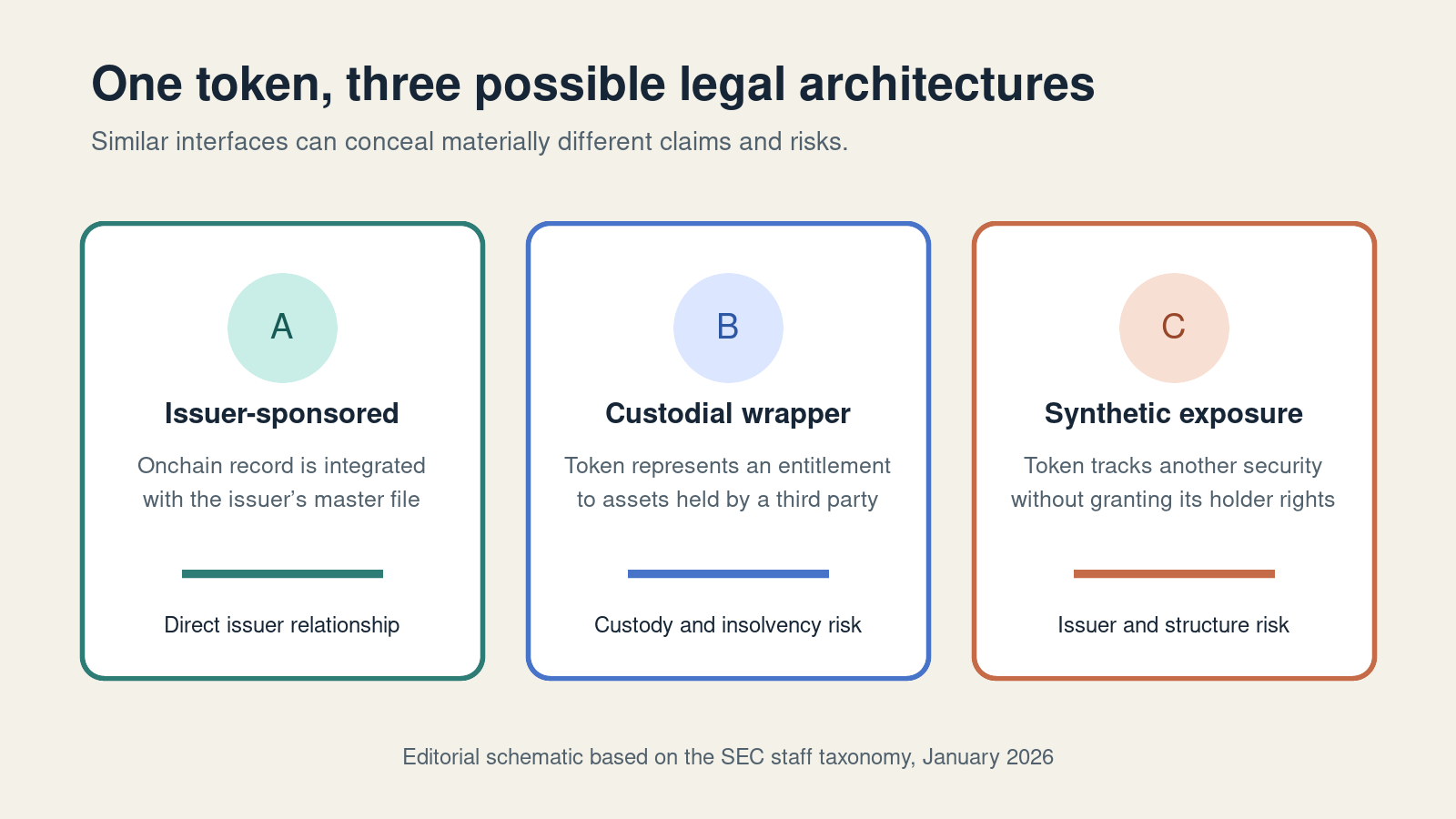
Issuer-sponsored records, custodial wrappers and synthetic exposure can look similar on a screen while delivering different legal claims. Original editorial schematic based on the SEC staff taxonomy.
What the proposal actually changes
The SEC’s official overview and fact sheet group the modernization around registration and reporting, electronic records, turnaround, risk management, inactive securityholders, compliance and restrictive legends. The complete proposing release is the controlling source and contains extensive questions for public comment; it should not be reduced to a single blockchain clause.
Several provisions nevertheless carry direct architectural consequences for tokenized securities.
First, technology neutrality comes with functional obligations. Electronic systems may replace older media, but records must remain accessible, accurate, reproducible and available for examination. The relevant test is not whether a system calls itself decentralized; it is whether the registered agent can discharge regulated responsibilities through it.
Second, outsourcing does not outsource accountability. Under proposed Rule 17ad-7(h), an agent using a third party to maintain or preserve records would generally obtain and file a legally binding agreement recognizing examination rights and prompt production. An exception would apply where the agent maintains independent access. The release says that in a blockchain or distributed-ledger context, independent access can exist where the agent can view the records and use that access to permit examination and promptly furnish copies. Even then, the third-party arrangement would not relieve the agent of its own recordkeeping responsibility.
Third, continuity becomes a lifecycle property. The proposal asks how agents should preserve record continuity through migrations, upgrades, staff changes and format changes, and whether duplicate records should be separately maintained. That is particularly important for smart-contract systems. A chain’s persistence does not itself guarantee that indexing, identity mappings, key-management processes, application logic and readable historical context will survive a vendor failure or protocol migration.
Fourth, the proposal elevates operational risk management. Tokenized systems compress transfer, recordkeeping and sometimes settlement into tightly coupled workflows. That can reduce reconciliation, but it also concentrates failure modes: a bad contract upgrade, compromised signing authority or flawed eligibility rule may propagate faster than a batch-era error. Controls must therefore cover both conventional operations and code-mediated actions.
Finally, restrictive legends expose the collision between programmable transfer and legal restriction. Securities may be subject to holding periods or other limitations. Digitizing the asset does not erase those constraints. Institutions must decide where restrictions are represented, who can remove them, which record prevails when systems diverge, and how an erroneous block or release is corrected.
The emerging control loop
The proposal implicitly replaces a simple “blockchain versus database” debate with a control loop connecting onchain state, legal identity and regulated supervision.
sequenceDiagram
    participant H as Securityholder
    participant W as Wallet / trading venue
    participant L as Distributed ledger
    participant T as Registered transfer agent
    participant I as Issuer master file
    participant R as Regulator
    H->>W: Authorize transfer
    W->>L: Submit eligible transaction
    L-->>T: Observable state change
    T->>T: Validate identity, restrictions and reconciliation
    T->>I: Record or confirm legally effective transfer
    I-->>H: Rights and servicing follow recognized ownership
    R->>T: Request examination or records
    T-->>R: Produce complete, current, readable evidence
    Note over L,I: Architecture determines whether L is the master file or an input to it
This loop matters because blockchains are excellent at proving that a protocol accepted a state transition under its rules. They do not, without surrounding arrangements, prove that the signer had authority under securities law, that a court will recognize the transferee’s interest, or that identity and sanctions controls were satisfied. Conversely, keeping a conventional master file without reliable integration can leave investors holding a token whose apparent transfer is not synchronized with enforceable ownership.
Commissioner Hester Peirce’s statement accompanying the proposal makes the unresolved policy edge unusually clear. She asks whether transfer-agent roles will expand or contract as securities move onchain, whether rules should be adjusted to facilitate onchain trading, and whether digital wallet or email addresses should supplement or replace physical-address collection. These are questions, not adopted conclusions. But they identify the interface where public-chain pseudonymity meets issuer obligations and investor servicing.
Implications for institutions and Web3 markets
For issuers, the strategic choice is not simply public versus private chain. It is whether the ledger is authoritative, mirrored or merely communicative. An authoritative onchain master file offers the cleanest link between token transfer and legal ownership, but demands mature controls for keys, upgrades, forks, privacy, corporate actions and court-ordered corrections. A mirrored model can preserve familiar books and controls, yet introduces reconciliation and timing gaps that dilute tokenization’s promise.
For transfer agents, blockchain may broaden rather than erase the role. A programmable ledger can automate routine posting, but someone must connect wallet activity to legally cognizable holders, administer restrictions and corporate actions, resolve exceptions, maintain continuity and respond to regulators. Competitive advantage may shift from proprietary database custody toward assurance: proving that distributed state and enforceable records remain aligned.
For infrastructure providers, “independent access” is a demanding design criterion. A block explorer is not necessarily a compliant books-and-records system. Institutions need durable data availability, intelligible exports, historical completeness and operational independence from a single vendor. The proposal’s logic favors architectures in which a regulated entity can reconstruct and produce its records even if an indexer, cloud provider or middleware company fails.
For investors, disclosure needs to become rights-centric. Product pages should distinguish direct issuer records from custodial entitlements and synthetic claims. They should explain voting, distributions, redemption, transfer restrictions, insolvency exposure and the consequences of losing wallet credentials. Token availability around the clock does not ensure that issuer servicing, cash legs or dispute resolution operate on the same schedule.
The settlement asset remains another unresolved dependency. The BIS’s 2025 blueprint argues that tokenization’s full benefits arise when money and securities share programmable infrastructure and delivery-versus-payment can be atomic, with central-bank money anchoring finality. The SEC proposal is focused on transfer agents, not wholesale money. Better ownership records alone therefore cannot eliminate settlement risk when the security and cash legs inhabit separate legal or technical systems.
Counterarguments and risks
The optimistic view is that explicit accommodation of blockchain records will accelerate institutional adoption. That may be right, but three cautions are warranted.
First, regulation can harden an immature architecture. Requirements written too specifically around current ledger models could discourage safer future designs. The proposal mostly avoids this by using functional concepts, yet industry comments will shape whether “independent access,” continuity and record production remain genuinely technology-neutral.
Second, faster settlement is not uniformly better. Atomic or near-instant settlement can reduce principal risk and reconciliation, but it also reduces time to fund positions, correct mistakes and net obligations. Market participants may need more prefunding and intraday liquidity. Programmability relocates risk; it does not abolish it.
Third, transparency conflicts with confidentiality. Public ledgers may make records independently observable, but securityholder names, addresses and holdings can be sensitive. Identity must often remain offchain or access-controlled. The resulting linkage layer becomes both essential and attractive to attackers. Privacy-enhancing methods may reduce exposure, but regulated examinations and issuer servicing still require dependable access.
There is also a governance risk in treating chain finality as legal finality. Networks can fork; transactions can be reversed through governance or remediation; keys can be stolen; courts can order transfers. A credible architecture needs an explicit hierarchy for conflicts among protocol state, transfer-agent records, issuer determinations and legal orders. “Code is law” is not an operating policy for a registered securities market.
What to watch during the comment period
The most informative comments will answer concrete operating questions rather than repeat ideological positions. Watch for evidence on whether wallet addresses can function as regulated identifiers; how agents can prove independent record access; what duplicate or offchain records are necessary; how permissionless infrastructure fits third-party-service-provider rules; and how errors, forks and lost keys should be handled. The treatment of restrictive legends will reveal how much transfer compliance can safely move into code.
Also watch the boundary between transfer and settlement. If tokenized securities trade continuously while transfer agents, banking rails and corporate-action processes operate on narrower schedules, operational seams may multiply. Coordination with broker-dealer, exchange, custody, clearing and payment rules will determine whether a modernized transfer layer becomes an integrated market or another digital island.
Conclusion
The September proposal is consequential precisely because it is mundane. It focuses on records, access, turnaround, continuity, controls and responsibility—the institutional disciplines that transform a token from a tradable representation into part of a dependable securities system.
Its central lesson is not that blockchains have been blessed as official books. It is that a blockchain can participate in official recordkeeping only when accountable parties can explain what the record means, keep it accessible, reconcile it with legal identity, preserve it through change and produce it to supervisors. The proposal does not complete the US tokenization framework, and it may change materially after comments. But it puts the right question at the center: when a token moves, what exactly has transferred—and who can prove it?
Primary sources
SEC: Transfer Agent Rules proposal page, file S7-2026-30 (September 1, 2026)
SEC staff: Statement on Tokenized Securities (January 28, 2026)
Commissioner Hester M. Peirce: “Time to Transfer” (September 1, 2026)
BIS Annual Economic Report 2025, Chapter III: The next-generation monetary and financial system
Research cutoff: September 7, 2026. The SEC measure discussed is a proposal, not a final rule.