Ethereum’s Glamsterdam Rewires the Block: Why Platåberget Is a Test of Market Structure, Not Just Throughput
Glamsterdam places block construction, validation and execution on a new operating path. Original editorial illustration.
Research date: 6 September 2026
Executive summary
Ethereum’s new Platåberget testnet is easy to misread as another staging environment for another capacity upgrade. It is more consequential than that. Opened to public participation in August, Platåberget is the first durable public proving ground for Glamsterdam, a fork that changes who commits to an execution payload, when that payload is revealed and validated, how state dependencies are represented, and how computation and state growth are priced. The upgrade’s central proposition is that Ethereum can raise its execution ceiling without asking ordinary validators to absorb an unsustainable increase in critical-path work.
That proposition rests on three coupled mechanisms. Enshrined proposer-builder separation (ePBS, EIP-7732) moves the economic exchange between block builders and proposers into consensus and removes the relay from the protocol’s trusted path. Block-level access lists (BALs, EIP-7928) expose the accounts, storage locations and state changes touched by a block, making parallel reads, execution and state-root work possible. A coordinated gas repricing, including separate accounting for new state, seeks to ensure that a much larger gas envelope does not become a cheap route to permanent state bloat. The Ethereum Foundation describes the target as a roughly 200 million gas floor, not a promise of four times today’s real-world throughput.
Our thesis is that Glamsterdam should be evaluated as an operating-model redesign, not a benchmark contest. Its success criterion is not simply “more gas.” It is whether a heterogeneous network can coordinate a new block market, carry extra access-list data, defer execution validation safely, price state creation coherently, and preserve reliable wallet and infrastructure behavior. Platåberget therefore matters precisely because it can reveal interface failures that isolated client benchmarks cannot.
The institutional implication is equally important. Ethereum is attempting to internalize a market structure that already dominates block production while making the base layer more parallelizable. If it works, the result could be a more credible scaling path with fewer trusted intermediaries. If it fails, the failure is likely to appear first as degraded inclusion, missed or empty slots, inaccurate gas estimates, or client divergence—not as an elegant theoretical objection.
Why this testnet matters now
The Ethereum Foundation’s 17 August announcement says Platåberget is intended to run for a few months, unlike short-lived devnets, and to give the public a stable place to test post-Glamsterdam behavior before Sepolia and Hoodi. Its validator set is deliberately small but publicly joinable; validator and builder deposits are open. Glamsterdam activated there on 20 August. As of this report date, that makes the network an early test surface, not evidence that the fork is production-ready.
This distinction matters because no mainnet activation date is stated in the announcement. The published sequence is conditional: incorporate feedback, run a non-finality devnet to examine pathological consensus cases, upgrade long-lived testnets, observe stability, and only then move mainnet. A responsible assessment should preserve that uncertainty. “Running on Platåberget” means the specification has crossed from private development into public integration testing; it does not mean the design has passed that test.
flowchart LR
    A[Short-lived Glamsterdam devnets] --> B[Platåberget public testnet]
    B --> C[Feedback and client fixes]
    C --> D[Non-finality devnet for pathological cases]
    D --> E[Sepolia and Hoodi upgrades]
    E --> F{Stable across clients and infrastructure?}
    F -- Yes --> G[Ethereum mainnet consideration]
    F -- No --> C
The sequence is governance by evidence. It creates multiple stopping points because Glamsterdam changes both consensus and execution assumptions at once. For investors and operators, the relevant signal is therefore not a rumored calendar date but the quality of cross-client behavior under adversarial and messy conditions.
The first pillar: putting the block market inside consensus
Ethereum validators commonly outsource execution-payload construction to specialized builders through MEV-Boost. In the present architecture, relays broker a fair exchange: the proposer sees a bid rather than the full block, signs a blinded block, and relies on a relay to release the payload. This arrangement helped smaller validators access competitive builder economics, but the protocol cannot itself verify the relay’s role. Ethereum’s own security roadmap describes ePBS as removing these trusted middleware actors from block delegation.
EIP-7732 creates builders as in-protocol entities and has them commit to an execution payload and a payment. A payload-timeliness committee (PTC), sampled from validators, reports whether the promised payload and associated blob data arrived on time. The proposer can receive the committed payment through consensus accounting, while the builder obtains protocol-level protection that an honestly revealed payload becomes canonical under the design’s stated security assumptions.
The deeper scaling benefit is temporal. Today, validators have a short critical window to perform consensus processing, execution validation, data-availability work and fork-choice evaluation. EIP-7732 separates consensus validation from execution validation. Its current specification gives the next proposer six seconds and other validators nine seconds to validate execution, rather than forcing all of that work before the first attestation deadline. Smaller consensus messages should also propagate faster because they carry a commitment instead of the full execution payload.
sequenceDiagram
    participant B as Builder
    participant P as Proposer
    participant C as Consensus
    participant T as Payload-timeliness committee
    participant V as Validators
    B->>P: Signed payload bid and commitment
    P->>C: Beacon block with commitment
    B->>T: Reveal execution payload and blobs
    T->>C: Timeliness attestations
    C-->>P: Protocol-enforced payment outcome
    V->>V: Validate execution before next-slot vote
This is not the elimination of specialized builders. It is the redesign of their settlement and validation interface. Builder concentration, sophisticated order flow and MEV do not disappear because relays leave the trusted path. What can improve is the credibility of the exchange between the proposer and builder and the amount of work forced into the hottest part of a slot.
There are real trade-offs. EIP-7732 acknowledges a “free option” problem: a rational but adversarial builder may withhold a payload when doing so is profitable, causing an empty slot and worse user experience. Delayed validation also changes the meaning of first-slot inclusion. A transaction shown in a builder’s payload in slot N is not widely execution-validated until validators process the following slot. Applications, exchanges and risk engines should avoid treating the earliest observation as equivalent to broad validation or finality.
The second pillar: make state dependencies visible
Parallel execution sounds like a hardware problem, but the limiting information problem comes first. Transactions can touch overlapping accounts and storage. A client cannot safely parallelize work unless it knows which state locations will be read or changed. EIP-7928 makes a canonical access map part of the payload interface: it records accessed accounts and storage plus post-transaction changes, and commits to that map in the block header.
That structure allows parallel disk reads, parallel transaction validation, parallel state-root computation and certain state updates without re-executing every transaction. It is best understood as a manifest for a block’s state footprint. The builder supplies the manifest; executing nodes independently reproduce it; a mismatch invalidates the block. The access list is stored separately from the block body and may be exchanged between execution peers.
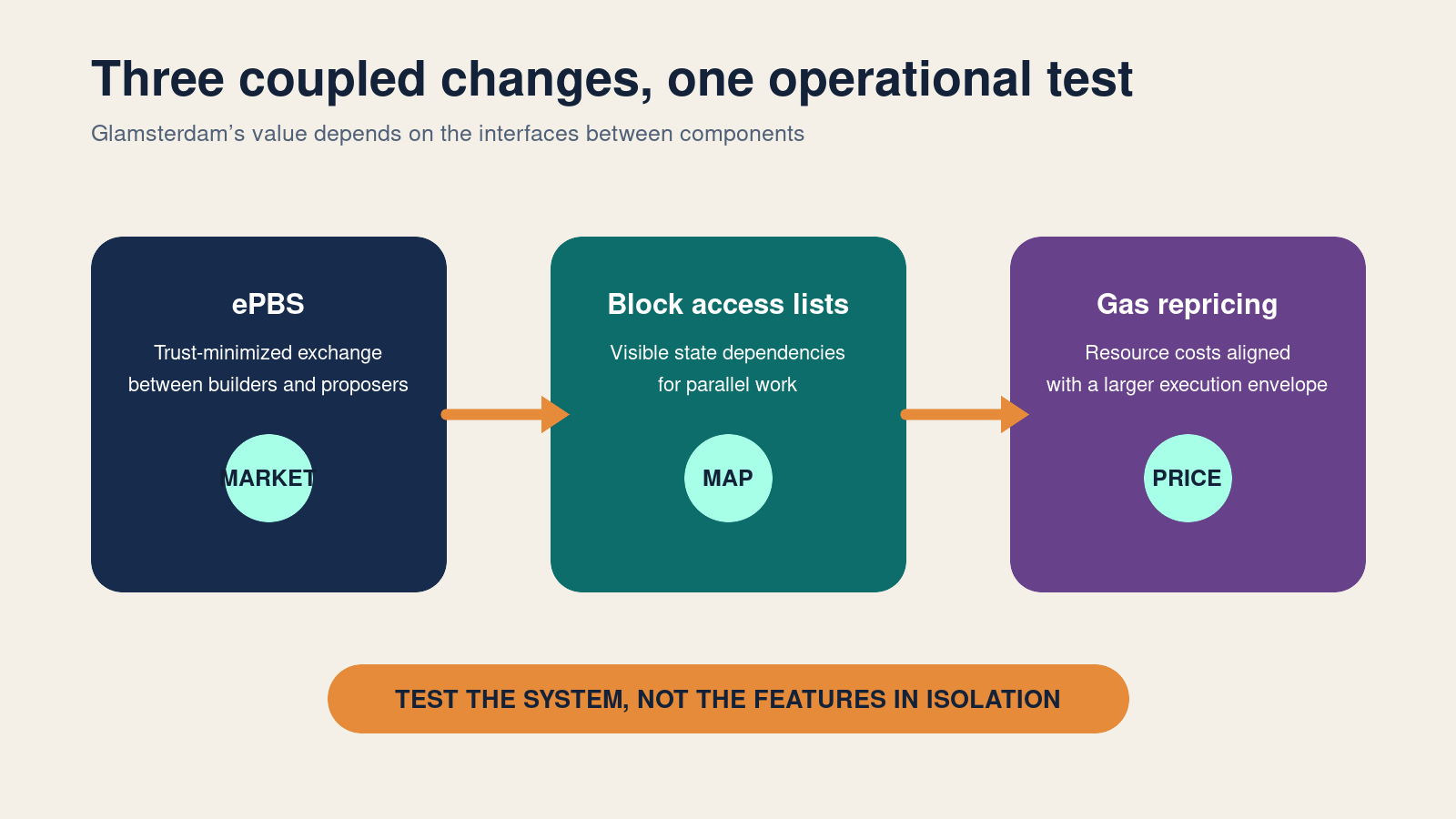
The market, the state map and the resource price must work as one system. Original editorial illustration.
The map is not free. An EIP-authored analysis of 1,000 historical blocks reports an average full BAL size of 110.8 KiB raw and 72.4 KiB after Snappy compression, with a compressed maximum of 191.4 KiB in that sample. Storage writes and reads were the largest components. These figures are measurements of a specified dataset—blocks 23,991,474 through 23,992,473—not guarantees about future blocks. They nonetheless demonstrate the architectural exchange: more explicit data over the network can unlock more parallel work inside clients.
Evidence | What it supports | What it does not prove |
|---|---|---|
1,000-block sample averaged 72.4 KiB compressed per BAL | The added object is material but plausibly manageable | Worst-case behavior at a 200M gas regime |
State writes and reads dominated measured BAL bytes | State-heavy activity drives the data burden | That every workload compresses similarly |
BAL must match independently generated accesses | The map is consensus-checked, not merely advisory | That all clients will implement it without bugs |
For institutional users, this is a useful reminder that “parallel execution” is not a single performance switch. It changes bandwidth, storage, synchronization and validation profiles. A high-throughput node may benefit from many cores while a bandwidth-constrained home validator sees a different bottleneck. The public test must establish that the combined profile remains compatible with Ethereum’s decentralization goals.
The third pillar: price the larger machine honestly
Glamsterdam’s capacity ambition would be unsafe if resource prices remained calibrated for a smaller execution envelope. The Foundation’s announcement highlights coordinated repricings aimed at a roughly 200M gas floor and warns that tools with a hard-coded maximum gas limit will break. This affects wallets, indexers and gas estimators, not only validator clients.
More subtly, EIP-8037 introduces a distinct state-gas dimension for operations that create new state, charged by state bytes at runtime. The familiar claim that every plain ETH transfer costs exactly 21,000 gas stops being universal: a transfer to an existing account retains that total under the testnet design, while a transfer that creates a new account incurs additional state gas. The editorial point is not the formula; it is that execution and permanent storage are different economic resources and should not be conflated when capacity rises.
This is where downstream breakage may be more visible than consensus innovation. A wallet that caps estimates, an exchange that assumes a fixed transfer cost, or an indexer sized around historical block limits can fail while the chain itself continues normally. Platåberget is therefore an ecosystem readiness exercise. The hardest bugs may sit in software that never considered itself part of consensus.
What institutions should watch
The next useful evidence should be operational rather than promotional. Five categories deserve attention.
First, watch slot outcomes: the frequency and causes of full, empty and skipped slots, especially under builder withholding and network impairment. Second, examine PTC participation and disagreement. A design that is sound under honest timing must also behave predictably when payload propagation is marginal. Third, compare client pairs. Consensus and execution diversity only protects the network when implementations converge on the same result. Fourth, measure the full resource envelope—CPU, memory, disk I/O and bandwidth together—at progressively higher gas loads. Finally, audit downstream estimates and indexing completeness, particularly for new-account transfers and larger contracts.
flowchart TD
    A[Platåberget observation] --> B{Consensus health}
    A --> C{Execution capacity}
    A --> D{Ecosystem compatibility}
    B --> B1[Full empty and skipped slots]
    B --> B2[PTC agreement and payload timing]
    C --> C1[Cross-client validation latency]
    C --> C2[BAL bandwidth and storage cost]
    D --> D1[Wallet gas estimates]
    D --> D2[Indexing and exchange pipelines]
    B1 --> E[Mainnet readiness judgment]
    B2 --> E
    C1 --> E
    C2 --> E
    D1 --> E
    D2 --> E
The diagram makes the key analytical point: no single throughput number resolves readiness. Mainnet confidence requires simultaneous evidence across consensus health, execution performance and ecosystem compatibility.
Counterarguments and unresolved risks
The strongest positive case says Ethereum is converting an already-established off-protocol specialization into a trust-minimized protocol market while buying validators more execution time. That is credible, but incomplete.
One counterargument is that enshrining PBS may ossify today’s builder-centric market. Removing relays as trusted intermediaries does not create competitive builders or democratize private order flow. A technically cleaner settlement layer could coexist with economic concentration. Builder deposits may also create a new capital requirement, even if modest relative to professional builder operations.
A second concern is complexity risk. ePBS changes fork choice and introduces PTC duties; BALs add new consensus-checked data; repricing changes application assumptions. Each component has a defensible rationale, but their interaction expands the testing surface. Glamsterdam’s benefit comes from coupling, and so does its risk.
Third, added capacity can relocate rather than eliminate centralization pressure. Parallel software and commodity multicore hardware may help execution, but larger blocks and access lists still traverse networks and occupy storage. Average BAL measurements should not be mistaken for adversarial upper bounds. The relevant test is tail behavior at the proposed higher gas regime.
Finally, improved base-layer throughput is not synonymous with lower user fees at all times. Demand, MEV, blob economics and L2 fee markets remain separate variables. Glamsterdam strengthens Ethereum’s supply-side capacity; it does not repeal congestion economics.
Conclusion
Platåberget marks the point where Glamsterdam’s architecture becomes a shared operational claim. Ethereum is asking its ecosystem to test a new bargain: professional builders may continue assembling blocks, but their exchange with proposers moves closer to protocol enforcement; validators gain more time and better state information for execution; users receive a larger capacity envelope whose state costs are priced more explicitly.
That bargain is strategically coherent. ePBS addresses trusted coordination and critical-path timing, BALs address the information barrier to parallelism, and repricing addresses the resource externalities of scale. Yet coherence on paper is not readiness. The public testnet’s editorial importance lies in its ability to falsify assumptions across clients, networks, wallets and market participants.
The right near-term stance is constructive scrutiny. Treat Platåberget as meaningful evidence that Glamsterdam has entered integration testing, but reserve judgment on mainnet until the network demonstrates stable slot outcomes, robust payload delivery, cross-client agreement, acceptable tail resource usage and downstream compatibility. Ethereum’s next scaling step will be won or lost at the seams.
Direct sources
Ethereum Foundation: Announcing the Platåberget Testnet (17 August 2026)
EIP-7928: 1,000-block component-size and compression analysis
Method note: This report distinguishes specification intent, measured historical samples and future outcomes. All status statements are current to 6 September 2026; no mainnet date is inferred where the primary announcement provides none.