Ethereum’s Glamsterdam Bargain: Scale the Machine, Price the Memory
Glamsterdam’s central question is not how to make blocks merely bigger, but how to make more capacity compatible with credible home validation. Illustration: original editorial artwork.
Executive summary
Ethereum’s forthcoming Glamsterdam upgrade is best understood as a capacity bargain. The protocol is preparing to give block production more time, nodes more visibility into the data a block touches, and simple payments a lower intrinsic cost. In return, applications that create or repeatedly access permanent state will face prices that better reflect their burden on every node. This is not one optimization but a coordinated attempt to remove three different ceilings on Layer 1: time, information and storage.
As of 4 September 2026, Glamsterdam is still being tested on devnets. Ethereum.org lists a Sepolia fork for 28 September and mainnet in the fourth quarter, with no confirmed mainnet date; it also warns that the scope, although frozen, can still change while the meta-EIP remains in draft. Those qualifications matter. This report analyzes the scheduled design, not a completed deployment or guaranteed specification (Ethereum.org upgrade page).
The headline mechanism, enshrined proposer-builder separation (ePBS), moves the exchange between block proposers and specialized builders into consensus. Its dual-deadline design expands the effective payload-propagation window from roughly two seconds to about nine, according to Ethereum.org. Block-level access lists (BALs) describe accounts and storage touched by a block, enabling parallel disk reads and faster state synchronization. EIP-8037 and EIP-8038 then reprice state creation and access, addressing the database growth and hardware workload that could otherwise make larger blocks hostile to independent operators.
The investment and operating takeaway is nuanced. Glamsterdam is not a promise of three-times immediate throughput, nor a simple fee-cut fork. The Ethereum Foundation says its repricing target supports roughly a threefold increase in base throughput, but realizing that capacity depends on later gas-limit decisions, client performance and stable public-testnet results. Some state-heavy actions become more expensive even as ordinary ETH transfers may become cheaper. The upgrade’s institutional importance lies in this explicit accounting: Ethereum is trying to scale by assigning scarce resources to their actual cost centers rather than hiding them inside a single gas budget.
Why this upgrade matters now
Ethereum’s rollup-centered roadmap made data availability the obvious scaling story. Dencun lowered blob costs; Fusaka, activated in December 2025, introduced PeerDAS and a path for staged blob-capacity increases. Glamsterdam turns back to the execution layer’s internal constraints. The official roadmap frames its goals as parallelization, expanded capacity and prevention of database bloat. The connective tissue is that higher throughput is safe only when nodes can receive, inspect and retain the resulting workload without a permanent jump in minimum viable hardware.
That framing makes Glamsterdam unusually consequential for institutions. Custodians and staking providers must track new consensus duties. Wallets and RPC providers must revise gas estimation. Protocol treasuries and application teams must test contracts that embed assumptions about gas. Investors should distinguish lower unit cost from lower total demand for blockspace: increased capacity can reduce congestion while greater usage can raise aggregate resource consumption. And decentralization should be measured in node-operating feasibility, not validator count alone.
flowchart LR
    A[More L1 demand] --> B[Pressure for larger blocks]
    B --> C{Three constraints}
    C --> D[Time to propagate]
    C --> E[Unknown state dependencies]
    C --> F[Permanent database growth]
    D --> G[ePBS: wider payload window]
    E --> H[BALs: visible access map]
    F --> I[State creation and access repricing]
    G --> J[Safer capacity increases]
    H --> J
    I --> J
    J --> K[Goal: throughput with accessible validation]
The capacity bargain in three parts
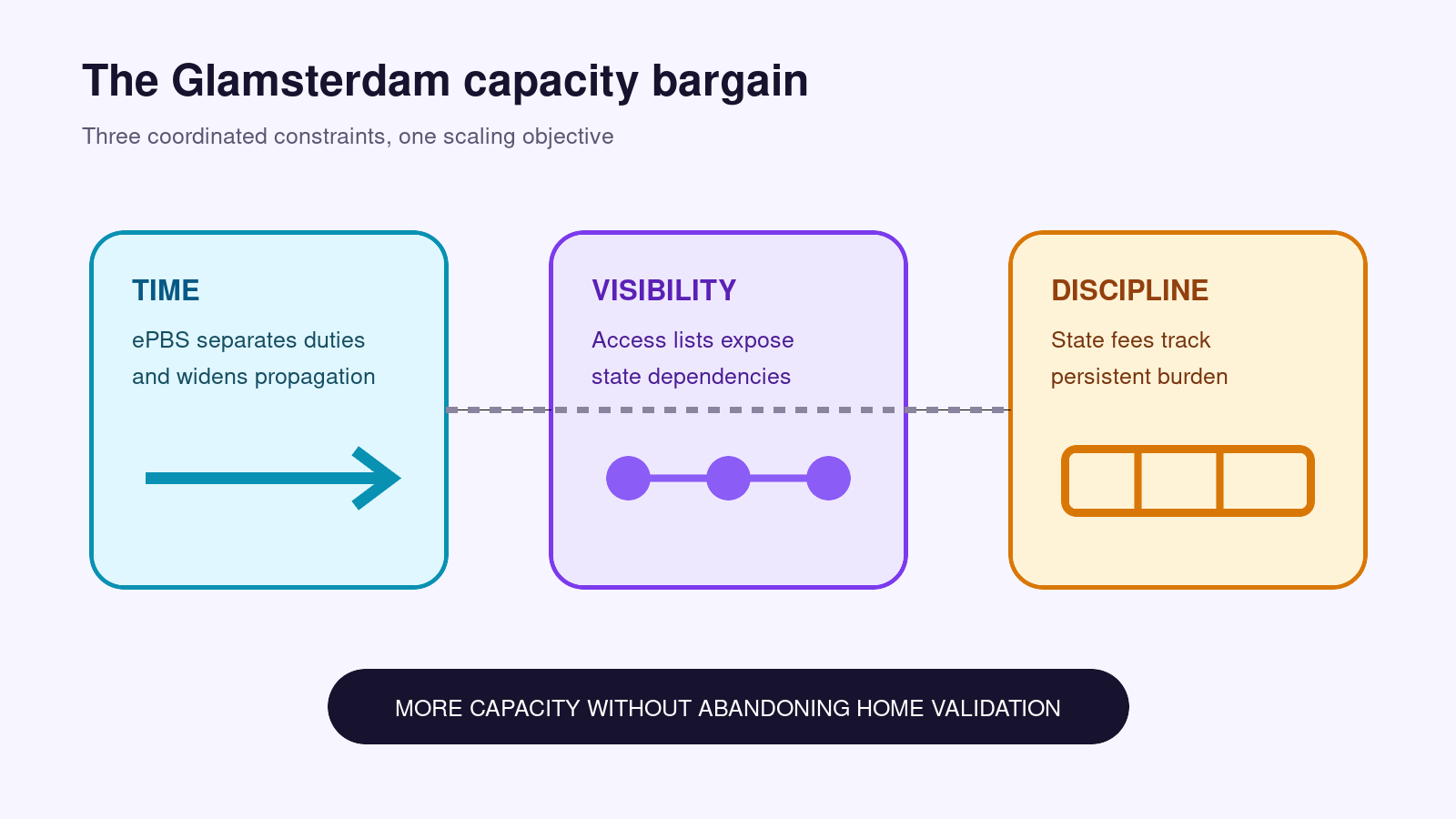
Time, visibility and cost discipline are complementary controls. Removing only one bottleneck would push pressure into the others. Illustration: original editorial artwork.
1. ePBS buys time, but changes the market’s plumbing
Today, specialized builders commonly assemble execution payloads and compete for a proposer’s slot through off-protocol software and relays. The economic division of labor exists, but consensus does not fully enforce the hand-off or payment. EIP-7732 formalizes separate builder and proposer roles, registers staked builders, and introduces a Payload Timeliness Committee (PTC). The proposer commits to a builder bid; the payload is revealed on a separate schedule; attestations distinguish whether the slot was full, empty or skipped. The EIP’s rationale says delayed validation gives the next proposer six seconds and other validators nine seconds to validate the payload (EIP-7732).
This is capacity engineering, not merely market-structure tidying. Moving payload execution away from the tight consensus “hot path” allows more time for larger payloads to cross a globally distributed network. Trustless protocol payment also reduces the relay’s role as the guarantor of exchange. Yet “enshrined” does not mean every intermediary disappears. Ethereum.org explicitly notes that participants may retain external relays for features outside the core protocol. Commercial routing, privacy and order-flow services can persist above the base guarantee.
New guarantees bring new failure modes. A builder can withhold a payload when doing so is economically advantageous, producing an empty slot and degrading user experience. EIP-7732 calls this the “free option problem” and discusses penalties as a mitigation. Staking pools also need architectural changes to monitor builder selection and payload availability. Concentration may shift rather than vanish: reducing trust in relays does not automatically distribute sophisticated block-building capacity.
2. BALs make execution dependencies legible
Ethereum execution is serial partly because a node does not know which accounts and storage locations transactions will read or write until it executes them. EIP-7928’s block-level access list records the relevant accesses and post-execution values, with a commitment in the block header. Independent state reads can then occur in parallel, while syncing nodes can apply verified results without replaying every intermediate computation in the same way. Its networking companion allows peers to exchange these lists.
The distinction between parallel reads and fully parallel execution is important. BALs provide a dependency map and enable immediate client optimizations, but they are infrastructure for a more parallel future, not proof that every transaction in a block can execute simultaneously. Conflicting transactions remain ordered. Performance will depend on database layout, client implementation, bandwidth and workload composition. The institutional reading is therefore “parallel-ready,” not “parallel solved.”
BALs also change the shape of verification. More explicit witnesses and final values can accelerate synchronization, but they add data and consensus commitments that clients must implement consistently. This is why devnet and public-testnet diversity matters: a mechanism can be sound on paper yet reveal bottlenecks when multiple client teams, networking stacks and real applications interact.
3. State repricing protects the decentralization budget
Permanent state is a peculiar public resource. An application pays once to create an account, contract or storage slot, while node operators continue storing and serving that data. If its gas price understates long-run disk and database costs, higher block limits accelerate an unpriced liability. The Ethereum Foundation notes that state-operation prices were last broadly adjusted in the 2021 Berlin fork and that state has grown substantially since then (Foundation compatibility notice).
EIP-8037 establishes a standardized cost per state byte and a separate state-gas reservoir. Its published calibration uses 1,530 gas per byte, a 150-million-gas reference block and a target of 120 GiB annual state growth. These are design parameters, not a forecast: actual growth depends on utilization and future block limits. EIP-8038 updates charges for state access to better track database work and reduce denial-of-service exposure. The combined schedule is summarized in the Glamsterdam gas repricing meta-EIP, while the detailed rationale appears in EIP-8037 and EIP-8038.
This makes the fork distributional. Applications that produce persistent records or rely on underpriced database access bear more of the cost. Simple transfers between existing accounts can move the other way: EIP-2780 is scheduled to reduce intrinsic transaction gas, with the official roadmap describing a reduction of up to 71% for a standard ETH transfer while retaining a surcharge when a new account must be created. “Fees fall” and “fees rise” can both be true because different resources are being separated.
Constraint | Scheduled mechanism | Intended gain | Principal caveat |
|---|---|---|---|
Tight block-production timing | ePBS / EIP-7732 | Roughly 2s to 9s payload propagation window; protocol-enforced exchange | Builder withholding and operational migration |
Opaque state dependencies | BALs / EIP-7928 plus network exchange | Parallel reads, faster state update paths | Not equivalent to universal parallel execution |
Underpriced persistent state | EIP-8037 and EIP-8038 | Sustainable gas-limit growth and DoS resilience | State-heavy contracts may cost more or fail under old limits |
Overpriced simple payment base work | EIP-2780 | Up to 71% lower intrinsic gas for transfers between existing accounts | Total fee still depends on base fee and transaction conditions |
Compatibility evidence: small tail, material consequences
The most decision-useful evidence arrived on 24 August. Ethereum Foundation, EthPandaOps and specifications teams replayed historical mainnet transactions under the new gas schedule. They report that the “large majority” execute identically, while a small set of contracts can degrade or break because old assumptions move. The published categories are precise: unchanged; successful with changed gas or outcome details; fixable with a higher gas limit; and potentially broken even after a substantial increase. Most flagged cases are reportedly fixed by raising the gas limit, and maintainers of the most affected systems are being contacted.
No public percentage accompanies those qualitative terms on the notice, so it would be misleading to manufacture one. A small tail can still matter if it contains high-value settlement, liquidation or custody logic. Historical replay is powerful evidence about known traffic, but it cannot capture dormant paths, future inputs or private transaction flows. Contracts that hard-code gas allowances, branch on gas remaining, or rely on fixed stipends deserve attention even if their address is absent from a replay list.
sequenceDiagram
    participant T as Historical transaction
    participant R as Glamsterdam replay
    participant C as Classification
    participant O as Operator response
    T->>R: Execute under new schedule
    R->>C: Compare result and gas use
    alt Same result
        C->>O: Monitor; no change indicated
    else Higher limit resolves failure
        C->>O: Update estimation and supplied gas
    else Still fails
        C->>O: Inspect call path, patch and test
    end
    O->>R: Validate on Platåberget and public testnets
Platåberget, the longer-lived Glamsterdam testnet announced on 17 August, is the present proving ground. The Foundation says tools with hard-capped maximum gas limits—including wallets, indexers and gas estimators—need updates because the upgrade includes breaking changes (testnet announcement). Public-testnet milestones should therefore be treated as operational gates, not ceremonial dates.
Implications for institutions and the ecosystem
For staking businesses, ePBS moves responsibility toward the protocol but raises the premium on timely client upgrades, monitoring and builder-policy design. Service-level models should account for full, empty and skipped slots rather than treating missed payloads as a single undifferentiated event. Builder concentration, relay usage and payment reliability remain meaningful market metrics after the fork.
For application and infrastructure operators, the immediate issue is estimation integrity. Cached gas constants can underestimate costs. Wallets, RPC providers and simulation systems should converge on the scheduled rules before users encounter mainnet failures. Risk teams should prioritize contracts by economic criticality and call-path sensitivity, not only by transaction count. A rarely called emergency function can carry more risk than a high-volume transfer path.
For users, there is no token migration. Ethereum.org explicitly warns that ETH need not be “upgraded,” making fake migration instructions a predictable scam vector. Lower intrinsic gas can make plain transfers cheaper, but it does not guarantee a particular dollar fee because the base fee and ETH price remain variable.
For the competitive landscape, Glamsterdam strengthens the argument that Ethereum L1 can grow without abandoning the rollup roadmap. A longer propagation window also accommodates more blob data, while improved L1 execution supports settlement and high-value activity. But it does not erase the cost and latency advantages of L2s, nor does it resolve fragmentation. The likely effect is complementary: a stronger settlement layer with more abundant data capacity, not a wholesale reversal to L1-only applications.
Risks and counterarguments
First, schedule risk is real. Q4 is an expectation, not a confirmed mainnet date. Scope is frozen but the meta-EIP is draft; test results can still change parameters or timing. Any valuation thesis that depends on activation on a particular day is premature.
Second, more complex consensus creates a larger implementation and operations surface. ePBS modifies fork choice, attestations, payments and payload timing. BALs add new commitments and peer-to-peer exchange. Cross-client correctness matters more than an elegant specification.
Third, capacity can centralize at a layer the protocol does not directly democratize. Larger payloads and sophisticated auctions may favor well-capitalized builders even if validators retain accessible hardware. Enshrining the exchange reduces counterparty trust; it does not guarantee competitive builder markets or censorship resistance.
Fourth, repricing can create localized breakage. The Foundation’s replay results are reassuring but not exhaustive, and “most” is not “all.” In composable finance, one failing downstream call can alter an upstream system’s behavior. The correct counterweight is staged testing and transparent incident preparation, not a blanket claim of backward compatibility.
Finally, targets should not be confused with outcomes. The 120 GiB annual state-growth figure is a calibration objective under stated assumptions; the roughly threefold throughput support is a performance design target. Neither is an observed post-mainnet measurement.
Conclusion
Glamsterdam’s coherent thesis is that sustainable scaling requires time to distribute data, information to organize computation and prices that expose persistent cost. ePBS, BALs and state repricing address those constraints as a system. That is more credible than a single headline capacity increase because it acknowledges who must receive, verify and store every additional unit of activity.
The upgrade is also a test of Ethereum’s governance-by-engineering process. The strongest evidence is not a promised Q4 date but the sequence of public specifications, historical replay, a purpose-built devnet and upcoming public testnets. Institutions should judge readiness through those gates and preserve the distinction between scheduled mechanisms, calibrated targets and measured outcomes.
If Glamsterdam succeeds, its legacy will not be that Ethereum made transactions uniformly cheaper. It will be that the network made its resource accounting more honest—and used that honesty to expand capacity without casually spending its decentralization budget.
Direct sources
Research cutoff: 4 September 2026, UTC. Upgrade status and parameters remain subject to the Ethereum governance and testing process.