Ethereum’s Price of Scale: Glamsterdam Repricing Turns State Growth into an Institutional Risk Test
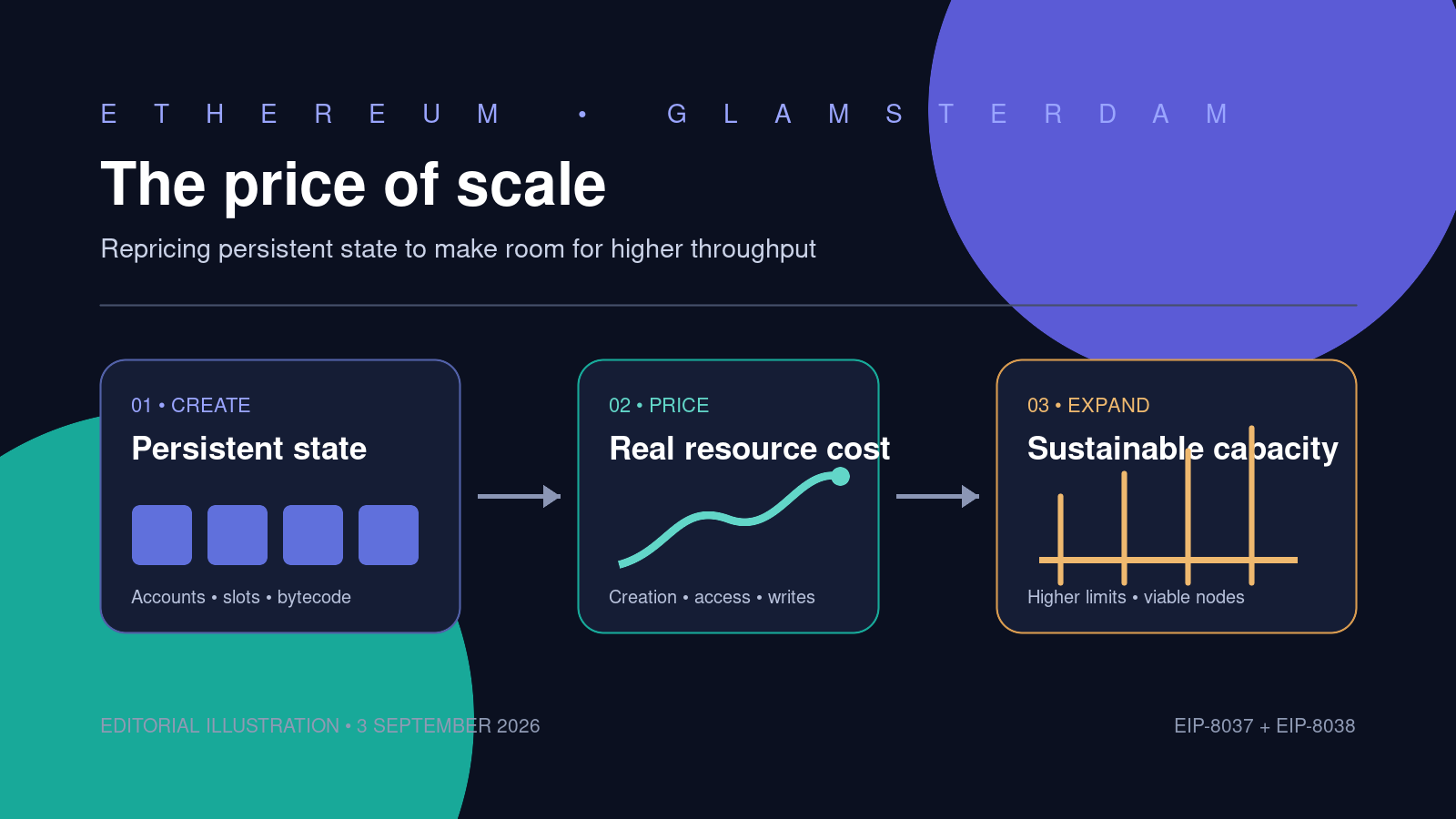
Glamsterdam’s economic bargain: price persistent work more accurately today so that higher throughput does not make tomorrow’s node set prohibitively expensive. Editorial illustration.
Research date: 3 September 2026
Executive summary
Ethereum’s forthcoming Glamsterdam upgrade is often described through its headline architecture—enshrined proposer-builder separation and block-level access lists—but its most immediate application-level consequence may be less glamorous: the network is changing what persistent state costs. Two proposals scheduled for inclusion, EIP-8037 and EIP-8038, reprice state creation, access and writes. On 24 August, Ethereum Foundation, EthPandaOps and specification teams published the result of replaying historical mainnet transactions under that schedule. Their finding is reassuring in aggregate and uncomfortable at the edge: the large majority of transactions are unaffected, most flagged failures can be corrected by supplying more gas, but a small class of contracts can break or degrade because their logic embeds assumptions about gas itself.
The thesis of this report is that repricing is best understood as a capacity covenant, not a fee tweak. Ethereum wants to expand Layer 1 throughput while keeping ordinary node hardware viable. That bargain only holds if gas remains a credible proxy for the work imposed on the distributed database. State-access prices were last materially calibrated in the 2021 Berlin fork; meanwhile the state has expanded and the block gas limit rose. EIP-8037 reports that daily new state climbed from about 105 MiB to 326 MiB after the limit moved from 30 million to 60 million gas—more than tripling after a doubling. Its reference design targets roughly 120 GiB of annual growth at a 150 million gas limit.
For institutions, the central risk is not that “Ethereum contracts will stop working.” That framing is too broad. The relevant risk is concentrated in systems with fixed gas stipends, hardcoded call limits, branches based on remaining gas, presigned transactions with fixed limits, and infrastructure that caps or caches gas estimates. The mitigation window is real: Glamsterdam is still on devnets, the official roadmap lists Sepolia for 28 September and mainnet in Q4 2026 with no confirmed date, while the longer-lived Platåberget environment is available for testing. But the window should be treated as a change-management deadline, not evidence that the issue can wait.
Why Ethereum is repricing state now
Gas performs two jobs. It rations scarce block capacity in the moment, and it prices the lasting burden that computation and data impose on every validating node. Those functions can drift apart. A computation ends; a newly created account, storage slot or piece of bytecode persists in the state database and must remain accessible. If creating or touching that state is underpriced relative to hardware work, higher throughput can silently transfer costs from transaction senders to node operators.
That is the problem EIP-8037 and EIP-8038 divide between them. EIP-8037 harmonizes the cost of creating new accounts, storage and code around a cost-per-state-byte model, and separates state gas from execution gas. EIP-8038 updates the cost of reading and modifying an already-large database. Its draft schedule lifts cold account access from 2,600 to 3,000 gas, introduces or isolates write components, and raises the effective storage-write component from 2,800 to 10,000 gas. These parameters remain part of draft proposals under peer review; they should be read as the currently specified schedule, not an immutable mainnet promise.
The empirical premise is more important than any single constant. EIP-8037 says a Geth node’s state database was approximately 390 GiB in January 2026. Following the gas-limit increase from 30 million to 60 million, average new state per day rose from roughly 105 MiB to 326 MiB. The authors caution that this is not a clean linear response: user behavior shifted. Yet extrapolating the post-increase baseline to a 200 million limit would imply about 387 GiB of annual state growth and cross a cited 650 GiB performance-degradation threshold within a year. The proposal therefore aims at a controlled growth budget rather than assuming storage and access will remain cheap indefinitely.
flowchart LR
    A[Higher block gas limit] --> B[More transactions and state creation]
    B --> C[Larger state database]
    C --> D[Slower reads and heavier node hardware]
    D --> E[Fewer viable independent operators]
    E --> F[Decentralization pressure]
    G[Reprice creation, access and writes] -. breaks the feedback loop .-> B
    G --> H[Resource costs better reflected in gas]
    H --> I[Room for safer capacity increases]
This is why “gas becomes more expensive” is an incomplete interpretation. Some state-heavy operations become materially more expensive, but the intended system-level dividend is greater safe capacity. Glamsterdam’s wider design reinforces that point. Block-Level Access Lists, EIP-7928, record the accounts and storage locations accessed during a block alongside post-transaction values, enabling parallel disk reads, transaction validation and state-root computation. Enshrined proposer-builder separation, EIP-7732, moves the builder hand-off into the protocol and lengthens the effective window for execution and data-availability work. Repricing makes sure the resulting capacity is not purchased with uncontrolled database growth.
What the replay evidence actually shows
The Ethereum Foundation’s 24 August analysis groups historical transactions replayed under the proposed schedule into four outcomes: no change; success with a changed gas footprint or other detail; failure at the original gas limit but success with a higher one; and potential breakage even after the limit is substantially raised. The publication does not provide a universal percentage for each bucket, so it would be misleading to manufacture a failure rate. Its defensible conclusion is qualitative: the large majority fall into the first category, while most flagged problems are limit-estimation issues rather than semantic failures.
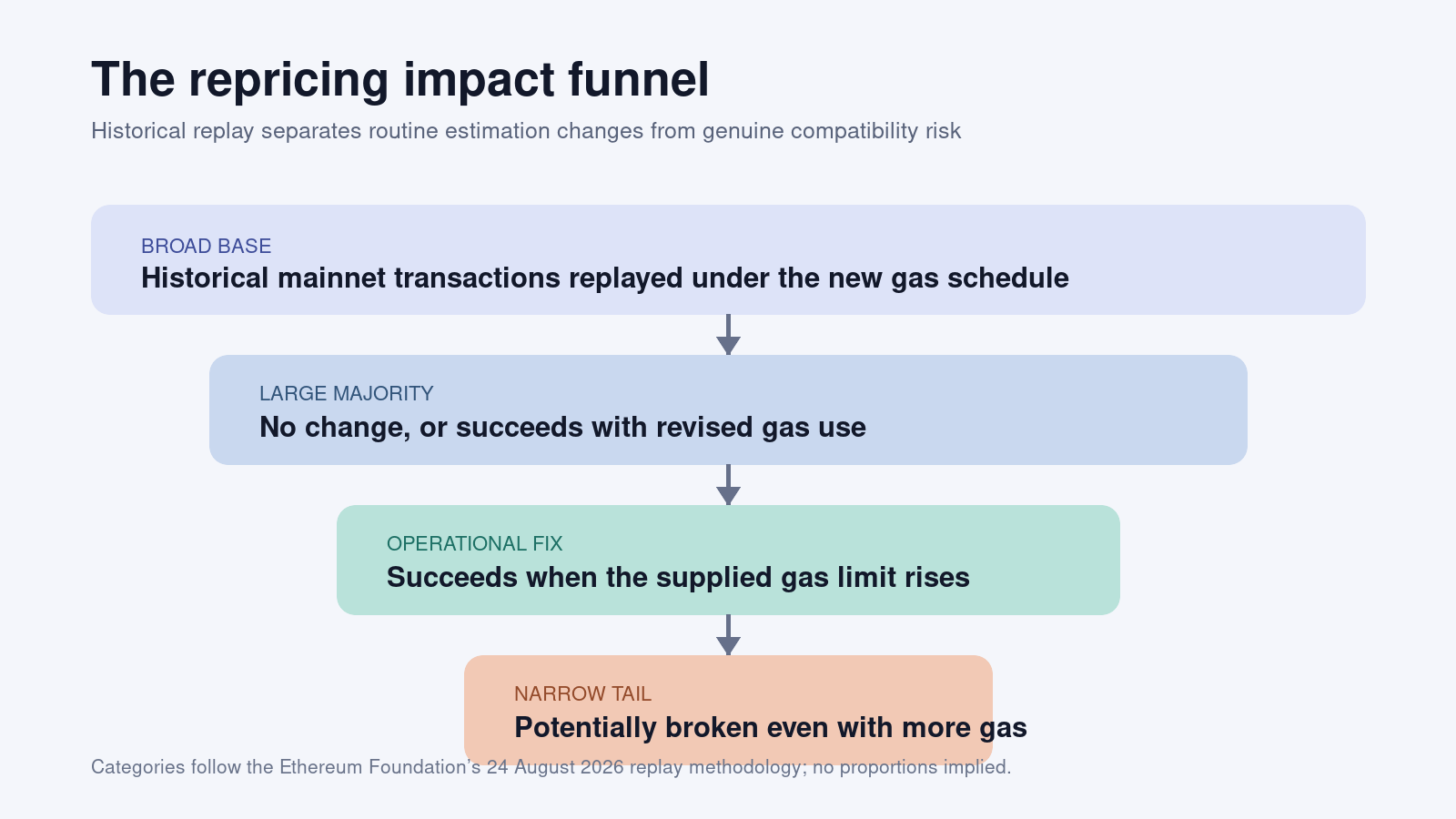
The replay evidence narrows the risk: ordinary execution dominates; operational gas-limit fixes come next; genuine incompatibility is a small but important tail. Widths are illustrative and do not claim measured proportions.
That distinction matters operationally. An out-of-gas transaction caused by a stale estimate is disruptive, but the contract may be sound: a wallet, relayer or transaction policy can provide a higher limit. A transaction that remains broken with ample gas signals a deeper coupling between business logic and the old schedule. The Foundation identifies four recurring patterns: Solidity’s historical transfer or send stipend of 2,300 gas, explicit gas amounts in calls, decisions branching on gasleft(), and presigned transactions that fix a gas limit before submission.
These patterns turn metering into behavior. A receiving contract may once have completed within a stipend but now run out of gas; a fallback path can change; a signature may authorize a transaction that cannot be respecified; a contract can deliberately or accidentally use remaining gas as a control signal. Raising the outer transaction limit does not necessarily enlarge an inner fixed stipend. This is the narrow tail in which repricing becomes a compatibility event rather than a cost event.
flowchart TD
    A[Replay or test a transaction under Glamsterdam] --> B{Same result?}
    B -->|Yes| C[No compatibility action]
    B -->|No| D{Succeeds with a higher supplied limit?}
    D -->|Yes| E[Update estimation, caps and transaction policy]
    D -->|No| F{Fixed stipend, hardcoded call gas, gasleft branch or fixed presign?}
    F -->|Yes| G[Contract-level remediation or migration]
    F -->|No| H[Investigate state-dependent divergence]
    E --> I[Retest on Platåberget and public testnets]
    G --> I
    H --> I
The replay dataset is valuable precisely because it replaces blanket anxiety with triage. It is not, however, a proof of future safety. Historical transactions do not cover dormant emergency functions, novel paths, future market stress, private order flow, or combinations of state that have never appeared on-chain. A contract absent from the affected list is not certified compatible. The Foundation explicitly recommends reviewing hardcoded gas and gas-dependent branches even when an address is not listed.
The institutional exposure map
The risk travels beyond contract authors. Wallets and RPC providers must update gas estimation; cached constants or hard maximums can cause transactions to fail. Indexers and monitoring systems can mistake a higher failure rate for user error or network congestion. Custodians may have presigned withdrawal or recovery transactions whose gas limit is operationally difficult to replace. Relayers and account-abstraction infrastructure may enforce risk controls calibrated to the old cost envelope. DeFi governance processes can impose delays longer than the available testing window, especially where immutable components require a migration rather than a parameter update.
Stakeholder | Primary exposure | Evidence-led response before activation |
|---|---|---|
Protocols and DAOs | Fixed internal gas forwarding; immutable legacy components; slow governance | Review flagged paths, simulate non-routine functions, prepare upgrades or migration communications |
Wallets, custodians and relayers | Cached estimates, hard caps, fixed presigned transactions | Refresh estimation logic, inventory presigned flows, test replacement and escalation policies |
RPC and infrastructure providers | Underestimation and inconsistent behavior across client versions | Validate estimators against the new schedule and monitor divergence on testnets |
Stakers and node operators | Mandatory client changes for a network fork | Track supported high-priority releases and rehearse upgrades; avoid premature mainnet assumptions |
Risk committees and treasury teams | Transaction failure during volatile or time-critical conditions | Add Glamsterdam compatibility to operational-risk registers and recovery exercises |
The official Glamsterdam roadmap currently labels the upgrade “testing on devnets,” gives a 28 September 2026 Sepolia milestone and says mainnet is expected in Q4, with the date unconfirmed. Scope is frozen but the meta-EIP remains draft and can still change. That combination should govern communications: teams can plan against the scheduled design, but should not represent the exact parameters or activation date as final.
The Platåberget announcement adds a separate warning for infrastructure: tools built around a hard-capped maximum gas limit—including wallets, indexers and estimators—will break and need updating. Platåberget is intended to run for several months, longer than the short-lived development networks, giving teams a stable venue before Sepolia and Hoodi. This is an unusually explicit signal that compatibility testing is not confined to smart-contract bytecode.
Strategic implications
First, state is becoming an explicit economic product. EIP-8037’s multidimensional accounting distinguishes execution gas from state gas and fills blocks according to the bottleneck resource. Conceptually, Ethereum is moving away from a single blended meter toward resource-aware capacity. That makes state-intensive designs more visible and rewards applications that minimize permanent storage, reuse deployed code and push nonessential data elsewhere. It also makes application economics more legible: a protocol that permanently expands the database should pay differently from one that performs transient computation.
Second, the upgrade links Layer 1 scaling to decentralization constraints. A higher gas limit is not free throughput if it makes state growth or validation too costly for independent operators. The 120 GiB annual-growth target is a policy choice embedded in engineering: it expresses how much persistent burden the proposal considers compatible with future commodity hardware. Investors should therefore evaluate Glamsterdam less as an isolated throughput catalyst and more as an attempt to improve the credibility of Ethereum’s scaling path.
Third, repricing redistributes costs unevenly. Routine users are not asked to take action, and greater capacity may reduce average congestion over time. State-heavy applications, deployers and legacy contracts face more immediate costs. The network-level benefit and application-level burden can both be true. Protocol teams should resist presenting the change as either a universal fee reduction or a universal fee shock.
Fourth, the episode demonstrates the value—and limit—of public transaction replay. Publishing an address-searchable impact dashboard and conducting outreach converts protocol governance into measurable ecosystem risk management. Yet public remediation can itself reveal which contracts are operationally fragile. Teams need a disclosure strategy that informs users without advertising an exploitable condition before a fix is ready.
Risks, counterarguments and unknowns
The strongest counterargument is that repricing may solve a projected problem by imposing certain costs now. The forecast from a 60 million to a 200 million gas limit assumes the recent creation rate is a useful baseline; the EIP itself notes the observed response was non-linear and likely included a one-off behavior change. Hardware improves, clients optimize, and state-expiry or statelessness research could change the constraint. Any annual-growth target is therefore a judgment under uncertainty, not a physical constant.
There is also execution risk in combining major changes. Glamsterdam includes ePBS, block-level access lists, repricing and other proposals. Interactions can enlarge testing complexity even when each component is defensible. Draft specifications can change late; divergent client implementation can expose edge cases; and a compressed sequence from public testnets to mainnet could leave governance-heavy protocols with insufficient time. Conversely, delaying the upgrade prolongs reliance on off-protocol builder infrastructure and leaves resource prices misaligned.
Finally, there is a communication hazard. Because the majority of replayed transactions are unaffected, teams may dismiss the tail. Because potentially broken contracts exist, commentators may overstate systemic danger. The correct posture is neither complacency nor alarm: identify whether a system embeds gas assumptions, test its full operational surface, and distinguish estimation failures from contract semantics.
Conclusion
Glamsterdam’s state repricing is the bill that accompanies Ethereum’s ambition for a larger Layer 1. EIP-8037 and EIP-8038 attempt to keep that bill with the users who create, access and modify persistent state rather than quietly passing it to every node operator. Historical replay suggests the transition is manageable: ordinary transactions dominate and many failures are corrected by better limits. But the residual class—fixed stipends, hardcoded gas, gas-sensitive branches and inflexible signatures—deserves immediate attention because it converts a price change into a behavior change.
For institutional users, the near-term decision is straightforward. Treat 28 September’s planned Sepolia fork as a testing milestone, not a release date; treat Q4 mainnet as expected but unconfirmed; inventory both contracts and the surrounding transaction infrastructure; and preserve the distinction between draft parameters and the stable policy direction. Ethereum is making persistent state more expensive so that capacity can expand without making independent verification untenable. Whether that covenant succeeds will be measured not only in throughput, but in how cleanly the ecosystem handles its narrow, consequential compatibility tail.