The Arc Test: Institutional Consensus Meets Open Stablecoin Finance
Arc’s real launch question is not whether another blockchain can go fast. It is whether controlled validation can support an open application economy without turning operational certainty into structural dependence.
Research date: 2 September 2026. Public mainnet is scheduled for 16 September 2026.
Executive summary
Circle’s Arc is approaching public mainnet with an unusually explicit institutional proposition. It combines an EVM-compatible Layer 1, USDC-denominated gas, sub-second deterministic finality, and open application deployment with a permissioned group of known validators. Circle says the network has been operating in private mainnet with more than 100 institutional and ecosystem builders; its public launch announcement fixes 16 September as the opening date. The founding validator list includes Circle alongside BlackRock, DTCC, Galaxy, Global Payments, ICE, Mastercard, MoneyGram, SBI, Standard Chartered, Sumitomo Corporation, and Visa. These are not merely brand endorsements: validator operation places recognisable firms inside the network’s consensus perimeter.
The thesis of this report is that Arc should be evaluated as a new institutional settlement bargain, not as a generic “Ethereum killer.” Its design deliberately exchanges one form of uncertainty for another. Dollar-denominated fees and deterministic finality can reduce treasury friction, settlement ambiguity, and the need to hold a volatile gas token. In return, users accept dependence on USDC availability, a permissioned validator-admission model, and a platform whose issuer, core applications, interoperability tools, and initial monetary rail sit within one corporate ecosystem.
That bargain may be rational for payment, foreign-exchange, collateral, and tokenized-asset workflows that value identifiable operators and predictable completion. It is less obviously suitable where credible neutrality, permissionless validation, or resistance to coordinated exclusion is the primary requirement. The correct institutional response is therefore neither dismissal nor automatic adoption. It is to treat Arc as production financial infrastructure, demand measurable service and governance evidence after launch, and retain credible exit routes across chains and assets.
What launches—and what does not
Arc’s official launch notice says public mainnet will go live on 16 September. As of the research date, that remains a forward-looking commitment, not an observed mainnet result. The distinction matters. Private-mainnet participation demonstrates integration interest; it does not establish public-network uptime, fee behaviour under adversarial demand, liquidity depth, or governance performance during a live incident.
Circle’s second-quarter Form 10-Q provides the most useful independently accountable baseline. It reported 502 million cumulative testnet transactions and 2.8 million cumulative transacting wallets through 30 June 2026, plus a private mainnet launched in May and more than 100 partners as of 20 July. These are scale indicators, not adoption metrics. Test traffic can be automated, incentivised, or duplicated; a “transacting wallet” is not a verified person or funded customer. The filing itself frames Arc as one of three reinforcing business pillars alongside Circle’s digital assets and Circle applications.
That platform logic is important. Circle expects Arc to support stablecoin payments, FX, lending, and capital markets; its applications include Circle Payments Network and StableFX, while CCTP and Gateway provide interoperability. In the same filing, Circle says new offerings could generate network-service, subscription, and developer-service fees and increase demand for its digital assets. Arc is thus both infrastructure and a distribution strategy for a vertically integrated financial platform.
flowchart LR
    A[Fiat and bank rails] --> B[Circle minting and liquidity]
    B --> C[USDC as money and gas]
    C --> D[Arc permissioned validators]
    D --> E[Deterministic onchain settlement]
    E --> F[Payments and FX]
    E --> G[Tokenized assets]
    E --> H[Open DeFi applications]
    F --> I[More USDC utility]
    G --> I
    H --> I
    I -. platform flywheel .-> B
The diagram shows why Arc cannot be analysed only at the consensus layer. The stablecoin, the fee asset, the settlement network, interoperability services, and applications reinforce one another. Integration becomes easier, but failures or policy changes can also propagate across layers that would be more institutionally separate in a modular stack.
The operational case: fewer moving parts
Arc’s clearest innovation is mundane in the best sense: a user who holds USDC does not need to acquire a second token merely to pay for computation. Arc’s August 28 technical explanation says transaction fees, native balances, and native value transfers are denominated in USDC while familiar EVM tooling remains usable. The same underlying USDC balance is exposed through native and ERC-20 interfaces. For an institutional product owner, the important point is not the interface detail; it is the elimination of a recurring onboarding and treasury exception.
On a conventional smart-contract chain, a dollar-payment application can fail because its user owns the dollars but not the chain’s gas asset. The business must source, custody, monitor, and account for that second asset or sponsor transactions through additional infrastructure. Arc internalises that problem. Its fee model also uses a smoothed measure of block utilisation rather than allowing the base fee to react fully to each block. Arc’s gas overview presents this as protection against short demand spikes and volatile gas-token prices.
The gain should not be overstated. Dollar denomination removes the crypto-price component of gas volatility; it does not guarantee a fixed fee, unlimited capacity, or a permanent USDC peg. Network demand can still move the base fee, applications still consume different amounts of computation, and USDC remains a privately issued claim with redemption and access conditions. “Predictable” should therefore be tested as a distribution—median, tail, and recovery behaviour—not accepted as a slogan.
Deterministic sub-second finality could be more consequential for financial workflows. Probabilistic confirmation forces an operator to decide how many blocks are enough before treating a payment or collateral transfer as irreversible. A Byzantine fault tolerant network with a known validator set can offer a clearer completion point. That is valuable for delivery-versus-payment, payment-versus-payment, intraday collateral movement, and autonomous transactions where an application must take the next action immediately. Yet deterministic protocol finality is not legal finality. A token transfer may be final on Arc while a bank payment, securities entitlement, sanctions review, or contractual dispute remains unresolved elsewhere.
Known validators are a feature—and a governance constraint
The founding cohort announcement names 11 validators in addition to Circle. The composition spans payments, banking, market infrastructure, asset management, technology, and crypto-native firms. It offers geographic and sector diversity, but it is not permissionless entry. Arc’s own disclaimer calls the network an open L1 “operated by a permissioned validator set.” Here, “open” describes access to build and transact; it does not describe access to produce blocks.
This separation can be useful. A regulated institution may prefer validators with legal identities, mature controls, and reputations to protect. Incident coordination can be faster, operational standards enforceable, and counterparties legible. But those same qualities create a coordination surface. A small, selected group may face common legal orders, shared vendors, or correlated risk appetites. The relevant decentralisation question is not a logo count. It is whether the system continues to process valid transactions when some operators fail, disagree, or are pressured to exclude activity.
Circle’s 10-Q says Arc is expected to begin with proof of authority and may later transition to proof of stake or delegated proof of stake. It also describes a possible ARC token, while stressing that timing, structure, terms, and scope remain subject to technical, business, legal, regulatory, and market considerations. This is material governance uncertainty. Institutions assessing the launch configuration must not assume that future token governance will necessarily decentralise power, nor that the initial arrangement is permanent.
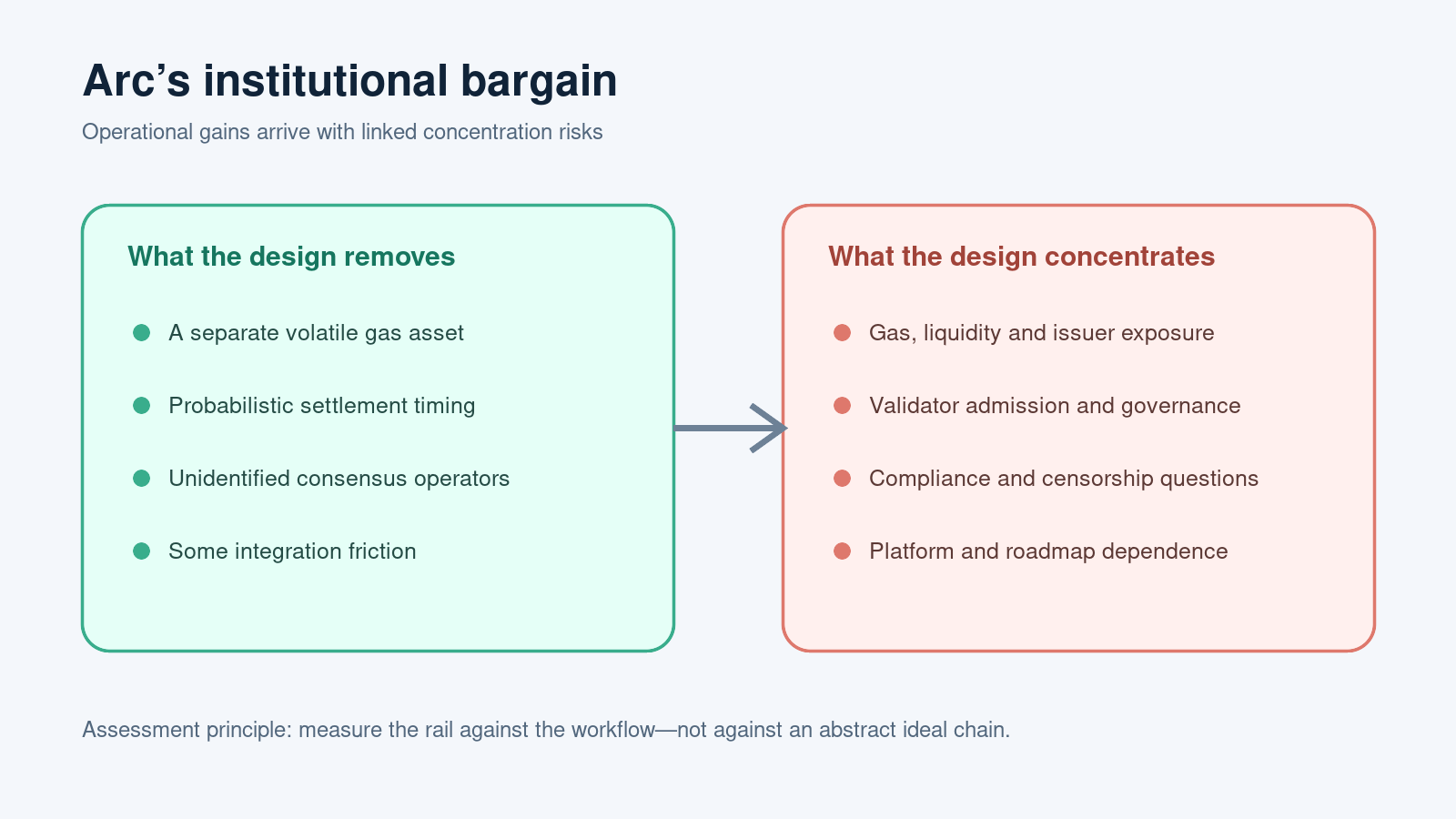
The design simplifies the transaction path by concentrating responsibilities. Whether that is an advantage depends on the workflow and the quality of governance controls.
The adoption evidence is promising but deliberately prospective
Arc’s partner roster has unusual institutional weight. BlackRock is expected to deploy BUIDL on Arc. Circle and DTCC are collaborating on access to DTC-custodied tokenized assets, but that connection is planned to begin in the second half of 2027—not at public-mainnet launch. The distinction between “validator,” “integrating,” “exploring,” and “live production flow” must be preserved. Announcements show strategic intent; only settled volume, recurring users, liquidity, and operational performance show adoption.
Day-one ecosystem names include established DeFi protocols, market makers, wallets, exchanges, custody providers, and payment companies. This can shorten the cold-start period. It also raises a key test: whether liquidity is genuinely additive or primarily migrated and subsidised. A chain can display deep quoted liquidity while remaining dependent on a few market makers, cross-chain routes, or Circle-controlled incentives. Analysts should watch organic fee-paying activity, concentration by application and counterparty, bridge and CCTP flows, stablecoin redemption patterns, and the share of transactions attributable to automated or low-value activity.
The strongest near-term use case may be institutional FX and treasury rather than general-purpose consumer finance. These flows value 24/7 availability, stable units of account, predictable execution costs, and rapid completion. They also often operate within permissioned application layers even when settlement infrastructure is broadly accessible. Arc can therefore make the base layer operationally legible without pretending every asset or participant is unregulated.
sequenceDiagram
    participant T as Treasury A
    participant App as FX or settlement app
    participant V as Arc validator cohort
    participant T2 as Treasury B
    participant O as Offchain books and controls
    T->>App: Authorize USDC leg
    App->>V: Submit transaction with USDC fee
    V-->>App: Deterministic finality
    App-->>T2: Release matched asset or payment
    App->>O: Reconcile timestamp, amount, counterparties
    O-->>T: Record subject to legal and compliance review
    Note over V,O: Chain finality accelerates the workflow; it does not replace external legal finality
Risks and counterarguments
Stablecoin concentration. Using USDC for value, liquidity, and gas is elegant during normal operation. It becomes a coupled dependency during issuer disruption, loss of banking access, redemption delays, address restrictions, or a peg event. Arc’s launch disclaimer explicitly says the ability to transact depends on obtaining and using USDC for gas. An institution should model the possibility that the asset needed to exit a position is also the asset needed to pay for the exit.
Neutrality and censorship. Known validators may improve accountability but can narrow credible neutrality. The question is not whether regulated entities comply with law—they must—but how conflicting jurisdictions, mistaken sanctions flags, validator abstention, and application-level controls affect liveness. Public documentation should ultimately make validator admission, removal, geographic distribution, software diversity, incident powers, and transaction-inclusion performance observable.
Vertical integration. Circle issues the starting gas asset, sponsors the network, supplies cross-chain and wallet infrastructure, and is developing applications atop it. This alignment can accelerate delivery. It can also privilege the platform’s own assets and interfaces, complicate competitive neutrality, and increase switching costs. The counterargument is practical: integrated payment networks have historically won by making complex coordination reliable. Arc’s success will depend on whether third parties can compete fairly and exit cheaply, not on whether integration exists.
Technical and launch risk. EVM compatibility reduces migration cost but is not equivalence. Arc documents network-specific behaviour, and its own notices warn of smart-contract vulnerabilities, outages, and the absence of recourse for transaction errors. Public mainnet will introduce real adversarial traffic and economic incentives that private environments cannot fully reproduce. Institutional pilots should cap exposure until uptime, client diversity, incident handling, and fee tails have been observed.
Interoperability risk. Arc is entering a multichain market, not replacing it overnight. CCTP-style burn-and-mint movement can avoid some wrapped-asset risks, but cross-chain messaging, destination-chain conditions, attestations, and application dependencies still matter. A “native” asset across chains does not make operational state instantaneous or eliminate fragmentation. Exit capacity should be measured under stress, not only in ordinary routing tests.
An institutional decision framework
The sensible evaluation unit is the workflow. A payment processor may rationally value predictable dollar costs more than permissionless block production. A censorship-resistant publishing protocol may reach the opposite conclusion. Before moving material value, decision-makers should require evidence in five areas:
Test | Evidence that matters after launch | Why it changes the decision |
|---|---|---|
Settlement | Finality distribution, reorg record, degraded-mode behaviour | Confirms whether “sub-second” survives production conditions |
Operations | Uptime, client and cloud diversity, incident disclosures | Reveals correlated failure and recovery capacity |
Economics | Median and tail fees, liquidity depth, incentive share | Separates sustainable unit economics from launch subsidies |
Governance | Validator admission/removal, upgrade powers, inclusion metrics | Defines the real control perimeter |
Exit | USDC redemption access and multichain route capacity under stress | Tests whether concentration remains reversible |
No single metric answers the question. High throughput without valuable transactions is noise; famous validators without transparent operating rules are branding; deep liquidity without stress-tested exits is conditional. Institutions should stage exposure, separate signing and settlement controls, maintain another rail, and specify legal responsibility for chain-final but commercially disputed transactions.
Conclusion
Arc is editorially important because it makes a latent Web3 divide explicit. Public-chain finance has often treated permissionless consensus and volatile native tokens as a package. Institutional finance has often treated controlled membership and closed application access as a package. Arc unbundles both: it proposes open application access and a familiar EVM environment atop selected institutional validators, with a regulated stablecoin doing double duty as money and gas.
That design could remove genuine friction. It could also create a highly efficient concentration point. The launch on 16 September, if it proceeds as scheduled, will begin—not settle—the argument. The first months should be judged by observable finality, inclusion, fee stability, operator diversity, live liquidity, and credible exit capacity. Arc does not need to be the most decentralised chain to be useful. It does need to be candid about who controls what, resilient when its tightly coupled components are stressed, and open enough that users can choose another rail when the bargain no longer suits them.
Primary sources
This report distinguishes announced or expected integrations from live production deployment. It is research, not investment, legal, tax, or operational advice.