The Tokenized-Money Fork: Stablecoins Have Distribution; Banks Still Have the Monetary Anchor
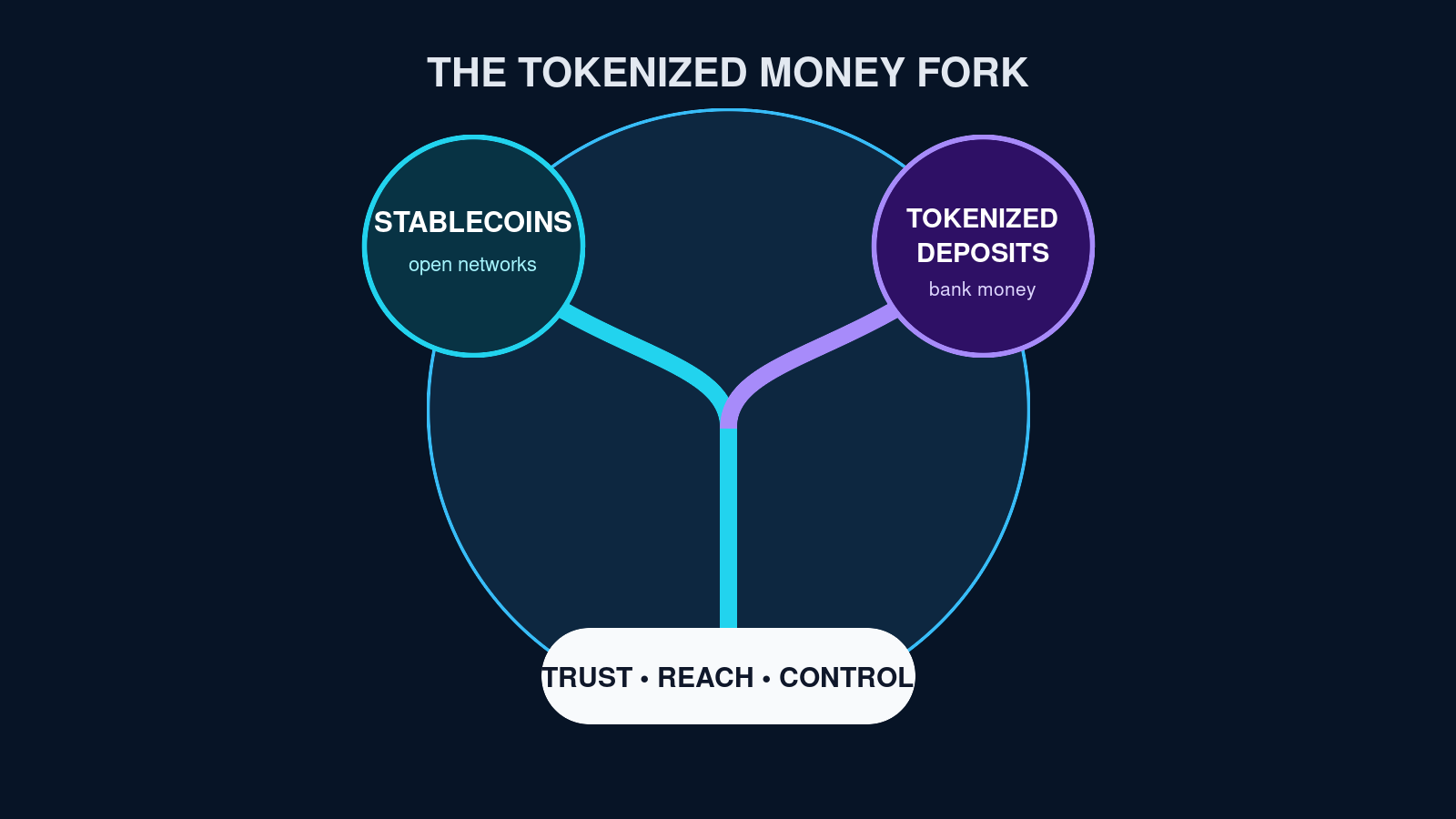
Two rails are competing to carry programmable money. The winner may not be a single instrument, but the institution that makes different instruments feel like one.
Executive summary
The argument over stablecoins has moved beyond crypto market plumbing. On 28 August 2026, Bank for International Settlements (BIS) General Manager Pablo Hernández de Cos used the Jackson Hole Economic Symposium to contrast stablecoins with tokenized bank deposits. His preference was clear: tokenized deposits can import programmability into the existing two-tier monetary system, while stablecoins must still prove that they can operate at par, supply liquidity elastically and enforce financial-integrity rules at scale. The speech matters because it reframes the contest. This is no longer merely “blockchain versus banks”; it is a race between two balance-sheet models for delivering digital money.
Stablecoins enter that race with a formidable advantage: distribution. They move around the clock, across open networks and between users who need not share a bank. The market is already large. The Financial Action Task Force (FATF) reported that more than 250 stablecoins were circulating by mid-2025 and that aggregate capitalization exceeded $300 billion. Circle reported $73.7 billion of USDC in circulation on 27 August 2026. These figures describe genuine adoption, but they do not prove that stablecoins can become the general-purpose monetary backbone.
Tokenized deposits have the inverse profile. They inherit supervision, deposit relationships, access to public backstops and the ability of banks to create credit-linked money. Yet they remain fragmented experiments, often confined to permissioned networks and institutional users. Their central challenge is not conceptual soundness but interoperability and reach.
Our thesis is therefore conditional: stablecoins are winning the interface and distribution layer, while tokenized deposits retain the stronger claim to the monetary core. A durable system is likely to be hybrid, with regulated stablecoins serving open-network and cross-border edges, tokenized deposits serving bank-mediated commerce and credit, and central-bank money anchoring final settlement. The decisive policy question is not which token looks most digital. It is whether convertibility, liquidity and compliance can survive stress across the boundaries between them.
Why Jackson Hole changed the frame
The BIS speech did not deny the current system’s defects. It explicitly cited patchy interoperability, constrained competition and inefficient cross-border payments. Distributed ledgers and tokenization could address some of those frictions by synchronizing records and allowing money and assets to be programmed together. That acknowledgement is important: the institutional case for tokenized deposits is not an argument for preserving legacy messaging chains unchanged.
Instead, Hernández de Cos returned to properties that users normally take for granted. “Singleness” means a dollar issued by one acceptable intermediary trades at the same face value as a dollar issued by another. Elasticity means the supply of money and liquidity can respond to economic needs, including under stress. Integrity means the system can enforce the law without forcing every recipient to investigate the pedigree of every payment. The BIS argues that central-bank settlement, prudential supervision and public liquidity facilities make these properties systemic rather than issuer-specific.
This produces a more useful comparison than transaction speed alone:
Dimension | Reserve-backed stablecoin | Tokenized bank deposit | Institutional question |
|---|---|---|---|
Liability | Claim on a non-bank or specialized issuer | Commercial-bank liability | Who absorbs losses and owes redemption? |
Funding | Normally pre-funded with cash-like reserves | Created within bank balance-sheet and credit process | Can supply respond without forced asset sales? |
Reach | Often transferable on public networks, 24/7 | Usually tied to bank customers or approved networks | Who can hold and transact? |
Par value | Depends on reserves, redemption access and market liquidity | Supported by bank regulation, settlement and backstops | Does one unit remain one unit in stress? |
Compliance | Issuer controls coexist with self-hosted wallets and cross-chain paths | Customer relationship sits with supervised institutions | Where is responsibility enforceable? |
Innovation | Strong composability and global developer access | Potential atomic settlement with deposits and assets | Can interoperability arrive without new silos? |
flowchart LR
    A[User or firm needs programmable money] --> B{Where must value move?}
    B -->|Open network or cross-border edge| C[Regulated stablecoin]
    B -->|Bank-mediated commerce and credit| D[Tokenized deposit]
    C --> E[Reserve and redemption layer]
    D --> F[Bank balance sheet and supervision]
    E --> G[Convertibility gateway]
    F --> G
    G --> H[Central-bank money for final settlement]
The diagram is not a forecast that every jurisdiction will adopt this exact stack. It shows the economic dependencies hidden by similar wallet interfaces. A stablecoin depends on a pool of already-created money and safe assets; a deposit token depends on a bank balance sheet and the legal framework around it. Both ultimately need credible conversion into the unit of account.
The distribution advantage is real
Stablecoins solved a problem before traditional institutions agreed on a common design. They gave exchanges, wallets, merchants and decentralized applications a bearer-like dollar instrument with continuous settlement. That network effect is difficult to recreate by decree. Circle says USDC is available in more than 185 countries and, as of late August, is supported by a broad ecosystem of banks, blockchains and distributors. Its public materials describe reserves consisting of bank deposits, overnight reverse Treasury repo and Treasury securities with less than three months to maturity; weekly disclosures and monthly third-party assurance aim to make the backing legible.
These are issuer claims and should be read as such, but they demonstrate how the strongest stablecoin models are converging toward regulated financial infrastructure. Circle’s MiCA white paper reported 73.0 billion USDC outstanding on 6 July 2026, close to its later 27 August figure of $73.7 billion. The apparent stability across those dates is not evidence of zero volatility; it is a useful cross-check that two dated issuer disclosures describe the same order of magnitude.
The stablecoin proposition is especially powerful where domestic payment systems are slow, local currencies are unstable, or access to dollar banking is limited. A May 2026 BIS paper estimated that roughly 98% of stablecoin value is dollar-denominated and argued that adoption is therefore likely to reinforce existing currency hierarchies. It identified three broad paths: niche use inside crypto; rapid “digital dollarization” in vulnerable economies; or integration of domestic stablecoins under local regulatory capacity. The same distribution capability can thus be an efficiency gain for a user and a monetary-sovereignty risk for a state.
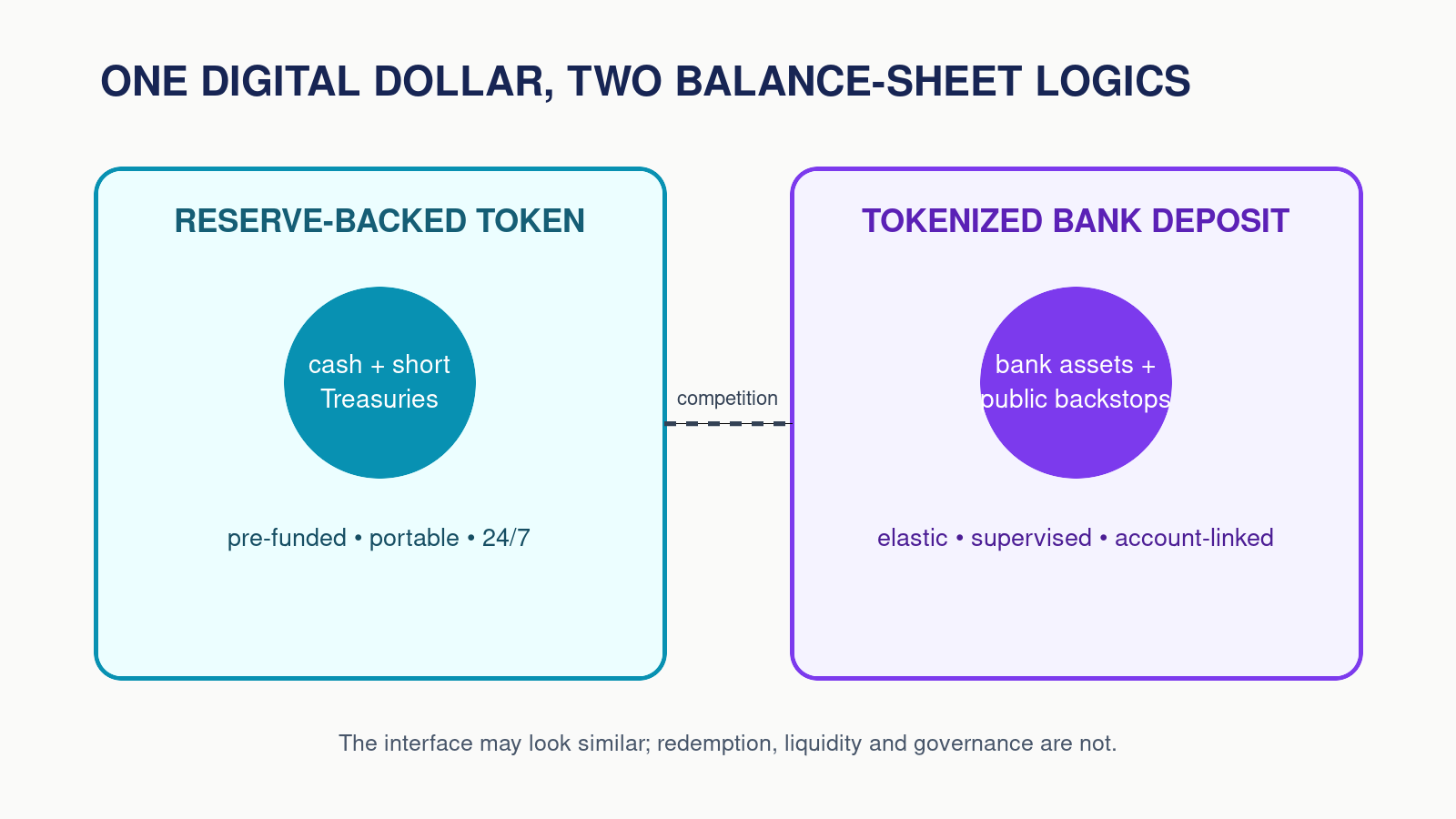
Similar wallet balances conceal different funding, redemption and public-backstop structures.
The balance-sheet difference matters in stress
The International Monetary Fund’s July 2026 note on tokenization identifies a basic asymmetry: stablecoins generally require existing money to fund issuance, while banks can create deposits elastically through lending, subject to capital, liquidity and supervisory constraints. This does not make bank money unlimited or automatically safe. It means that stablecoin supply is structurally closer to narrow, reserve-backed money, whereas deposits are embedded in credit creation.
In calm markets, the distinction may be invisible. During a redemption wave, it becomes decisive. A stablecoin issuer must deliver cash against tokens, drawing on bank deposits, repo or maturing and saleable securities. The quality, custody and liquidity of those reserves matter, as do the holder’s direct or indirect access to redemption. Secondary-market prices can diverge from one dollar even when ultimate assets are sound if arbitrage channels are congested. Tokenized deposits face conventional bank-run and operational risks, but public liquidity facilities and resolution frameworks are designed around the banking system’s role in supplying money and credit.
The two designs also distribute economic returns differently. Stablecoin holders commonly receive no direct yield while the issuer or its partners earn income on reserves. Bank deposit pricing reflects competition, services, regulation and the economics of lending. Neither arrangement guarantees that users receive the benefit of underlying interest rates. As tokenized Treasury funds and yield-bearing instruments proliferate, non-yielding stablecoins may face sharper competition, a risk Circle itself identifies in its second-quarter disclosures.
sequenceDiagram
    participant U as Token holder
    participant W as Wallet or exchange
    participant I as Issuer or bank
    participant R as Reserve/settlement system
    U->>W: Requests conversion at par
    W->>I: Presents token or deposit claim
    I->>R: Sources cash or settlement liquidity
    alt Liquidity and access hold
        R-->>I: Settlement funds
        I-->>W: Full-value redemption
        W-->>U: Par maintained
    else Market, operational or legal friction
        R--xI: Funds delayed or costly
        I--xW: Redemption bottleneck
        W-->>U: Discount, delay or access gap
    end
This sequence reveals why “fully backed” is necessary but not sufficient. Par depends on assets, legal claims, operational availability, distribution intermediaries and settlement hours working together. For tokenized deposits, the analogous promise depends on the issuing bank and the public-private safety net. Technology can shorten messages; it cannot repeal balance-sheet constraints.
Integrity is the hardest boundary problem
FATF’s March 2026 targeted report adds a less comfortable dimension. It said stablecoins represented 84% of illicit virtual-asset transaction volume in 2025, citing Chainalysis, and highlighted peer-to-peer transfers through unhosted wallets and cross-chain activity as specific control gaps. That statistic is a share of identified illicit crypto transaction volume, not a claim that 84% of all stablecoin activity is illicit. Confusing those denominators would grossly misstate the evidence.
Open transferability creates the very reach that makes stablecoins valuable, but it also separates the asset from a persistent customer relationship. Issuers can freeze some addresses and regulated gateways can screen customers, yet bridged assets, decentralized protocols and self-custody complicate responsibility. FATF calls for jurisdictions to implement its Recommendation 15 and for public-private cooperation on typologies and investigations. The practical issue is how to preserve lawful peer-to-peer use without building a system whose controls exist mainly at easily bypassed entrances.
Tokenized deposits begin with identifiable bank customers, which makes accountability clearer. But this advantage can become a constraint: if every transfer requires bilateral permission or a closed consortium, the product may reproduce today’s fragmentation in a newer database. Moreover, banks are not immune to illicit finance, cyberattacks or faulty monitoring. Integrity is an institutional capability, not a magic property of permissioned ledgers.
Implications for institutions and policymakers
For banks, the threat is deposit displacement. If households and firms hold more transaction balances in stablecoins, reserves flow from bank deposits toward short-dated government assets and custodial accounts. The scale is still modest relative to global banking, but the direction can affect funding costs and credit provision. Banks cannot answer only with a token wrapper. They need interoperable deposits that settle outside business hours and work across institutions without making users manage bilateral credit risk.
For stablecoin issuers, regulatory legitimacy is becoming a product feature. Reserve segregation, direct redemption, high-frequency disclosure, operational resilience and cross-chain controls are not peripheral compliance costs; they determine whether a token can remain money-like during stress. Issuers that rely on opacity or fragile banking links may be separated from those admitted into mainstream payment and collateral systems.
For central banks, the choice is not simply to endorse or ban. They can improve instant-payment access, offer settlement assets for tokenized markets, establish convertibility standards and supervise gateways. The IMF points to Eurosystem projects intended to connect distributed-ledger platforms with central-bank settlement infrastructure. Such bridges could let private innovation continue while keeping the unit of account anchored.
For investors and corporate treasurers, ticker-level analysis is inadequate. They should map issuer liability, reserve composition, redemption eligibility, network and bridge exposure, custody, legal jurisdiction and stress liquidity. A token’s on-chain availability is not the same as cash availability. Conversely, a bank-branded deposit token is not automatically interoperable or bankruptcy-remote.
Counterarguments and unresolved risks
The BIS case may underweight how institutional reform actually happens. Open stablecoin networks create competitive pressure precisely because incumbents did not solve cross-border friction. A bank-centric architecture could entrench access barriers, surveillance and market concentration. Tokenized deposits may also fragment by bank and jurisdiction unless common settlement and messaging standards mature.
Stablecoin advocates can fairly argue that transparent, short-duration reserves may be easier to evaluate than a leveraged bank balance sheet. A well-designed narrow issuer does not make loans against its payment liabilities. Yet reserve safety does not remove operational, custodial, legal or redemption risk, and a system that cannot expand liquidity in a panic may transmit asset sales into funding markets.
There is also no guarantee that hybrid interoperability will be benign. Bridges concentrate technical risk; conversion gateways concentrate market power; multiple compliance regimes can exclude legitimate users; and programmable controls can be abused. Dollar stablecoin growth may give users in unstable economies a better store of value while weakening domestic monetary transmission. These are genuine trade-offs, not problems that one ledger choice resolves.
Conclusion
The stablecoin-versus-tokenized-deposit debate is best understood as a contest over institutional architecture, not token aesthetics. Stablecoins have demonstrated global distribution, composability and persistent demand. Tokenized deposits carry the deeper advantages of the supervised monetary system: elasticity, established customer relationships and a route to central-bank settlement. Each side is strongest where the other is weakest.
The likely end state is therefore plural but anchored. Regulated stablecoins can serve open-network edges; tokenized deposits can modernize bank money; central-bank money can preserve finality and the unit of account. Success should be measured by whether a user can move value at par through stress, not by transaction speed in calm conditions. Jackson Hole’s most consequential message was not that banks have already won. It was that programmability is no substitute for a credible balance sheet—and that the institutions owning those balance sheets must finally match the reach that stablecoins have already built.