Europe’s Tokenization Bridge: Why Pontes Changes the Institutional Web3 Debate
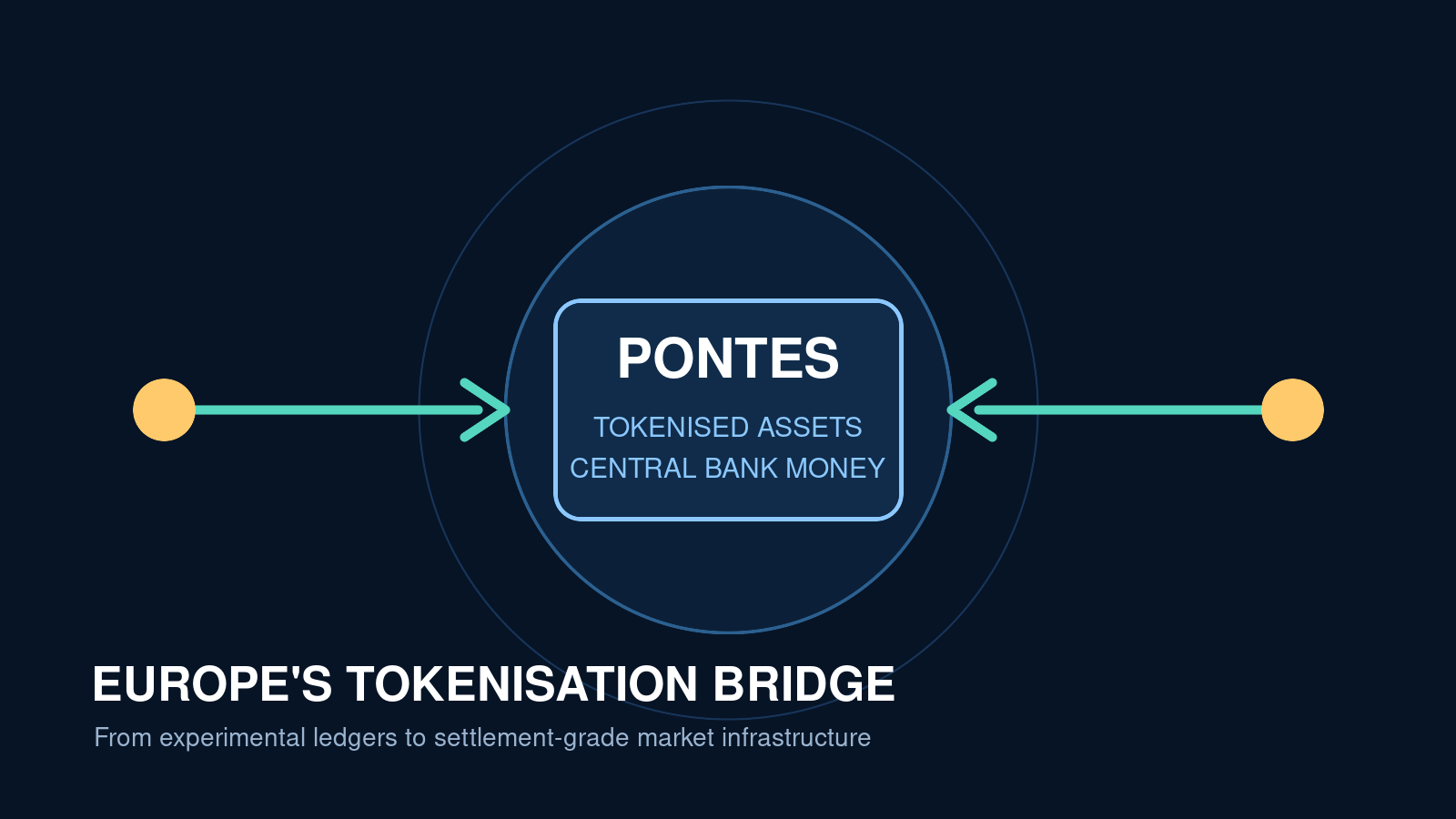
Editorial illustration: Europe’s next tokenization milestone is a settlement bridge, not another token launch.
Executive summary
Europe is approaching a consequential threshold in institutional Web3. The European Central Bank says Pontes—its service linking market distributed-ledger platforms to the Eurosystem’s TARGET Services—is planned to go live in September 2026. Its purpose is narrow but foundational: allow the cash leg of wholesale transactions conducted on DLT platforms to settle in central bank money. Alongside it, the longer-horizon Appia initiative is working toward a blueprint for an integrated European tokenized financial ecosystem in 2028.
The timing matters. Tokenization has spent years proving that securities and claims can be represented on programmable ledgers. The unresolved question is whether those assets can become part of a market rather than remain islands: whether payment is final, ownership is legally portable, collateral can move, liquidity can concentrate, and different platforms can interoperate. Pontes addresses one of those constraints by preserving the monetary anchor. Appia acknowledges that the remaining constraints are architectural and legal, not merely technical.
This report’s thesis is that Pontes marks a shift from token production to market production. Europe is not simply putting existing instruments on new databases. It is attempting to connect decentralized or distributed execution environments with public-money settlement and regulated institutions. If successful, that hybrid design could make DLT relevant to mainstream capital markets without requiring those markets to accept stablecoin credit risk as their common settlement foundation. But a bridge to central bank money does not by itself create liquidity, harmonize law, remove operational risk, or guarantee commercial adoption.
That distinction should discipline both enthusiasm and skepticism. Pontes is neither a wholesale reinvention of money nor an incremental technology demo. It is production-oriented public infrastructure whose importance will be measured by the markets that cross it.
From an asset token to a functioning market
The tokenization narrative often begins with issuance: represent a bond, fund unit, deposit or other claim as a token, then automate transfers and lifecycle events. Yet issuance is only one component of a transaction chain. A buyer still needs a settlement asset; delivery and payment must be synchronized; the resulting transfer must be legally final; custody and servicing obligations must persist; and the asset must be useful across venues.
This is why the ECB’s framing is more significant than the novelty of any ledger. In an August 26 speech, Executive Board member Piero Cipollone described three risks: fragmentation among incompatible networks, loss of the monetary anchor through reliance on private settlement assets, and external dependence on infrastructure or governance outside Europe. He also made the institutional point plainly: if an asset moves technically but its ownership becomes uncertain, it is not genuinely portable; if code synchronizes a transaction but the law does not recognize finality, it is not genuinely settled.
flowchart LR
    A[Tokenised security on market DLT] --> B[Trade instruction]
    B --> C{Pontes synchronisation}
    C -->|Asset leg| D[Delivery on market platform]
    C -->|Cash leg| E[Final settlement in TARGET Services]
    D --> F[Delivery versus payment completed]
    E --> F
    F --> G[Custody, servicing and collateral use]
Pontes is designed around that middle junction. According to the ECB’s official service page, market DLT platforms connect to TARGET Services, while final cash settlement is achieved in T2. Synchronization enables delivery-versus-payment: either the asset and cash legs both complete, or neither does. This reduces principal risk without pretending that every component must live on one chain.
The architecture is therefore hybrid by design. It treats a DLT venue as a place where an asset-side transaction can occur, but retains central bank money as the final settlement asset. This is institutionally conservative and technologically open at the same time. It also challenges a common Web3 assumption that composability requires a single universal ledger. For regulated wholesale markets, coordinated state changes across distinct systems may be more acceptable than collapsing assets, cash and governance onto one public chain.
What changed between experimentation and delivery
Pontes follows substantial exploratory work. In 2024, the Eurosystem brought together 64 market participants in more than 50 trials and experiments. The ECB says those exercises showed that central bank money could settle transactions conducted on DLT platforms and confirmed that access to it was a condition for safe scaling. Project Agorá, run by the Bank for International Settlements and the Institute of International Finance with central banks and more than 40 financial institutions, subsequently demonstrated atomic wholesale cross-border settlement in a prototype using tokenized central bank reserves and commercial bank deposits. Its next phase focuses on transactions with real value.
These are not equivalent achievements. A prototype demonstrates feasibility under controlled conditions; a live service must handle onboarding, operational continuity, governance, exception management and legal accountability. The scheduled transition to Pontes therefore moves the policy conversation from “can it work?” toward “who will use it, for what, and at what scale?”
The roadmap is intentionally staged. The ECB has said Pontes will initially offer favorable pricing through one-off onboarding fees. It plans progressively longer operation—22.5 hours per business day—and immediate settlement finality in the Eurosystem DLT, with 24/7 service, greater programmability, stronger resilience and multicurrency capability targeted by mid-2028. These are plans, not delivered features, and should be evaluated as milestones rather than guarantees.
Layer | What Pontes or Appia contributes | What remains unresolved |
|---|---|---|
Settlement money | Central-bank-money cash leg through TARGET Services | Hours, currencies, access and integration breadth |
Transaction safety | Synchronization for delivery versus payment | Failure handling across platforms and intermediaries |
Market architecture | Appia work on standards, governance and interoperability | Convergence among competing networks |
Legal certainty | Policy focus on finality, ownership, custody and liability | Harmonization across EU jurisdictions |
Commercial scale | Lower settlement risk and potential automation | Secondary liquidity and compelling economics |
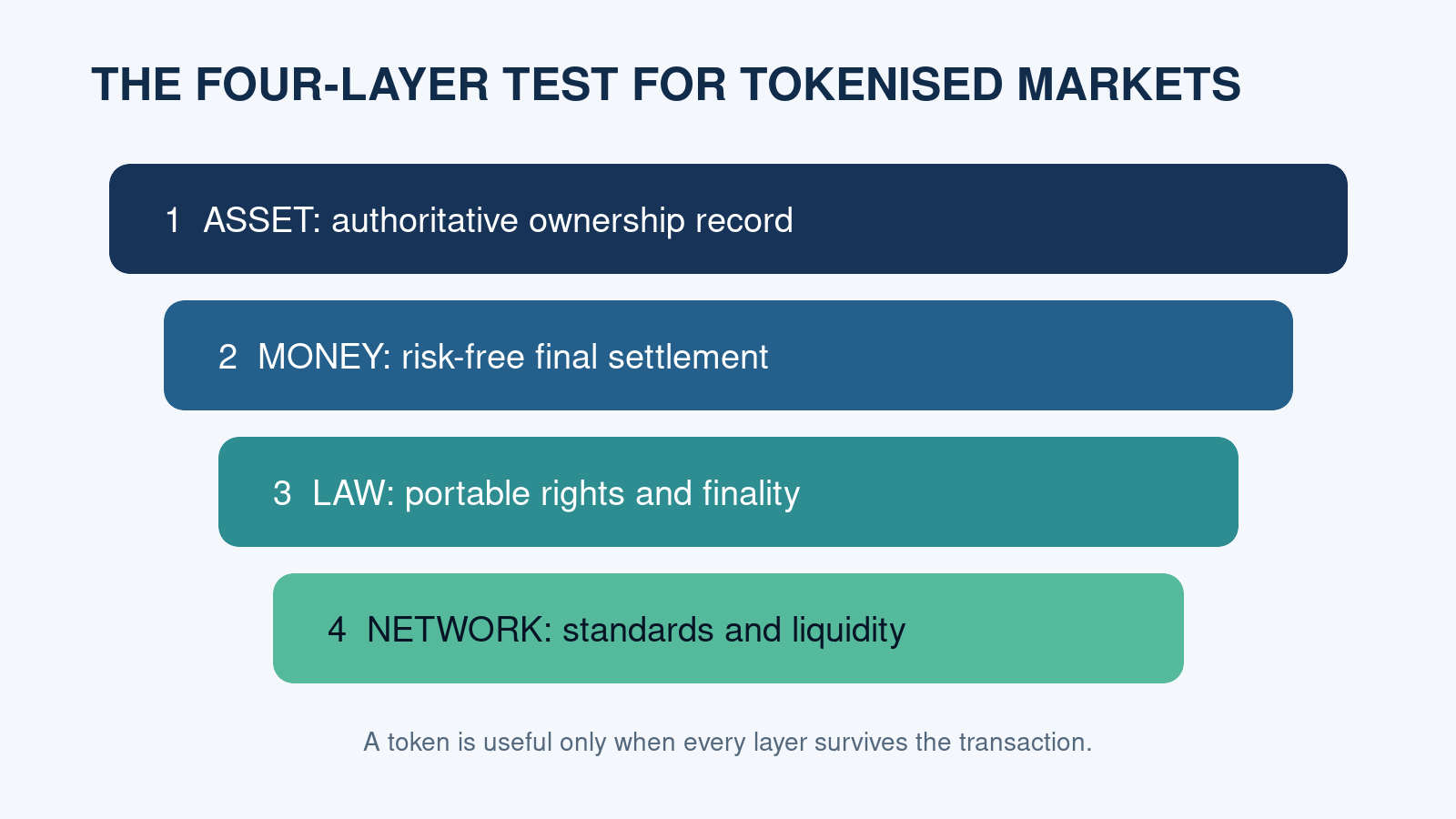
Editorial framework: representation is the first layer; money, law and network effects determine whether a market scales.
The monetary anchor is the strategic choice
The most important design decision is not the use of DLT. It is the choice of money. Central bank money is the common risk-free settlement asset for the regulated financial system: it does not expose participants to the creditworthiness of a commercial issuer when obligations are finally discharged. Pontes seeks to carry that property into transactions initiated on tokenized venues.
This aligns with the BIS’s 2026 Annual Economic Report, which argues that tokenized central bank reserves, commercial bank money, regulated private money and assets could be joined through a unified ledger or interoperable networks. The BIS is critical of treating current stablecoin designs as the monetary system’s foundation, citing weaknesses in singleness, elasticity and integrity. Whatever one thinks of the BIS’s policy preference, the underlying distinction is useful: programmability describes how value moves; it does not determine the quality of the settlement claim.
For Web3, this creates a competitive boundary rather than an automatic defeat for stablecoins. Properly regulated stablecoins may remain valuable for internet-native, cross-border or always-on activity. Tokenized deposits may retain a role in bank-client relationships. Central bank money, meanwhile, can anchor final wholesale settlement. The likely institutional future is plural, with convertibility and interoperability mattering more than a single winning token.
flowchart TB
    CB[Central bank money<br/>final settlement anchor]
    BD[Tokenised commercial bank deposits]
    SC[Regulated stablecoins]
    AS[Tokenised securities and collateral]
    CB <-->|convertibility| BD
    CB <-->|redemption / settlement links| SC
    BD -->|payment leg| AS
    SC -->|selected use cases| AS
    CB -->|Pontes cash leg| AS
    GOV[Law, supervision and common standards] --- CB
    GOV --- BD
    GOV --- SC
    GOV --- AS
This model can be read as a rebuttal to two extremes. One says public blockchains will simply displace incumbent market infrastructure; the other says regulated finance will absorb DLT without changing anything important. Pontes suggests a third path: regulated public infrastructure may connect to multiple programmable venues while retaining control over final settlement. That can preserve institutional trust while allowing asset-side competition.
Why collateral may be the sharper business case
Tokenized securities are often discussed through faster settlement. Yet shortening settlement cycles is not always an unqualified benefit: market makers and investors can lose netting efficiencies and need liquidity earlier. Collateral mobility may offer a clearer economic case. A high-quality asset that can be identified, pledged, substituted and released closer to real time could reduce trapped buffers and improve responses to intraday margin calls.
DTCC’s May 2026 research argues that tokenized representations and near-real-time collateral movement could reduce liquidity buffers and improve capital efficiency, including beyond traditional operating hours. The claim is directionally plausible, but it should not be confused with realized system-wide savings. Benefits depend on legal recognition, common eligibility data, valuation, custody, operational resilience and sufficient counterparties using compatible rails.
Pontes can strengthen this use case because collateral movement is more useful when the associated cash obligations can settle safely. Appia’s work explicitly includes collateral management and monetary-policy implementation. Together, the projects could turn tokenization from a display technology into a balance-sheet tool. The test will be whether institutions retire duplicate processes rather than layering a tokenized workflow on top of legacy reconciliation.
Law and the authoritative record
Europe’s program is also converging with an important U.S. regulatory taxonomy. A January 2026 statement by three SEC divisions distinguishes issuer-sponsored tokenized securities from third-party tokenization. In an issuer-sponsored model, DLT may form part of the issuer’s master securityholder file, so a network transfer changes the authoritative ownership record. Third-party models can instead represent a custodial entitlement, linked security or synthetic exposure; the token holder’s rights depend on that structure.
The statement is staff views, not an SEC rule, and has no legal force. Still, it clarifies why the phrase “on-chain ownership” is insufficient. Investors must know whether the chain is the master record, a synchronized interface to it, or merely evidence of a separate contractual claim. In every jurisdiction, operational finality and legal finality have to agree.
That principle is central to Appia. The ECB’s stated agenda covers ownership rights, settlement finality, liability, custody, asset servicing and enforceability of smart-contract outcomes. Technical interoperability without legal compatibility only moves ambiguity faster. This is why the less glamorous work of harmonization may create more value than another high-throughput chain.
Risks and counterarguments
Fragmentation may persist. A central settlement bridge can connect platforms without ensuring that assets or liquidity are portable among them. Different permissioning models, identity systems, data standards and smart-contract controls can still produce walled gardens. If every venue connects vertically to cash but not horizontally to peers, Europe may gain safe settlement without a unified market.
Adoption may be circular. Issuers wait for investors, investors wait for liquidity, and intermediaries wait for volume before investing in integration. Favorable onboarding prices help only at the margin. The strongest adoption catalyst would be recurring activity—collateral, repo, funds or public debt—whose economics improve materially on the new rails.
Operational coupling creates new failure modes. Atomic settlement reduces principal risk, but synchronized systems can propagate outages or leave transactions pending when one component fails. Cybersecurity, key management, governance changes, recovery, privacy and sanctions controls remain institutional requirements. “On-chain” does not eliminate human accountability.
Public-chain advocates can fairly question openness. A permissioned connection to TARGET Services may preserve incumbent access boundaries and limit composability. That criticism is real. Yet wholesale central bank money is not an ungoverned asset, and regulated institutions require known accountability. The practical question is whether interfaces and standards permit contestability around the settlement core.
Policy ambition may outrun delivered capability. September’s planned launch, extended hours and the 2028 Appia blueprint are separate milestones. Readers should distinguish an announced timetable from production evidence. Volumes, eligible platforms, service reliability and genuine process retirement will provide the meaningful scorecard.
Implications for institutions and Web3 builders
For financial institutions, the strategic unit of analysis should become the end-to-end transaction rather than the token. A credible program should identify the authoritative asset record, settlement money, legal finality, servicing chain and fallback path. It should measure reduced capital or operational burden, not just issuance speed.
For Web3 infrastructure providers, the opportunity lies in making heterogeneous systems safely interoperable: identity, messaging, compliance, proofs, data standards, privacy and lifecycle automation. The winning product may be connective tissue rather than a new base layer. Public networks can still compete where transparency, broad distribution and global availability matter, but institutional integration will require clear governance and enforceable rights.
For policymakers, Pontes creates an empirical laboratory. If central-bank-money access catalyzes issuance and secondary liquidity, it supports the ECB’s architecture. If activity remains thin, the bottleneck lies elsewhere—perhaps law, commercial incentives or market structure. Publishing usage and reliability metrics would make the experiment more informative.
Conclusion
Pontes is important because it tackles the cash side of tokenization, the side that technology narratives often treat as an afterthought. By connecting market DLT platforms to TARGET Services, the Eurosystem is attempting to preserve final settlement in central bank money while allowing programmable asset venues to develop. Appia extends the project from a bridge to a market blueprint.
The result should not be judged by whether Europe has “put finance on-chain.” That slogan hides the hard questions. Success means that assets can move with legally durable rights, payment can settle without private credit risk, collateral can be reused safely, networks can interoperate, and institutions can remove rather than duplicate processes. The bridge matters; what matters more is whether a liquid, resilient and contestable market forms on both sides.
Direct sources
European Central Bank, “From vision to delivery: building Europe’s tokenised financial market,” 26 August 2026
European Central Bank, Pontes service overview and timeline
European Central Bank, Project Agorá findings, 27 May 2026
European Central Bank, “Towards an efficient and integrated digital capital market in Europe,” April 2026
Bank for International Settlements, Annual Economic Report 2026, Chapter III
U.S. Securities and Exchange Commission staff, Statement on Tokenized Securities, 28 January 2026
DTCC, “Tokenized Collateral Could Unlock Billions in Capital,” 13 May 2026