Glamsterdam’s Real Test: Ethereum Rewrites Block Production and the Price of State
Platåberget turns Ethereum’s next upgrade from a roadmap item into a live operational question. Editorial illustration.
Executive summary
Ethereum’s Platåberget testnet is now active, and its significance reaches well beyond a routine pre-fork rehearsal. Launched on 13 August 2026, with the Gloas fork scheduled for epoch 1,536 on 20 August, the network is the first durable, publicly joinable environment devoted to the combined Glamsterdam upgrade. The Ethereum Foundation’s announcement describes it as a place to test and break post-Glamsterdam software for several months before the changes reach Sepolia, Hoodi and, eventually, mainnet. The official network page currently labels the network active.
The upgrade’s headline components are individually ambitious. Enshrined proposer-builder separation, or ePBS, moves the builder market’s core commitment and payment logic into Ethereum consensus. Block-level access lists, or BALs, record which parts of state a block reads and changes, opening a route to more parallel processing. A coordinated gas repricing package aims to support a roughly 200 million gas floor. A separate state-gas mechanism charges explicitly for persistent state creation. Contract and initialization-code ceilings rise substantially.
Taken together, however, these features express a single strategy: Ethereum is trying to increase throughput without pretending that computation, persistent storage and time-critical consensus communication are the same resource. The protocol is decomposing them. Block construction is separated from proposal; consensus validation is separated in time from execution validation; state growth is priced separately from ordinary execution; and access information is made explicit rather than reconstructed after the fact.
That decomposition is the report’s central thesis. Glamsterdam is not simply “more gas.” It is an operating-model reset that moves some risks out of implicit conventions and into protocol rules, while pushing new integration risk into wallets, estimators, indexers, builders and validator software. Institutions should therefore judge readiness by cross-stack behavior—not by a single throughput number or a successful client fork.
Why Platåberget matters now
Ethereum devnets are not normally institutional news. Platåberget is different because its stated audience extends across the production chain. Its validator set is open; test validators and builders can deposit; multiple execution and consensus clients are represented; and the environment is intended to persist until Glamsterdam ships. This makes it an early coordination venue rather than a disposable engineering sandbox.
The timing also matters. The fork has passed its scheduled 20 August activation point, but the sequence toward mainnet remains conditional. The Foundation says a non-finality devnet will follow to exercise pathological consensus scenarios. Only after feedback is incorporated and devnets remain stable are the long-lived Sepolia and Hoodi testnets expected to upgrade. Mainnet comes after those transitions stabilize. No mainnet date is asserted in the announcement or the Glamsterdam meta EIP; treating one as fixed would confuse a testing sequence with a release commitment.
flowchart LR
    A[Platåberget public testnet<br/>active August 2026] --> B[Feedback and client fixes]
    B --> C[Non-finality devnet<br/>pathological scenarios]
    C --> D[Sepolia and Hoodi forks]
    D --> E{Stable across clients<br/>and downstream tooling?}
    E -- No --> B
    E -- Yes --> F[Ethereum mainnet Glamsterdam]
This staged route is not bureaucracy. Glamsterdam changes both layers and the boundary between them. A validator can be correct under a local interpretation yet still fail to interoperate around payload timing, builder payments or fork choice. An application can remain EVM-compatible yet misprice a transfer because it assumes every simple ETH transfer costs exactly 21,000 gas. A data service can parse blocks successfully yet miss state information moved outside the traditional block body. The testnet’s value lies in exposing these mismatches while the economic stakes are artificial.
The first structural change: block building becomes protocol business
Today, most Ethereum proposers outsource execution-payload construction to specialized builders through an external relay-mediated market. The arrangement improved access to competitive block value, but its fair exchange relies on middleware and tight timing. EIP-7732, still explicitly marked “Review,” brings the essential relationship into the protocol.
Under ePBS, a builder commits to an execution payload and a payment. The beacon block contains the signed bid rather than the full payload. The builder reveals the payload afterward. A payload-timeliness committee drawn from validators attests whether the correct payload and blob data arrived on time. Builder balances recorded on the beacon chain enable protocol-enforced payment. Execution validation is deferred: the proposal’s consensus portion can travel on the critical path, while most validators receive more of the slot to check execution and data availability.
sequenceDiagram
    participant B as Staked builder
    participant P as Beacon proposer
    participant C as Consensus network
    participant T as Timeliness committee
    participant V as Validators
    B->>P: Signed payload bid and payment commitment
    P->>C: Beacon block containing the bid
    B->>C: Reveal execution payload and blobs
    T->>C: Attest payload presence and timeliness
    C->>P: Protocol accounts for builder payment
    V->>V: Validate execution with a delayed deadline
The design attacks several bottlenecks at once. Removing the full payload from the beacon block reduces data on the consensus-critical propagation path. Deferring execution validation gives the next proposer and other validators more time than today’s compressed pre-attestation window. Protocol accounting reduces the trusted-middleware role in builder-proposer exchange. These are prerequisites for larger blocks: raising capacity is less useful if validators cannot receive and validate the result without increasing missed attestations or reorganization risk.
But enshrinement is not the same as eliminating market concentration. Specialized builders may retain advantages in order flow, latency and optimization. EIP-7732 itself records unresolved security trade-offs: a rational builder may withhold a payload when profitable, creating empty slots; committee equivocation has deliberately simple treatment; and the fork-choice rule changes substantially because nodes may observe different payload availability. The proposal is under peer review precisely because the protocol will inherit responsibilities previously handled at the edge.
For institutions running validators, the practical exposure expands. Builder deposits, payload availability, new message types and delayed validation become part of operational assurance. Service-level monitoring must distinguish a skipped slot from a beacon block whose committed payload did not arrive. A binary “node is up” metric is no longer an adequate description of block-production health.
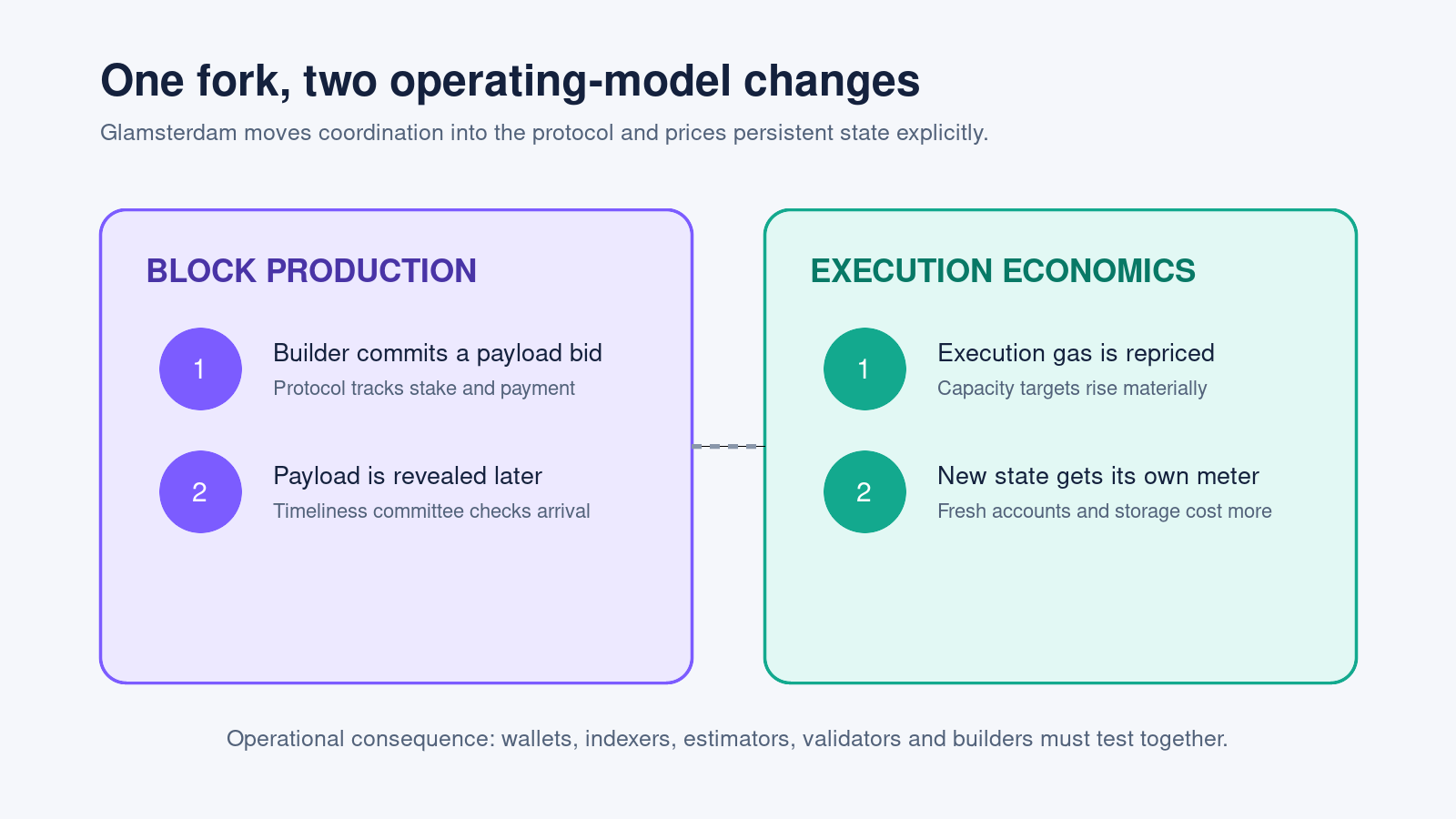
Glamsterdam couples consensus-path reform with a more explicit model of execution and state costs. Editorial illustration.
The second structural change: capacity without a state subsidy
The execution-layer package is easy to summarize badly. Saying Ethereum is preparing for a 200 million gas floor implies that the current gas schedule can simply be multiplied upward. The actual logic is the opposite: operations are repriced so that the gas limit better represents safe resource consumption, while persistent state receives dedicated protection.
EIP-8007 is the coordination document for the repricing bundle. It groups changes affecting opcode costs, transaction intrinsic costs, state access, precompiles, logs, calldata, contract size and state creation. The number is a target enabled by a bundle, not a promise that every workload scales linearly or that fees fall by the same proportion.
The most consequential application-level change is EIP-8037. It meters operations that create durable state at a fixed cost per state byte, charged at runtime. Creating an account, deploying code or writing a previously untouched storage slot can consume this state gas. The Foundation highlights an intentionally disruptive example: sending ETH to an existing account remains a 21,000-gas transaction under the decomposed schedule, while sending to a previously nonexistent account additionally pays for new-account state. “A transfer costs 21,000” stops being a universal truth.
That distinction matters because state is a long-lived obligation. Computation ends with the transaction; persistent state must be stored, synchronized and accessed by future nodes. A larger aggregate gas limit without better state pricing could turn short-term transaction capacity into long-term hardware pressure and centralization. Glamsterdam’s answer is to admit two constraints: Ethereum can process more per block, but creation of durable shared state must remain scarce enough to defend node accessibility.
EIP-7928 complements that model by introducing block-level access lists. BALs describe accounts and storage locations accessed in the block, including post-execution changes, and are exchanged separately from the traditional block body. Explicit access information can help clients parallelize disk reads, prefetch state and execute transactions with better knowledge of dependencies. Yet it also adds a new consensus-critical artifact that networking, storage, RPC and indexing systems must transport and interpret consistently.
EIP-7954 increases maximum deployed contract size from 24 KiB to 64 KiB and maximum initialization code from 48 KiB to 128 KiB. This relaxes a visible developer constraint, but it should not be read as free complexity. Larger contracts increase code-state footprint and may alter deployment, verification and analysis workloads. The broader repricing package is what makes the increased ceiling defensible.
Change | Intended gain | New operational question |
|---|---|---|
ePBS | Trust-reduced builder-proposer exchange; more validation time | Can builders, validators and monitoring agree on payload availability and payment state? |
Block-level access lists | Prefetching and parallel execution opportunities | Can clients and data systems transport and verify the new artifact reliably? |
Gas repricing | A gas limit closer to actual safe resource use | Which applications and tools embed obsolete ceilings or opcode-cost assumptions? |
State gas | Explicit protection against durable state growth | Do wallets and estimators detect state-creating transfers and calls? |
Larger contract limits | More room for complex applications | Can deployment, verification and security tooling handle the larger objects? |
The downstream blast radius
The Foundation’s unusually direct warning deserves attention: any tool that relies on a hard-capped maximum gas limit will break. Wallets, indexers and gas estimators are named explicitly. This is not limited to software that submits huge transactions. Fixed caps often hide in validation rules, database column choices, simulation timeouts, dashboards, fee heuristics, fraud controls and third-party API contracts.
The new state dimension makes estimation path-dependent. Two visually identical transfers may have different resource requirements depending on whether the recipient already exists. A contract call’s cost can depend on whether a storage slot is fresh. Estimators must simulate the relevant pre-state rather than apply a familiar constant. Account-abstraction bundlers, custody policy engines and batch-payment systems deserve particular scrutiny because an under-estimate can fail an entire bundle or operational batch.
Indexers face a different challenge. BALs are stored separately from the block body and propagated through a newer execution peer protocol. A system that treats the legacy block body as the complete record may remain online while becoming semantically incomplete. Data vendors should state whether their products expose access-list and state-change information, how they handle reorgs when payload validation is delayed, and what consistency guarantee applies between consensus and execution views.
For validators and builders, testing must include degraded paths rather than only successful blocks: late reveal, missing payload, inconsistent payload views, builder balance exhaustion, client restart near a fork boundary and loss of access-list data. Platåberget’s forthcoming non-finality environment is especially relevant because ordinary uptime tests do not approximate adversarial fork-choice conditions.
Counterarguments and unresolved risks
The strongest counterargument is complexity. Ethereum is combining a new block-production regime with a broad execution repricing and new data structures. Each component may be justified in isolation, but their interactions enlarge the testing surface. A simpler fork could reduce coordination risk. The response is that capacity itself creates coupled problems: larger blocks tighten timing, increase state pressure and magnify builder specialization. Addressing only the gas limit would defer rather than remove those constraints.
A second objection is that ePBS could ossify today’s builder market. Protocol recognition can legitimize specialized builders and raise the cost of later redesign. EIP-7732 permits self-building, but formal neutrality does not guarantee economic competitiveness. Metrics should therefore track builder participation and payload concentration, not merely successful protocol operation.
Third, explicit state pricing may produce user-facing unpredictability. A new recipient costing more than an existing one is rational at the resource layer but unfamiliar at the product layer. Wallets that fail to explain or buffer the difference will turn sound economics into failed transfers and support incidents. Better protocol accounting does not automatically create better user experience.
Finally, all material specifications remain subject to change. The meta EIP is the authoritative inclusion tracker, and component EIPs can remain in review even while implementations are exercised. Platåberget proves that code paths can be run in public; it does not prove economic safety, eliminate client bugs or guarantee mainnet inclusion on a particular date.
Institutional implications
The appropriate response is not to forecast a fee number. It is to revise assurance boundaries. Asset managers and treasuries should ask custodians how transaction simulation handles new-account and fresh-storage costs. Exchanges should test withdrawal batches to new and existing addresses. RPC and data purchasers should demand explicit Glamsterdam compatibility statements. Validator operators should extend incident taxonomy to builder and payload states. Smart-contract teams should retest deployment, verification and gas-budget guardrails.
Governance and risk committees should also separate three milestones: specification selection, public-testnet interoperability, and production readiness. A feature’s presence in Platåberget is evidence of engineering maturity, but not a mainnet guarantee. Conversely, waiting for a mainnet date before testing is risky because the announced sequence exists to surface downstream assumptions early.
Conclusion
Platåberget makes Ethereum’s scaling strategy unusually legible. Glamsterdam does not pursue throughput by treating the gas limit as a volume knob. It restructures who commits a block, when execution is validated, how state dependencies are disclosed and what persistent state costs. The reward could be materially higher capacity with a healthier consensus path and more honest resource accounting.
The price is a wider definition of readiness. A clean fork by execution and consensus clients is necessary but insufficient. Wallets must estimate a state-sensitive transaction; indexers must ingest new artifacts; builders and validators must coordinate under delayed payload validation; monitoring must describe partial failure states. The institutions that recognize this as a system transition—and test across organizational as well as software boundaries—will be better prepared than those waiting for a headline mainnet date.
Direct sources
Research cut-off: 25 August 2026, UTC. Testnet status and specifications can change; readers should consult the linked trackers before making production decisions.