Platåberget Is Ethereum’s Dress Rehearsal for a Wider Execution Frontier
Platåberget turns an abstract roadmap into a public, breakable system. Editorial illustration, 24 August 2026.
Report date: 24 August 2026
Executive summary
Ethereum’s Platåberget testnet crossed its scheduled Glamsterdam fork on 20 August. That event is more important than a routine test-network milestone. Platåberget is intended to remain available for months, is open to public validators and builders, and sits between short-lived development networks and the eventual upgrades of Sepolia, Hoodi and mainnet. It is therefore the first durable proving ground where the wider ecosystem can confront Glamsterdam as an integrated operating environment rather than a list of Ethereum Improvement Proposals.
The central thesis of this report is that Glamsterdam should not be evaluated as a simple “more gas” upgrade. It is a coordinated redesign of three constraints that have limited Ethereum layer-one scaling. Enshrined proposer-builder separation (ePBS) changes the coordination and trust model of block production. Block-level access lists (BALs) make execution dependencies and resulting state changes explicit, creating the substrate for parallel reads, validation and state reconstruction. A bundle of gas repricings seeks to align the cost of permanent state with its long-run hardware burden. Capacity is the intended outcome; institutionalized coordination, visible state dependencies and more truthful resource accounting are the mechanism.
This distinction matters to investors, application operators and infrastructure providers. A higher headline gas limit is useful only if nodes can propagate, verify and store the resulting workload without sacrificing resilience or home operation. Glamsterdam’s design attacks those bottlenecks together. But integration is also the risk: ePBS introduces consensus complexity, BALs add data and validation overhead, and repricing deliberately breaks old assumptions embedded in wallets, indexers and estimators. Platåberget’s editorial significance is precisely that it moves these trade-offs from specifications into observable failure modes.
From devnet to public proving ground
The Ethereum Foundation announced Platåberget on 17 August and scheduled its Glamsterdam fork for 20 August. Unlike earlier, short-lived devnets, it says this network will run for a few months, allowing the community to experiment before the upgrade reaches long-lived testnets. Its validator set is deliberately small but publicly joinable; participants can test both validator and builder deposit workflows. That makes the network a bridge between client-team interoperability work and downstream operational readiness (Ethereum Foundation announcement).
The sequence is important. The Foundation describes a non-finality devnet, designed to probe pathological consensus scenarios, as the next step after feedback is incorporated. Only after stability on these environments would Sepolia and Hoodi fork, followed by mainnet. Ethereum.org currently describes Glamsterdam as planned for Q4 2026, but no mainnet date should be treated as fixed: the process is explicitly gated by feedback, client releases, security review and stable testnet operation (Glamsterdam overview).
flowchart LR
    A[Short-lived Glamsterdam devnets] --> B[Platåberget public testnet]
    B --> C[Feedback and client fixes]
    C --> D[Non-finality stress devnet]
    D --> E[Sepolia and Hoodi forks]
    E --> F{Stable across clients?}
    F -- No --> C
    F -- Yes --> G[Mainnet fork decision]
This is not ceremony. In April, the Foundation’s Protocol Support team called ePBS implementation “trickier than anticipated” because all parts of the stack must reason about partial blocks and coordination between two parties. It described BALs as a fundamental rethinking of gas and state access, not a marginal optimization. The checkpoint also made the decision rule clear: stabilize a complete devnet, cut client releases, perform final security reviews, move through testnets and only then announce mainnet timing (Protocol Checkpoint #9). Platåberget is evidence of progress along that path, not proof that the path is complete.
Constraint one: bringing the builder market inside the protocol
Today, many validators outsource block construction through an off-protocol supply chain involving builders and relays. This arrangement has enabled a competitive block-building market, but the fair exchange between a proposer and a builder is not enforced by Ethereum consensus. Middleware conveys bids and payloads; operational trust and timing assumptions sit outside the base protocol.
EIP-7732’s ePBS makes that hand-off a protocol concern. In broad terms, the proposer selects a builder commitment for the consensus block, the builder later reveals the execution payload, and a payload-timeliness committee attests to whether the payload and blob data arrived. Builder payments are handled through consensus rules. The EIP’s stated objective is fair exchange: an honest proposer should receive the builder payment, while an honest builder’s payload should become canonical regardless of unilateral misbehavior by the other party (EIP-7732).
The scaling benefit comes from separating deadlines. Under the current design, validators face a tight critical path in which consensus transition, execution validation and data-availability work compete before attestation. Ethereum.org says ePBS can expand the payload propagation window from roughly two seconds to about nine seconds by separating consensus and execution validation. A larger window can safely accommodate larger payloads and more blob data without simply asking every node to move faster.
sequenceDiagram
    participant P as Beacon proposer
    participant B as Registered builder
    participant N as Network validators
    participant T as Payload timeliness committee
    P->>B: Select committed bid
    P->>N: Publish consensus block and commitment
    N-->>N: Validate consensus path
    B->>N: Reveal execution payload and blob data
    T->>N: Attest payload presence and availability
    N-->>N: Resolve payload status and fork choice
    Note over P,B: Protocol rules mediate payload-for-payment exchange
Enshrining does not make the builder market automatically decentralized, nor does it outlaw relays. Ethereum.org explicitly notes that parties may still use middleware for features not captured by the base protocol. What changes is the minimum trust boundary. The chain itself can enforce the essential payload-for-payment exchange, reducing reliance on a small set of relay operators for correctness. For staking pools, distributed-validator systems and solo operators, however, this also means architectural work: builder monitoring, new failure states and “partial block” logic become consensus-facing responsibilities.
Constraint two: turning hidden execution dependencies into a map
Ethereum transaction execution is difficult to parallelize because a node does not necessarily know which accounts and storage locations a transaction will touch until it runs. Two transactions may be independent, or one may depend on state changed by the other. Without a reliable dependency map, speculative parallelism risks conflicts and wasted computation.
EIP-7928 introduces a block-level access list recording accounts and storage locations accessed during execution together with post-execution values. The block header commits to the list with a hash, while the access-list data is stored separately from the block body. The proposal identifies four benefits: parallel disk reads, parallel transaction validation, parallel state-root computation and state reconstruction without re-executing transactions (EIP-7928). A companion networking change, EIP-8159, enables execution clients to exchange these lists over the eth/71 protocol (EIP-8159).
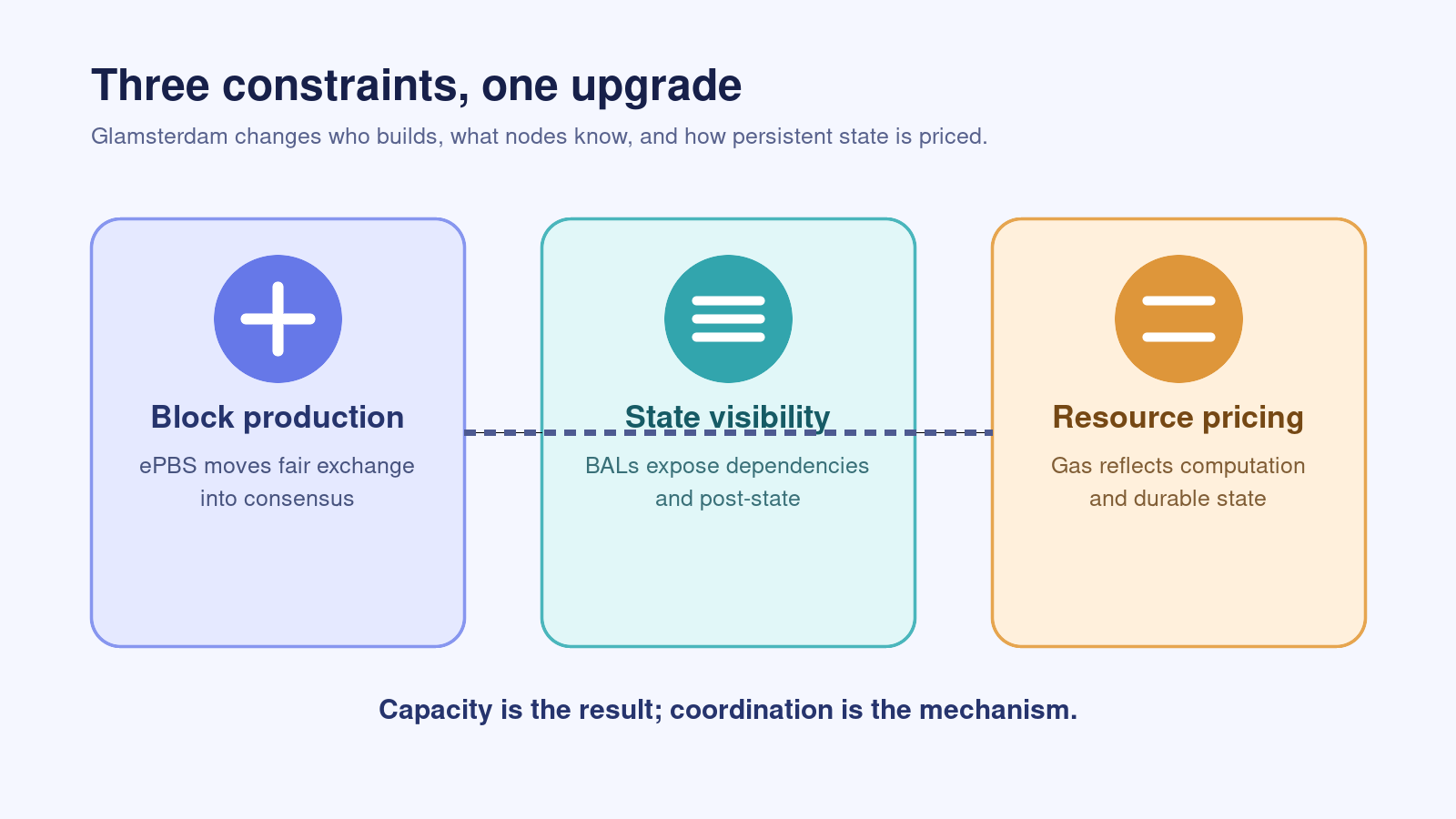
Glamsterdam’s three levers are complementary: more capacity is credible only when propagation, validation and storage are addressed together.
BALs are sometimes summarized as “parallel execution,” but that overstates the immediate promise. Their clearest near-term benefit is visibility: clients can prefetch relevant state, separate non-conflicting work and reconstruct post-state from authenticated outputs. Different clients will still need to implement safe scheduling and prove performance under adversarial blocks. The access list itself also consumes bandwidth and must be validated. Glamsterdam creates the data structure and exchange layer that make parallelism practical; it does not guarantee an identical throughput multiplier across hardware, workloads or clients.
For institutions operating nodes, this distinction is useful. Executionless state update can reduce the need to replay every transaction during certain synchronization paths, potentially lowering recovery time and operational friction. Yet an authenticated result is not the same as blind trust: nodes still verify commitments and protocol rules. The architecture shifts work; it does not abolish verification.
Constraint three: charging for the database, not only the computation
If Ethereum increases block capacity without repricing state creation, it can accelerate growth of the database every full node must maintain. Glamsterdam’s gas package therefore treats sustainable capacity as an economic problem as well as a performance problem. Ethereum.org describes EIP-8037 as pricing new state by byte and targeting a predictable 120 GiB annual state-growth rate. It separates state-related charges into a dedicated reservoir, allowing computation and durable storage to be accounted for differently (EIP-8037).
The public testnet announcement gives a concrete downstream consequence. A transfer to an existing account still totals 21,000 gas under the decomposed pricing, but sending to an account that does not yet exist incurs additional state gas. Any wallet or estimator that treats 21,000 as universally sufficient is therefore wrong in the proposed environment. Likewise, tooling that hardcodes a maximum block gas limit will break as the repricing bundle aims toward an approximately 200 million gas floor. These are not obscure client internals; they touch user interfaces, exchange withdrawal systems, accounting pipelines and transaction-simulation services.
The policy logic is defensible. Permanent state imposes a recurring storage and database-access burden on all validating nodes, while a computation is transient. Pricing both through one undifferentiated limit obscures that asymmetry. Separate accounting can support larger contracts and higher aggregate capacity without making cheap state creation an unlimited subsidy. But repricing also redistributes costs. State-heavy applications may pay more even if average transaction fees decline as capacity expands. “Scaling” should therefore not be interpreted as every operation becoming cheaper.
Design lever | Bottleneck addressed | Intended benefit | Principal risk to test |
|---|---|---|---|
ePBS (EIP-7732) | Tight propagation path and relay trust | Longer payload window; protocol-enforced exchange | Consensus complexity, builder failure, pool architecture |
BALs (EIP-7928) | Unknown state dependencies | Parallel reads/validation and faster state update | List overhead, adversarial construction, client divergence |
Gas repricing (including EIP-8037) | Underpriced permanent state | Sustainable higher capacity | Broken estimates and higher cost for state-heavy activity |
Larger code limits | Application size constraints | Deployed code up to 64 KiB; initcode up to 128 KiB | Heavier validation and tooling assumptions |
Why the integrated package matters
The three pillars form a dependency chain. ePBS creates more time to disseminate a larger execution payload. BALs give clients a machine-readable view of the state touched by that payload. Repricing limits the durable database burden created when that extra capacity is consumed. Removing only one bottleneck would push pressure into another: a larger block that misses its deadline is not capacity; parallel execution that creates unbounded state is not sustainable; accurate storage pricing without better propagation and validation does not materially widen throughput.
That integrated logic is also why Platåberget is editorially important. Specifications can be reviewed in isolation, but production systems fail at boundaries. A wallet may estimate execution correctly yet misunderstand the state-gas dimension. A staking pool may support the new builder API but mishandle a missing payload. An indexer may accept larger blocks but retain a hardcoded ceiling. A durable public testnet expands the set of observers capable of finding these boundary failures before mainnet value is at risk.
For ETH holders, the upgrade requires no token conversion; claims that users must “upgrade” their ETH are scams, as Ethereum.org warns. The relevant exposure is operational and economic rather than custodial. Infrastructure providers face upgrade and testing costs. Applications must reassess fee assumptions. Node operators may eventually benefit from more efficient synchronization and higher network capacity, but they also inherit new data structures and consensus paths.
Risks, counterarguments and evidence still missing
First, complexity is itself a decentralization cost. ePBS removes a mandatory correctness dependency on trusted relays, but adds builder registration, payment and payload-timeliness machinery to consensus. If implementation or monitoring burdens disproportionately favor sophisticated operators, the protocol can reduce one form of intermediation while reinforcing another at the market layer.
Second, headline capacity targets are not measured outcomes. The Foundation says the repricing bundle is aimed at an approximately 200 million gas floor, while Ethereum.org notes testing at a 150 million reference limit to derive state pricing. Neither figure is a promise of sustained mainnet throughput. Client performance, state-growth measurements, bandwidth tails, reorganization behavior and heterogeneous consumer hardware remain the relevant evidence.
Third, BALs exchange execution for data availability and verification work. Malicious or worst-case access lists may stress decoding, commitment checks, storage and network propagation. The safe throughput gain depends on client implementations and workload independence; heavily contended applications will not parallelize like unrelated transfers.
Finally, the calendar remains conditional. A Q4 2026 plan is a target, not a guaranteed date. The explicit path through feedback, a non-finality devnet, Sepolia and Hoodi gives the process credibility precisely because it allows delay. Readers should treat discovered failures and schedule movement as the testing regime working, not automatically as evidence that the design has failed.
Conclusion
Platåberget marks the point at which Glamsterdam becomes an ecosystem obligation rather than a core-developer project. The testnet’s value is not that it confirms Ethereum can safely run at a much higher gas limit; that conclusion would be premature. Its value is that it exposes the interconnected assumptions that must hold before such a limit is credible.
The upgrade’s deeper design is coherent. Put the essential proposer-builder exchange into protocol rules, make block-wide state dependencies explicit, and charge durable state according to its long-run burden. Together those changes seek to widen Ethereum’s execution frontier without converting higher throughput into missed deadlines, opaque validation or uncontrolled database growth. The next evidence to watch is operational: multi-client stability on Platåberget, results from pathological non-finality tests, downstream wallet and indexer readiness, and clean forks on Sepolia and Hoodi. Mainnet timing is the last decision in that chain, not the first.