Stablecoins’ Audit Moment: Why Safe Reserves Are Only the First Line of Defense
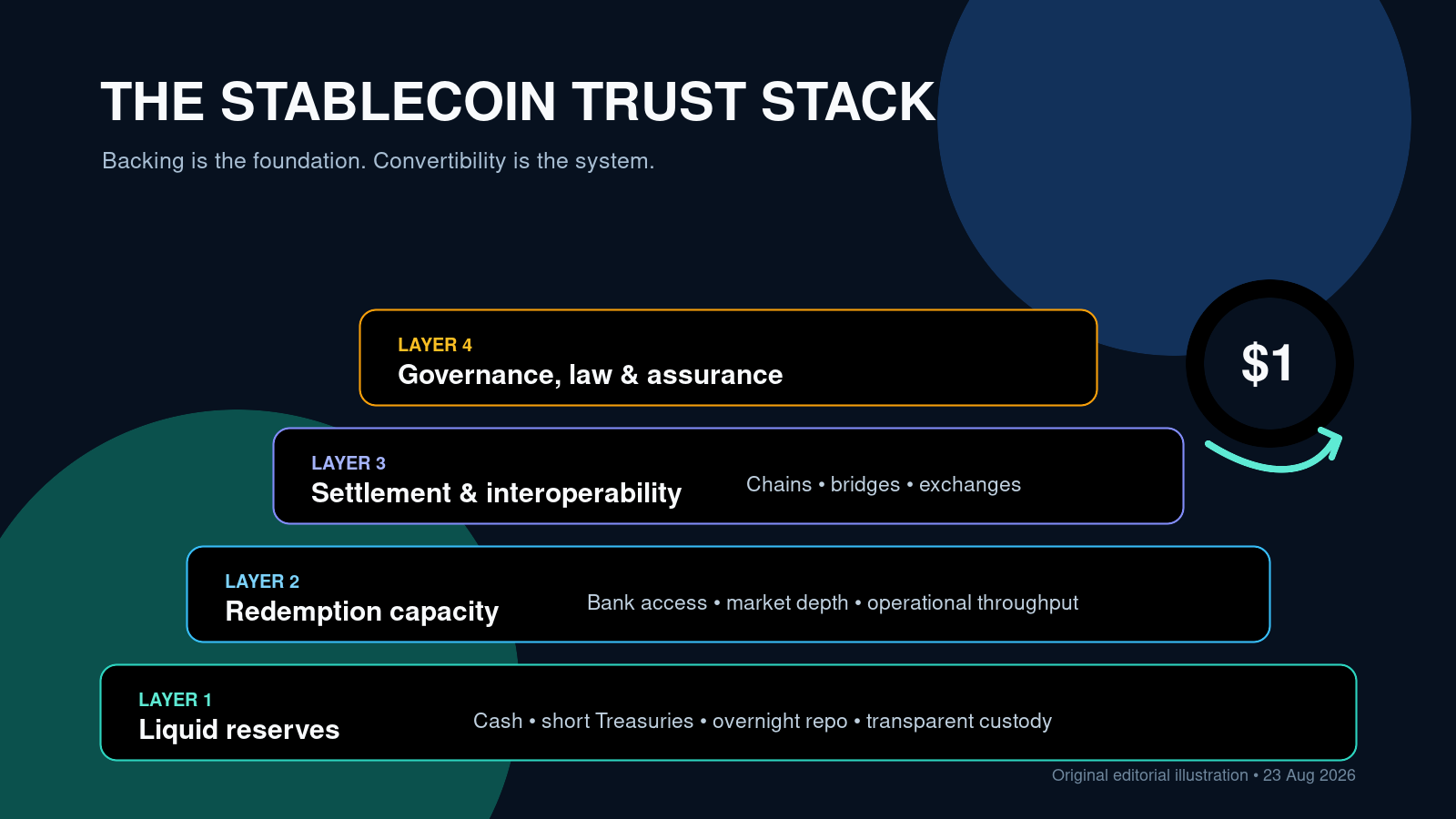
A stablecoin’s promise is delivered by a stack: assets, redemption capacity, settlement rails and enforceable governance. Original editorial illustration.
Executive summary
Stablecoins have crossed a threshold at which the central institutional question is no longer whether they matter, but what kind of money-like infrastructure they are becoming. Data providers using different inclusion rules placed the market around $300 billion in early August 2026: DeFiLlama’s broad, market-price-based series was reported at $312 billion on 2 August, while RWA.xyz’s narrower register was $297.88 billion on the same date. The gap is itself instructive. Even the headline size depends on which assets, wrappers and networks count.
Two issuer disclosures sharpen the point. Tether said USD₮ in circulation reached approximately $184.6 billion at 30 June, alongside a $4.11 billion reserve buffer, in its Q2 2026 attestation announcement. On 13 August it announced that KPMG had issued an unqualified opinion on Tether International’s 2025 financial statements—the company’s first full financial-statement audit. Circle, meanwhile, reported USDC circulation of $72.7 billion as of 20 August on its transparency page, after saying quarter-end circulation was $73.3 billion and Q2 on-chain transaction volume was $14.8 trillion in its second-quarter results.
These are meaningful advances in scale and disclosure. They do not, however, settle the harder issue: a token can be fully backed by high-quality assets and still face a run if redemption access, network capacity or secondary-market liquidity becomes congested. A June 2026 Federal Reserve staff paper formalizes precisely this possibility, showing that “perfectly safe” reserves do not preclude self-reinforcing redemptions when network value and congestion costs interact. The BIS arrives from another direction, arguing that current stablecoin designs still struggle with singleness of money, elastic liquidity and financial integrity in its 2026 Annual Economic Report.
The thesis of this report is therefore simple: reserve quality is the foundation of stablecoin trust, not the finished structure. For institutional users, the next due-diligence standard must test the entire conversion path—from the token holder to the issuer, banking partners, reserve assets, blockchain and eventual central-bank money. Audit quality matters enormously, but the relevant unit of analysis is the redemption system.
From proof of assets to proof of convertibility
The industry’s first disclosure battle concerned existence: are the assets really there? Tether’s announced 2025 audit is significant because an audit of financial statements is broader than a point-in-time reserve attestation. According to Tether, KPMG examined transactions, systems, ownership records, valuations, counterparties and supporting evidence, and reported reserves exceeding liabilities by $6.814 billion at 31 December 2025. The company also said the auditor physically inspected its gold bars. Those claims mark a material step up in assurance from issuer self-reporting.
The distinction should still be kept precise. An unqualified audit opinion means the auditor concluded that the historical financial statements were fairly presented, in all material respects, under the applicable accounting framework. It is not a permanent guarantee of solvency, a forecast of market liquidity or a promise that every holder can redeem directly at every hour. Tether’s public announcement is also not a substitute for an investor reading the signed audit and full financial statements where available. Institutional policy should treat audit, attestation, live reserve disclosure and redemption testing as complementary—not interchangeable—controls.
Circle’s model provides a different disclosure cadence. Its transparency materials say reserve holdings are disclosed weekly and a Big Four firm provides monthly assurance that reserve value exceeds USDC in circulation. They describe reserves as cash, short-dated US Treasuries and overnight Treasury repo, held separately from operating funds, with some assets in the BlackRock-managed Circle Reserve Fund. This structure gives analysts more frequent visibility, but frequency does not eliminate the need to inspect eligible redemption customers, transfer cutoffs, banking concentration and fund-liquidity mechanics.
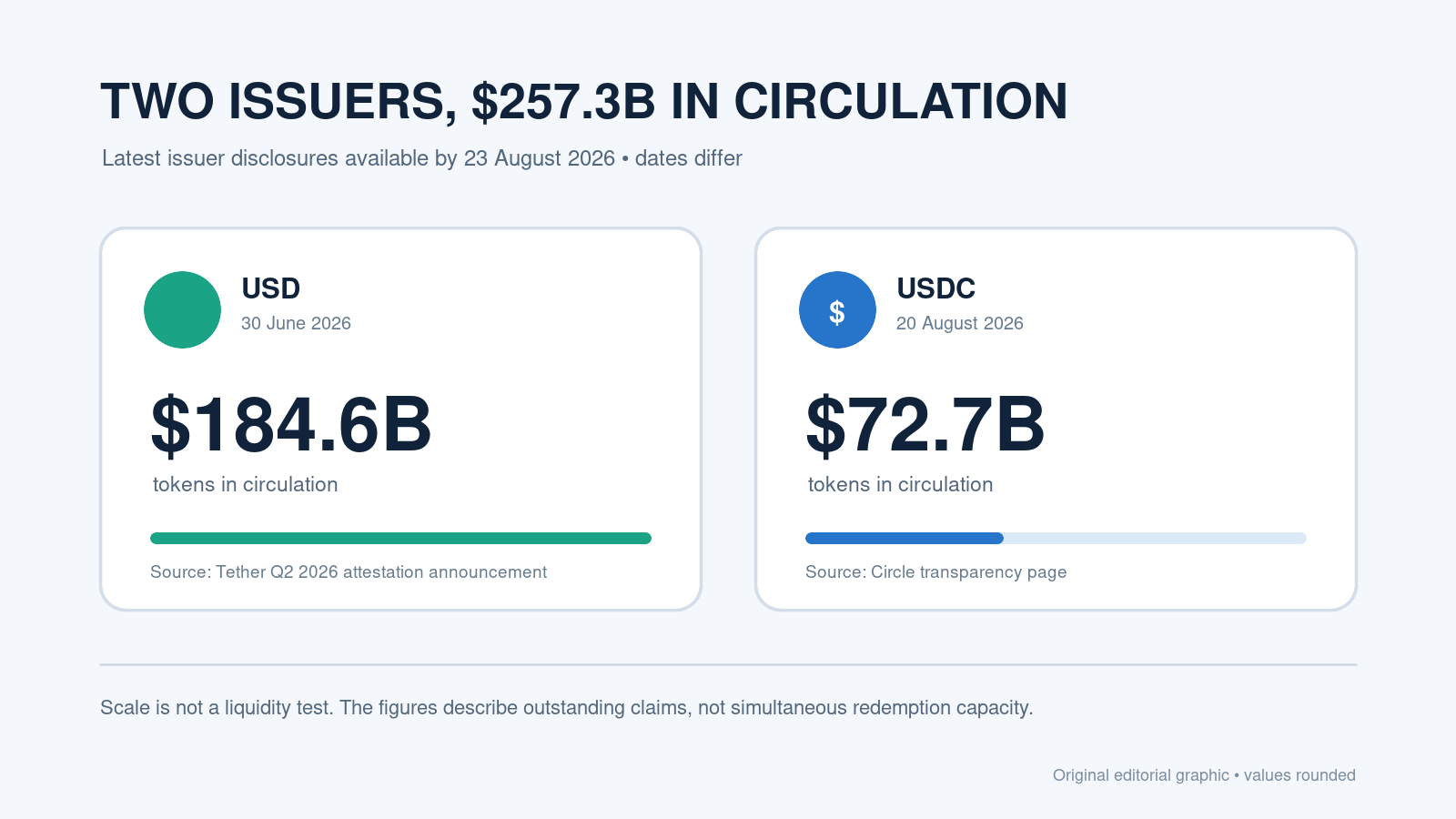
Two dominant issuers represented $257.3 billion of disclosed circulation at their respective latest dates. The dates differ, and outstanding supply is not the same as immediate redemption capacity.
The two snapshots sum to $257.3 billion, but that arithmetic should not be mistaken for a synchronized market measurement. Tether’s figure is dated 30 June and Circle’s 20 August. Nor should market capitalization be read as cash sitting idle in one bank account. Stablecoin reserves are portfolios; their ability to honor redemptions depends on maturity, custody, settlement timing, market depth and operational access.
flowchart LR
    A[Token holder requests exit] --> B{Direct issuer access?}
    B -->|Yes| C[Issuer verifies and burns tokens]
    B -->|No| D[Sell through exchange or dealer]
    C --> E[Cash, repo or Treasury liquidity]
    E --> F[Banking and payment rails]
    F --> G[Fiat received at par]
    D --> H[Secondary-market liquidity]
    H --> I{Price near $1?}
    I -->|Yes| G
    I -->|No| J[Discount, arbitrage demand or loss]
    K[Chain congestion / bridge failure] -. can delay .-> C
    K -. can impair .-> H
This map explains why the holder experience can diverge from the issuer’s balance sheet. Many retail or offshore holders do not have a contractual or operational path to mint and redeem with the issuer. Their “redemption” is a sale on an exchange, through a dealer or into a decentralized liquidity pool. In calm markets, arbitrage keeps that price close to one dollar. Under stress, the cost and speed of moving tokens, the willingness of market makers to warehouse risk and access to issuer redemption all determine whether the peg closes quickly.
The new evidence: sound collateral can still run
The Federal Reserve staff paper, The Fragility of Perfectly Safe Digital Money, is important because it separates reserve credit quality from coordination risk. Its model combines two forces. Network effects make a digital money more valuable when more people use it; congestion-sensitive transaction fees make exit more expensive when many people try to move simultaneously. If users expect others to redeem, they may rationally leave early to avoid a thinner future network or higher future costs. That strategic complementarity can generate a run even when backing assets are safe.
This is not a prediction that a particular stablecoin will fail. The paper is theoretical, and the Federal Reserve explicitly notes that staff research does not represent Board consensus. But it corrects a common category error. “Fully backed” addresses the asset side of the issuer’s balance sheet. It does not prove that token holders possess equal, instantaneous and costless access to those assets. A reserve can be solvent on a mark-to-market basis while the conversion channel is temporarily illiquid or operationally unavailable.
The BIS adds a system-level critique. Its 2026 report defines singleness as the ability of different monetary claims denominated in the same unit to exchange at par with central-bank money, with finality, in all relevant states. Stablecoins trade across issuers and chains, and the same brand of token on Ethereum is not natively the same ledger object as its version on Solana. Bridges and market makers can create practical interoperability, but they add counterparties, code dependencies and liquidity pools. In the BIS framing, fragmentation makes stablecoins resemble tradable claims whose price can deviate from net asset value rather than uniform money accepted “no questions asked.”
The report’s second test, elasticity, is equally relevant. Fully reserved stablecoins generally issue against prefunded assets. That discipline protects against unbacked expansion, but it also means the system cannot create settlement liquidity on demand in the way a central bank supplies intraday balances to a supervised banking system. The trade-off is structural: rigid backing improves asset certainty, while elastic liquidity supports payments during abrupt demand shifts. Regulation can narrow the gap, but it cannot make the trade-off disappear by changing terminology.
sequenceDiagram
    participant H as Holders
    participant M as Markets / chains
    participant I as Issuer
    participant R as Reserve portfolio
    participant B as Banks / central-bank money
    H->>M: Broad adoption increases usefulness
    Note over H,M: Calm state: arbitrage anchors price near $1
    H->>M: Shock triggers simultaneous selling
    M-->>H: Fees rise and liquidity thins
    M->>I: Authorized customers submit redemptions
    I->>R: Raise cash or unwind repo/Treasuries
    R->>B: Settle reserve assets
    B-->>I: Fiat liquidity arrives
    I-->>H: Fiat reaches eligible redeemers
    Note over H,B: Any bottleneck can widen the secondary-market discount
Regulation is moving from permission to plumbing
The United States’ GENIUS Act established a federal framework for payment stablecoins in July 2025. A March 2026 Federal Reserve note summarizes its core reserve logic: authorized issuers must use relatively safe assets such as insured depository balances, short-term Treasuries and, where permitted, balances at a Federal Reserve Bank; issuers cannot pay interest directly, although indirect rewards are not categorically ruled out. Treasury’s 2025 advance notice of proposed rulemaking emphasized consumer protection, illicit-finance controls and financial stability.
By August 2026, implementation—not legislative symbolism—is the key variable. A U.S.–UK regulatory working-group statement confirmed continuing work on GENIUS Act implementation and stablecoin regimes. In June, U.S. agencies also proposed customer-identification requirements for supervised payment-stablecoin issuers. Governor Michael Barr supported the proposal but warned that secondary-market activity could still allow bad actors to evade controls, according to his official statement.
That debate reveals the next policy frontier. Licensing an issuer and prescribing eligible reserves deal with the center of the network. Stablecoins, however, acquire reach through exchanges, wallets, brokers, decentralized protocols and cross-chain infrastructure at the edge. Rules that are strict at issuance but porous in distribution may preserve reserve quality without fully addressing integrity or run transmission. Conversely, controls applied indiscriminately to every wallet can impair privacy, access and permissionless innovation. The policy problem is not choosing “regulation” or “innovation”; it is defining responsibility at each conversion point.
What institutional allocators and treasurers should measure
The evidence suggests a four-layer scorecard.
Layer | Core question | Evidence that matters | Typical blind spot |
|---|---|---|---|
Reserves | Are assets sufficient and loss-absorbing? | Audited statements, attestations, asset mix, maturity and custody | Treating all “cash equivalents” as identical |
Redemption | Can claims convert at scale and on time? | Eligibility, minimums, cutoffs, tested throughput, banking concentration | Assuming every token holder can redeem directly |
Market and network | Can holders reach the exit? | Exchange depth, chain fees, bridge dependencies, native issuance | Measuring normal-day liquidity only |
Governance and law | Who owes what to whom? | Issuer terms, segregation, insolvency treatment, supervision, freeze powers | Confusing a token transfer with final fiat settlement |
This framework changes procurement and risk management. Treasury teams should not select a stablecoin solely by market capitalization or reserve yield. They should map which legal entity issues the token on the specific chain they use; whether the token is native or bridged; which account has redemption rights; how fiat arrives; and what happens outside banking hours. They should monitor both issuer-level and venue-level concentration. A stable issuer does not make an unstable bridge safe, and a deep exchange order book does not cure weak legal claims on reserves.
Stress testing should also distinguish solvency from access. One scenario might assume Treasury prices remain stable but a major chain becomes congested. Another might keep chains functioning while a banking partner pauses transfers. A third might model several exchanges de-risking simultaneously, forcing price discovery into thinner venues. The purpose is not to predict the exact crisis. It is to identify the bottleneck that becomes binding first.
Counterarguments and limits
There is a strong countercase. Stablecoins have operated through weekends, banking failures and crypto-market drawdowns, often providing dollar access where conventional correspondent banking is slow or unavailable. Circle’s reported $14.8 trillion of Q2 on-chain volume—though transaction volume is not equivalent to economic payment value—shows that these networks are not merely speculative prototypes. Tether’s move from quarterly attestations to an announced full audit reduces a long-standing information gap. Better assets, clearer rules and more professional reserve management should reduce both the probability and severity of failures.
Moreover, the BIS benchmark is demanding. Commercial bank deposits themselves rely on supervision, deposit insurance, central-bank liquidity and resolution frameworks; they are not intrinsically riskless. Stablecoins may not need to replace the two-tier monetary system to be useful. They can remain a complementary instrument for cross-border settlement, exchange collateral, programmable commerce and dollar savings. Their 24/7 reach is a genuine product advantage, especially in jurisdictions where access to reliable financial services is constrained.
The correct response is not to dismiss that utility. It is to price it honestly. On-chain transfer finality is not the same as final settlement in central-bank money. A reserve audit is not a live liquidity guarantee. A one-dollar quote on the largest exchange is not evidence that every venue and chain can clear a rush for the exit. Conversely, temporary secondary-market discounts do not automatically prove reserve insolvency. Each indicator answers a different question.
Data limitations also counsel humility. Aggregate stablecoin supply varies by provider methodology; issuer disclosures use different reporting dates; “on-chain volume” can include automated, intra-entity or economically repetitive transfers; and public dashboards cannot reveal every contractual dependency. The values in this report are dated snapshots, not real-time claims.
Implications: the stablecoin premium will become operational
As regulation standardizes eligible assets, competition is likely to move upward in the trust stack. Large issuers may converge on short-duration government instruments and higher-quality assurance. Differentiation will then depend more on redemption uptime, banking diversity, native chain coverage, compliant distribution and the ability to maintain par across fragmented venues. In other words, the stablecoin “risk premium” will increasingly be operational and legal, not merely credit-related.
That shift has consequences for public markets too. Large issuers are material holders of short-dated government securities. The BIS working paper Making stablecoins stable(r) models how rapid redemptions can force bond sales, creating losses for holders and spillovers to money markets; it argues that capital and liquidity requirements must be calibrated together. As stablecoin liabilities grow, reserve-management choices become part of the plumbing of sovereign debt markets, while shifts in policy rates affect issuer revenue and incentives.
Finally, the dollar’s role is likely to remain central. Federal Reserve researchers note that the dollar continues to dominate foreign exchange, cross-border payments, reserves and international debt, supported by the depth of U.S. markets and institutional confidence (conference summary). Dollar stablecoins can extend that reach, but they can also intensify dollarization and capital-flow volatility in emerging economies. What looks like payment innovation from the issuer’s jurisdiction may look like monetary substitution from the user’s.
Conclusion
August 2026 is an audit moment for stablecoins, but not because one audit resolves the sector’s credibility problem. It matters because the industry’s largest actors are being pulled toward the evidentiary standards of financial infrastructure at the same time that researchers and regulators are defining a tougher test.
The mature question is no longer “Is every token backed?” It is: Can heterogeneous holders convert at par, through stressed markets and networks, into final money—and which institution absorbs the delay, loss or compliance obligation when they cannot? Tether’s announced full audit, Circle’s frequent reserve reporting, U.S. rule implementation and new research on congestion-driven runs are all pieces of that answer.
Stablecoins have demonstrated reach, utility and extraordinary scale. Their next phase will be decided by whether the trust stack becomes as legible as the tokens themselves. Safe reserves are indispensable. Reliable money-like infrastructure begins where the reserve report ends.