The Transatlantic Stablecoin Corridor: Regulation Becomes Market Infrastructure
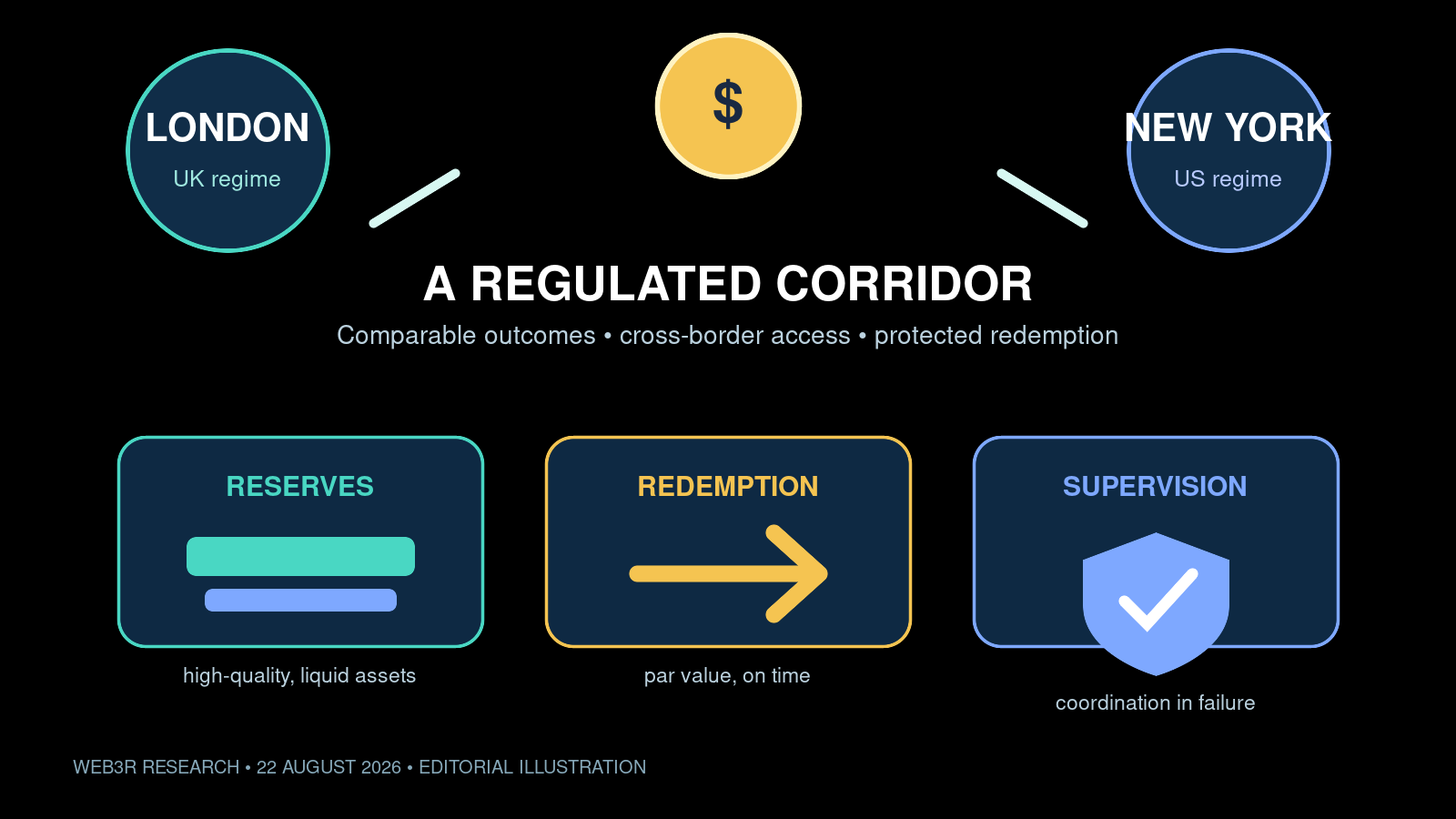
A shared policy direction is turning the Atlantic from a regulatory boundary into a potential settlement corridor. Illustration: Web3R Research.
Executive summary
The most consequential stablecoin development of mid-2026 is not a new token or chain. It is the attempt by the United Kingdom and United States to make separately regulated private digital money interoperable across their two markets. Their joint statement of 14 July sets out ten shared positions: one-to-one backing with high-quality liquid assets, timely redemption, reserve segregation, protected claims in insolvency, fair access to financial services, and a route by which a stablecoin supervised in one country might reach users in the other.
The thesis of this report is that this prospective corridor matters less as an endorsement of “crypto” than as a new layer of financial market infrastructure. If implemented well, regulatory recognition could reduce the duplication that currently forces issuers, custodians and payment firms to build country-specific balance sheets and operating structures. It could also make stablecoins credible settlement instruments for tokenised securities and cross-border treasury flows. But recognition is not equivalence, and equivalence is not safety. The hard problems—liquidity under stress, legal finality, sanctions and financial-crime controls, technology failures, and the macroeconomic effects of a larger offshore dollar network—remain.
This distinction is urgent because scale has arrived before the institutional design is finished. DefiLlama’s stablecoin dashboard, observed for this report on 22 August 2026, showed roughly $301 billion in total stablecoin market value, with USDT near $183 billion and USDC near $72 billion. Those figures are live and will change; they are a market snapshot, not an audited stock measure. Even so, they show a sector large enough to affect short-term government-debt demand and crypto-market liquidity, yet still small beside bank deposits. The corridor is therefore a live experiment in whether public rules can turn a private promise into reliably transferable money without importing unacceptable risks.
What changed in 2026
The political sequencing is important. The US enacted the GENIUS Act in July 2025. According to the Congressional Research Service summary, permitted payment-stablecoin issuers must hold one-to-one reserves in cash or similarly liquid assets, disclose redemption policies, publish reserve details monthly and comply with the Bank Secrecy Act. Foreign stablecoins can access the US through digital-asset service providers if Treasury finds the foreign regime comparable, among other conditions. That comparability mechanism is the legal hinge on which a transatlantic corridor can turn.
The UK’s structure developed on a different timetable. The Financial Services and Markets Act 2000 (Cryptoassets) Regulations 2026 created regulated activities for issuing qualifying stablecoins and safeguarding cryptoassets. The government is separately modernising payment-services rules so that using certain stablecoins for payments receives an appropriate conduct framework. In July, HM Revenue & Customs also said it intends, from April 2027, to treat eligible stablecoins more like money for tax purposes, including exempting disposals by individuals and trustees from capital-gains tax. This mundane tax change may matter as much for everyday use as blockchain throughput: money is difficult to spend if every purchase creates a disposal calculation.
The bilateral statement then joined these domestic tracks. It does not create a passport, approve any issuer or override either legislature. Its operative language is deliberately prospective: the governments “intend,” “support” and will “explore.” Yet the document establishes an unusually specific target state. Stablecoins held out as money should be fully backed; reserves should be segregated; holders should have a clear, protected claim, with priority ahead of other creditors where consistent with local law; and each side should consider a formal route for coins issued in the other to enter its market.
timeline
    title From domestic rules to a possible corridor
    July 2025 : US GENIUS Act becomes law
              : Federal/state issuer framework and foreign comparability route
    Early 2026 : UK cryptoasset regime establishes issuance and safeguarding activities
    14 July 2026 : UK–US joint stablecoin statement
                 : Ten shared principles and commitment to explore cross-border access
    3 August 2026 : UK Treasury responds to Lords committee report
    From April 2027 : Planned UK tax treatment for eligible stablecoins takes effect
The agenda has continued beyond the headline. The UK–US Financial Regulatory Working Group’s summer 2026 statement, published on 4 August, gives officials a recurring forum to turn the taskforce’s recommendations into practical work. That institutional continuity matters: cross-border recognition requires supervisors to exchange information and coordinate failures, not merely ministers to agree on principles.
The economic object beneath the token
Stablecoins make a simple claim—one token equals one unit of fiat money—but deliver it through a chain of institutions. A holder on a public blockchain may be several steps removed from the legal issuer. Exchanges and market makers supply secondary-market liquidity; banks and custodians hold reserve assets; asset managers may operate government money-market funds; and a redemption agent connects tokens back to bank money. The peg seen on an exchange is therefore the output of a balance sheet, a legal claim and an operational network.
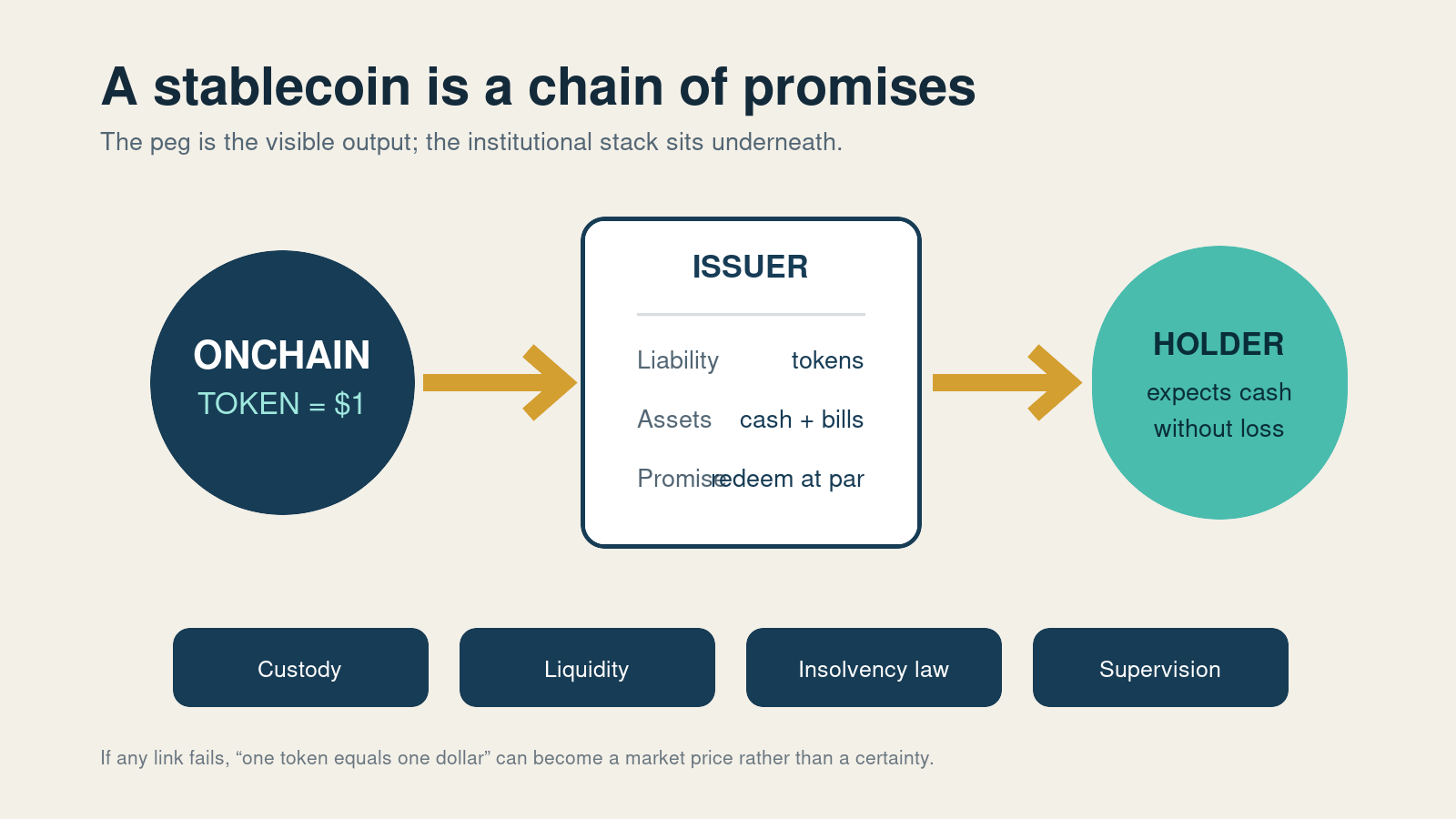
A token’s visible price compresses reserve quality, custody, liquidity, redemption and insolvency law into a single number. Illustration: Web3R Research.
Circle’s transparency page, for example, says most USDC reserves are held in an SEC-registered government money-market fund, reserve holdings are disclosed weekly, and a Big Four accounting firm provides monthly assurance that reserve value exceeds circulating USDC. Circle reported USDC circulation of $73.3 billion at 30 June 2026, up 19% year over year, while Q2 onchain transaction volume rose 151% to $14.8 trillion. Issuer-reported transaction volume should not be mistaken for payments to the real economy: onchain activity includes trading, transfers between wallets and automated financial activity. It nevertheless demonstrates why regulators now view the reserve and redemption stack as systemically relevant infrastructure rather than a niche crypto service.
The joint statement addresses this stack at several levels. High-quality liquid reserves reduce credit and market risk. Segregation limits the chance that general creditors capture holder assets. Timely redemption provides the arbitrage mechanism that keeps the market price near par. Priority claims and cross-border insolvency coordination seek to preserve that promise when an issuer fails. Fair, risk-based access to banks is designed to prevent a formally authorised issuer from becoming unworkable because it cannot hold cash, settle redemptions or access payment rails.
That is why “one-to-one backed” is necessary but incomplete. A portfolio can have assets equal to liabilities and still suffer a timing mismatch. Government bills settle through traditional market hours and intermediaries, while tokens move continuously. In a weekend run, a stablecoin may need cash before reserve assets can be sold. A corridor also adds foreign branches, custodians and conflicting insolvency rules. The quality of the system depends not only on what is owned, but on who controls it, how quickly it can become cash, and which court recognises the holder’s claim.
flowchart LR
    A[User or institution] -->|fiat subscription| B[Regulated issuer]
    B -->|mints| C[Stablecoin on public chain]
    B -->|places reserves| D[Bank / custodian / money-market fund]
    C -->|payment or settlement| E[Cross-border recipient]
    E -->|redemption request| B
    D -->|cash and liquid assets| B
    B -->|fiat at par| E
    F[UK supervisor] -. oversight and information .-> B
    G[US supervisor] -. recognition and coordination .-> B
    F <-. failure coordination .-> G
What a working corridor could unlock
The first opportunity is wholesale settlement. Tokenised bonds, funds and collateral can trade on programmable platforms, but the cash leg often remains fragmented. A regulated stablecoin available in both London and New York could let counterparties settle delivery-versus-payment outside the operating window of a single legacy system. The benefit is not that settlement becomes magical or risk-free; it is that assets and cash can share programmable rails, shortening reconciliation chains and reducing trapped intraday liquidity.
The second is corporate treasury. A multinational may hold working capital across entities, currencies and time zones. Stablecoins can move continuously and carry rich transaction logic. Comparable regulatory outcomes could allow a treasury platform to use one instrument across the two jurisdictions rather than maintain separate tokens and liquidity pools. Network effects are decisive here: two individually safe but non-interoperable coins may be less useful than one coin with credible access to both markets.
The third is competition in cross-border payments. The joint statement explicitly supports private digital money alongside tokenised deposits and similar instruments; it does not promise stablecoins a monopoly. That competitive neutrality is sensible. Stablecoins may be strong where open-network distribution, composability and continuous availability matter. Tokenised commercial-bank deposits may be stronger where credit creation, deposit relationships and direct integration with regulated balance sheets matter. Central-bank money remains the final settlement anchor. The corridor’s success should therefore be judged by lower cost, better access and stronger resilience, not by stablecoin issuance alone.
Design question | Joint direction | Why it matters | Unresolved test |
|---|---|---|---|
Reserve backing | At least 1:1 in high-quality liquid assets | Supports par redemption | Eligible assets, concentration and stress haircuts |
Holder protection | Segregation and protected claims | Reduces loss in issuer insolvency | Cross-border recognition and speed of payout |
Market access | Formal route for foreign-regulated coins | Limits duplicated structures and liquidity | Definition and withdrawal of comparability |
Banking access | Fair, risk-based access | Keeps minting and redemption operational | Bank risk appetite and concentration |
Financial integrity | Regulated providers and supervisory coordination | Supports lawful cross-border use | Treatment of unhosted wallets and chain-level screening |
The counterargument: regulation does not repair the monetary architecture
The strongest critique comes from the Bank for International Settlements. Its June 2026 Annual Economic Report chapter accepts that stablecoins demonstrate faster, programmable payments but argues that current arrangements fall short on foundational properties of money. The BIS framework emphasises singleness—the expectation that different forms of money exchange at par—elasticity—the ability of the system to supply liquidity under stress—and integrity against illicit finance. Its preferred destination is tokenisation anchored in central-bank reserves, commercial-bank money and government bonds, not a monetary system led by private bearer-like tokens.
This is more than institutional rivalry. Stablecoins fragment liquidity across issuers, chains and bridges. They generally cannot create elastic liquidity in a panic; an issuer must sell or repo reserve assets, find bank cash, or slow redemptions. Their global reach can also export dollarisation into economies with weaker currencies. If demand becomes large, reserve reallocations can affect Treasury-bill markets, bank deposits and credit provision. The BIS additionally flags financial-integrity challenges around unhosted wallets.
The bilateral policy can be read as a pragmatic answer rather than a rebuttal. It accepts that private tokens already circulate and tries to make their promises harder. Yet its pro-innovation language creates a genuine risk of regulatory under-specification. Avoiding “burdensome” requirements and “inappropriately high” local ring-fencing may improve operational efficiency, but shared global reserves can complicate a local supervisor’s ability to protect domestic holders in failure. A corridor optimised for normal-time capital efficiency can become a jurisdictional contest during stress.
Other risks deserve equal weight. Smart-contract or blockchain failures can interrupt transfer even if reserves are perfect. Freezing and blacklisting capabilities help sanctions enforcement but create governance and due-process concerns. Secondary-market users may not have the same direct redemption rights as issuer customers. Attestations verify specified information at a point in time; they are not a guarantee against future loss, operational failure or fraud. And regulatory recognition can entrench incumbents because liquidity, banking relationships and compliance costs reinforce the largest issuers.
A scorecard for institutional readers
The next phase should be evaluated through evidence, not announcement volume. Five indicators would show whether the corridor is becoming real.
First, the two governments need published comparability criteria: which reserve assets qualify, what redemption timetable applies, and how recognition can be suspended. Second, supervisors need a failure playbook covering information exchange, reserve control and holder payout. Third, issuers should disclose reserve maturity, custodian concentration, redemption eligibility and operational incidents in comparable formats. Fourth, market data should distinguish gross onchain transfers from economically meaningful payments and securities settlement. Fifth, the corridor should demonstrate competition: new entrants or multiple forms of tokenised money should be able to connect without sacrificing prudential standards.
There is also a distributional test. Faster settlement is valuable only if savings reach users rather than remaining with issuers and intermediaries. Non-interest-bearing stablecoins generate reserve income for issuers while holders bear technology, access and some credit risks. Transparent pricing and credible alternatives—bank deposits, tokenised funds and public payment systems—are therefore part of market discipline.
Conclusion
The UK–US initiative marks a shift from asking whether stablecoins should exist to specifying how a cross-border version of them should fail safely. Its importance lies in the institutional plumbing: reserve rules, redemption, custody, creditor priority, banking access and supervisory cooperation. If officials turn the July principles into enforceable, mutually intelligible rules, London and New York could form the first major corridor in which regulated stablecoins serve tokenised capital markets across jurisdictions.
But a corridor is a controlled passage, not an open frontier. The BIS critique remains the correct stress test: private digital money must preserve par value, obtain liquidity in bad times and meet financial-integrity obligations. The market snapshot—about $301 billion outstanding, concentrated in two issuers—makes that work urgent without making stablecoins system-defining. The sensible institutional position is neither dismissal nor inevitability. It is conditional adoption: allow the technology to compete, make the legal promise explicit, measure actual economic use, and design the failure regime before scale turns an operational weakness into a monetary event.
Direct sources
UK–US Joint Statement on Stablecoins, HM Treasury, 14 July 2026
Modernising Payment Services Regulation consultation, HM Treasury
Research cut-off: 22 August 2026, UTC. Market values are approximate snapshots and should not be read as audited figures or investment advice.