Arc’s September Test: Can a Stablecoin Issuer Become Financial-Market Infrastructure?
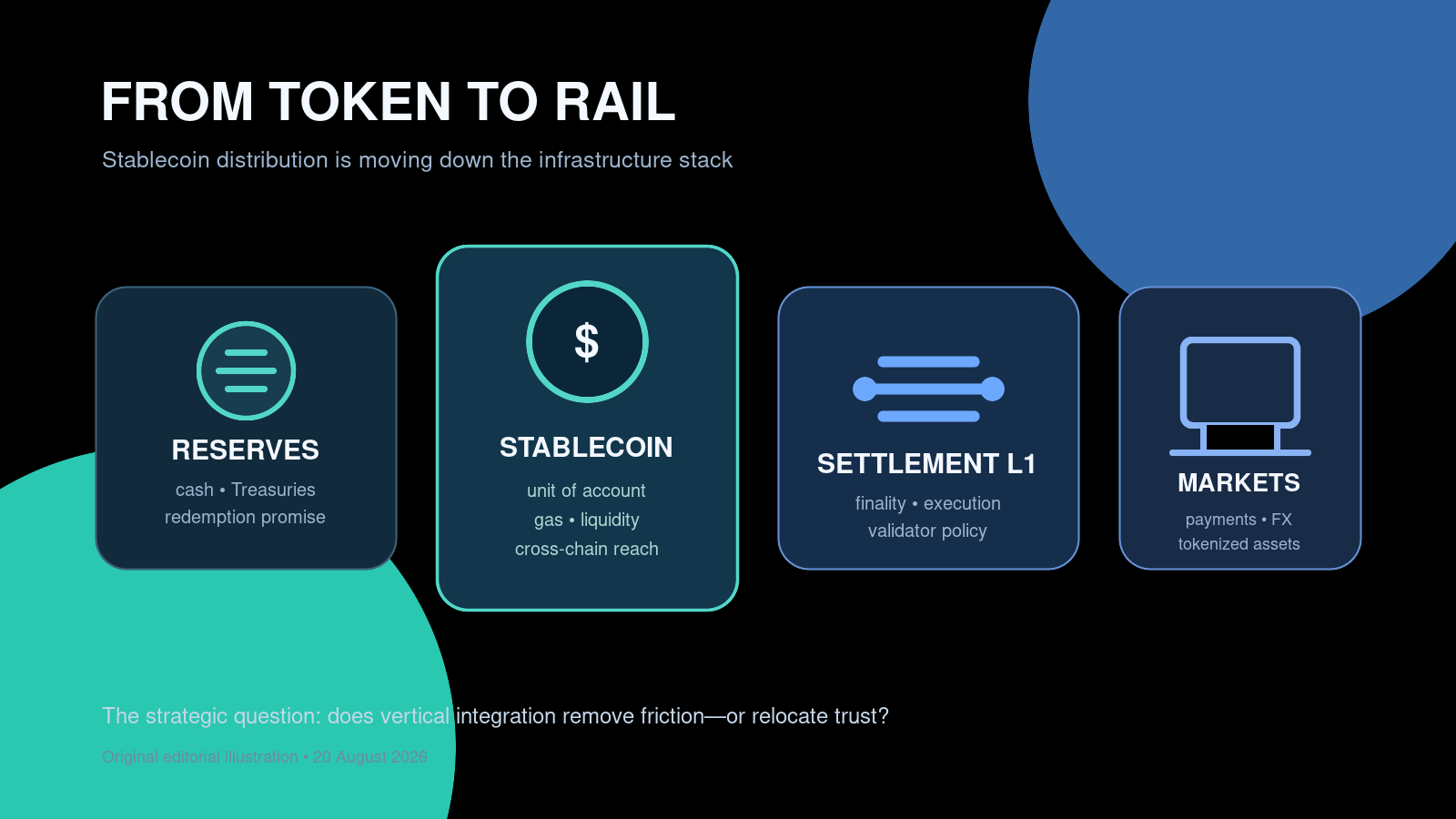
Circle’s Arc compresses the stablecoin stack—from reserve-backed money to execution and institutional markets—into one strategic system. Original editorial illustration, 20 August 2026.
Executive summary
Circle plans to open Arc’s public mainnet on 16 September 2026. The launch deserves attention beyond the familiar cycle of new-chain announcements because Arc is not primarily selling more generic blockspace. It is an attempt by the issuer of USDC to own and coordinate more of the infrastructure on which its money moves. Arc uses USDC for transaction fees, promises deterministic sub-second finality, retains Ethereum Virtual Machine compatibility, and begins with permissioned institutional validators. Circle says more than 100 institutional and ecosystem builders are already involved; its announced founding validator group includes BlackRock, DTCC, ICE, Mastercard, Standard Chartered and Visa.
The thesis of this report is that Arc is best understood as a vertical-integration strategy for digital money, not merely as another Layer 1. It can reduce three frictions that have held institutional onchain finance back: volatile network fees, uncertain settlement timing, and the operational mismatch between public crypto networks and regulated firms. Yet integration also concentrates dependencies. The same company is central to the reserve-backed asset, key liquidity and interoperability services, and the new settlement environment. Meanwhile, consensus participation is permissioned at launch, important privacy and multi-stablecoin capabilities remain on the roadmap, and institutional logos are not evidence of sustained production flows.
Arc therefore creates a sharp test. If it succeeds, stablecoin competition will extend from issuer balance sheets and distribution into execution, governance and workflow design. If it falls short, the result will reinforce the case that money should remain portable across neutral, general-purpose networks rather than settle on rails closely aligned with one issuer. The decisive metrics after launch will be economic activity, resilience and exit options—not testnet transaction counts.
Why this launch matters now
The context is unusually strong. Circle reported $73.3 billion of USDC in circulation at the end of Q2 2026, up 19% year over year, and $14.8 trillion of onchain USDC transaction volume during the quarter, up 151%. These are company-reported measures and transaction volume should not be mistaken for payments revenue or unique economic activity; blockchain volumes can include trading, internal routing and repeated movements. Still, the gap between circulation growth and transaction-volume growth suggests that the strategic prize is no longer only issuing more digital dollars. It is increasing the number and value of workflows each dollar can support. Circle’s Q2 release also reported $701 million in total revenue and reserve income, illustrating how economically important the underlying stablecoin float remains (Circle Q2 2026 results).
At the market level, the Bank for International Settlements put stablecoin capitalisation at roughly $320 billion at end-May 2026 and said 99.4% of fiat-backed coins were pegged to the US dollar. Its assessment is deliberately sceptical: stablecoins demonstrate programmability and faster-payment potential, but fall short on singleness, elasticity and integrity, while cross-border use can intensify dollarisation and capital-flow risks (BIS Annual Economic Report 2026, Chapter III). This is precisely why Arc matters. It is a private-sector answer to some operational weaknesses the BIS identifies, but it does not resolve the deeper question of what anchors money-like instruments to the public monetary system.
Circle’s announced 16 September launch turns that abstract debate into an observable production experiment. The company says Arc is already in private mainnet and has more than 100 builders. Its founding-validator announcement names 11 institutions alongside Circle and says BlackRock expects to deploy BUIDL, its tokenized institutional liquidity fund, while BNY, DTCC and Standard Chartered are exploring custody, settlement, stablecoin, foreign-exchange and repo integrations (Circle validator and integration announcement). “Exploring,” “building” and “expected to deploy” are materially different from live volume, however. A disciplined reader should treat them as evidence of distribution and intent, not completed adoption.
The strategic move: from issuing the money to shaping the venue
On a general-purpose chain, a stablecoin issuer controls issuance and redemption but inherits someone else’s fee market, consensus, finality model and upgrade politics. Arc brings those layers closer together. Its public documentation describes a Malachite Byzantine-fault-tolerant consensus layer, a Reth-based EVM execution layer, USDC as the native gas asset and deterministic finality in under one second. Developers can deploy without permission, while only approved validators participate in consensus (Arc network overview).
That design changes the product in three ways.
First, it makes cost legible in the same unit as the payment. A treasury department sending dollars no longer needs to acquire and account for a volatile native token merely to pay gas. Arc’s live Fee Manager uses smoothing to damp short-term fee spikes. The institutional benefit is not necessarily the lowest possible fee; it is a fee that is easier to quote, budget and reconcile.
Second, deterministic finality makes settlement an operational event rather than a probabilistic judgement. Public proof-of-stake networks can provide strong economic finality, but applications often wait for confirmations and build reorganisation handling into their workflows. Arc’s BFT model commits a block without that ambiguity. For payments, delivery-versus-payment and collateral movements, a clear point of finality can reduce buffers and exception handling.
Third, the validator model trades open participation for identifiable accountability. Arc’s deployment documentation says the network launches with permissioned proof of authority and envisages approximately 20 vetted, SOC 2-certified validators bound by service and compliance obligations. It also says the network may later move to permissioned proof of stake (Arc deployment model). This can fit regulated institutions better than anonymous validation, but it is not decentralisation in the open-membership sense. The word “open” applies to application deployment and verification more clearly than it applies to block production.
flowchart LR
    A[Fiat reserves and redemption] --> B[USDC as settlement asset]
    B --> C[Arc fee and execution layer]
    C --> D[Permissioned institutional validators]
    D --> E[Deterministic finality]
    E --> F[Payments, FX, repo and tokenized assets]
    F --> G[More USDC utility and distribution]
    G -. reinforces .-> B
This loop explains the strategic logic. More activity on Arc can deepen USDC utility; deeper utility can attract issuers, liquidity and applications; those applications can generate more activity. Circle is no longer limited to earning on reserves and distributing a token across other networks. It can shape the transaction environment and offer adjacent applications. Circle’s SEC filing already describes three reinforcing pillars: Arc and developer infrastructure; digital assets and liquidity services; and applications such as Circle Payments Network and StableFX (Circle Q1 2026 Form 10-Q).
What is real, and what remains a roadmap
Arc’s public testnet provides credible engineering evidence, but its numbers need careful framing. Circle said in its 2026 product vision that the testnet processed more than 150 million transactions and nearly 1.5 million transacting wallets in its first 90 days, with average settlement around 0.5 seconds (Circle 2026 product vision). Arc documentation separately reports a Q1 review snapshot of 30.7 million transactions, 916,000 unique wallets, 100% uptime and roughly 0.48-second blocks. Different windows can explain the different totals; neither figure establishes commercial demand because testnet assets are valueless and activity can be automated.
More important is the distinction between what exists and what is promised. The system overview marks the Fee Manager as live, but labels the Privacy Module and Stablecoin Services as planned. Those future modules are expected to support confidential transfers, selective disclosure, cross-currency settlement, sponsored transactions and multi-stablecoin gas (Arc system overview). Circle’s launch materials describe a product suite with privacy capabilities, so launch-day documentation must be checked against the present roadmap. Institutions should not design controls around a feature until its production behaviour, audit status and governance are verifiable.
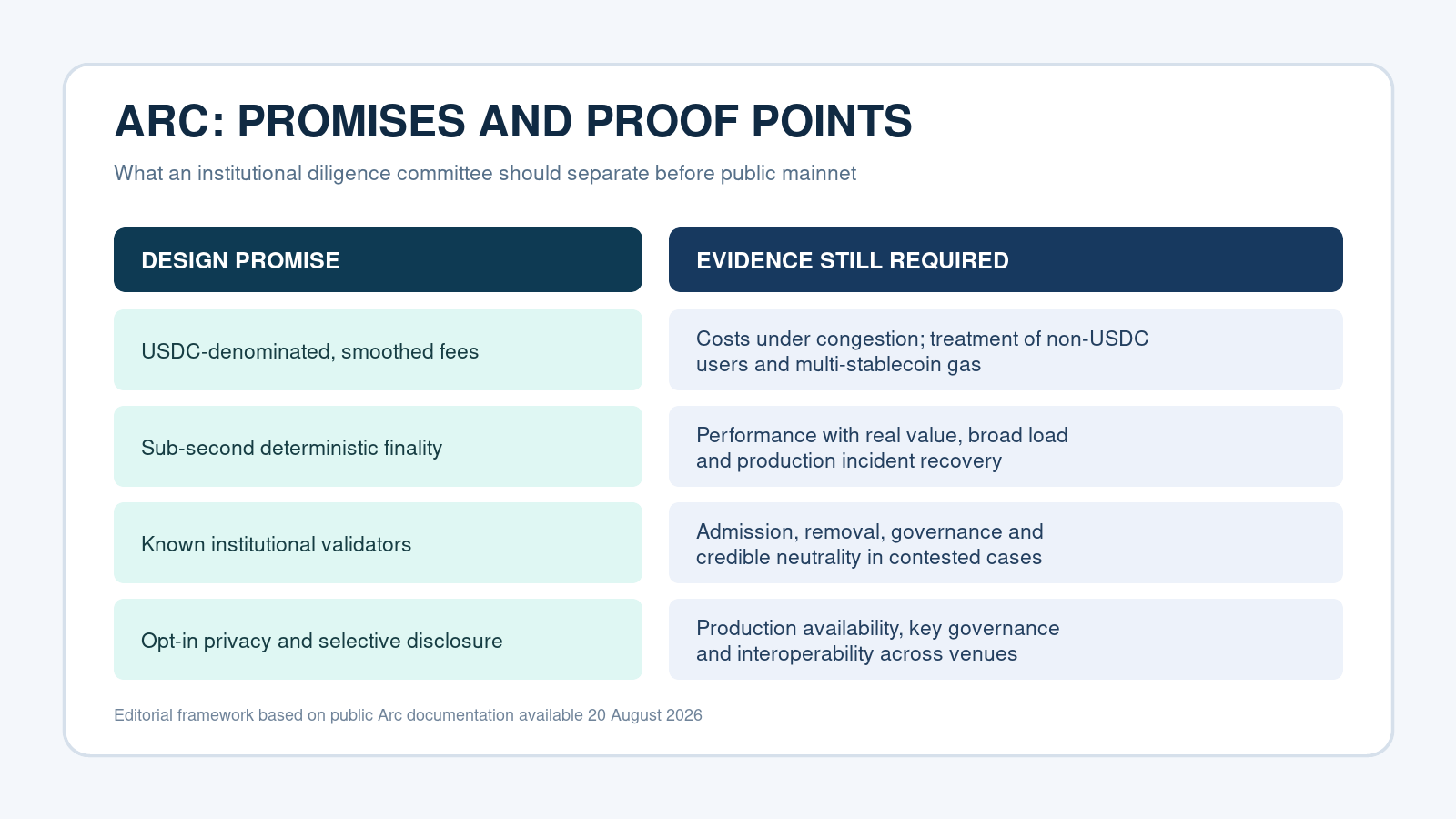
Fast finality and stable fees are design properties; resilience, governance and privacy must be demonstrated under production conditions. Editorial diligence framework.
The strongest part of Arc’s proposition is not any single feature. Stable fees, EVM execution, fast finality and known validators exist elsewhere in different combinations. Its advantage is coordination: Circle can align the money, bridge infrastructure, applications, institutional relationships and network roadmap. That reduces integration work. It also creates correlated risk. An issuer policy change, reserve or redemption stress, bridge interruption, software fault, or governance dispute can affect multiple layers at once.
The institutional decision: convenience versus credible exit
For a bank, asset manager or payments company, the relevant question is not “Is Arc decentralized?” in the abstract. It is whether Arc provides the control environment, service quality and legal certainty required for a specific workflow—and whether the institution can exit if those assumptions change.
Arc allows anyone to run a full node and independently verify blocks and execution, according to its node documentation. But those nodes do not join consensus or observe consensus messages; they verify decisions signed by the permissioned validator set (Arc node model). Independent verification is valuable, yet it is not the same as independent influence over ordering, censorship policy or validator admission.
That distinction makes governance a first-order diligence issue. Who can add or remove validators? What happens when legal obligations conflict across jurisdictions? How are emergency changes approved? What recourse exists after an erroneous but final transaction? Deterministic finality reduces one class of technical uncertainty while increasing the importance of ex-ante controls and institutional governance. Irreversibility is useful only when identity, authorisation and operational processes are sound.
Interoperability is equally important. USDC already circulates across multiple networks. Arc must become a useful hub without turning liquidity into an island. A tokenized fund that can subscribe and redeem on Arc may improve collateral mobility inside the venue, but its value to an institution depends on movement to custodians, exchanges, other chains and bank money. The more Arc relies on Circle-controlled interoperability and liquidity services, the more counterparties must assess concentration across the entire stack—not each product in isolation.
flowchart TD
    A[Institution considers an Arc workflow] --> B{Is production functionality live and audited?}
    B -- No --> C[Pilot only; cap value and dependencies]
    B -- Yes --> D{Are governance and validator controls acceptable?}
    D -- No --> C
    D -- Yes --> E{Can assets and data exit through independent routes?}
    E -- No --> F[Require contingency rails and liquidity buffers]
    E -- Yes --> G{Does real volume justify integration cost?}
    G -- No --> C
    G -- Yes --> H[Move a bounded production workflow]
    H --> I[Monitor finality, uptime, concentration and redemption]
Counterarguments and systemic risks
The most persuasive counterargument is that purpose-built rails fragment liquidity. Ethereum, Solana and established L2s already aggregate developers, assets and market infrastructure. Creating a new network for each issuer or payments platform can recreate the silos blockchains were meant to remove. EVM compatibility lowers application-porting costs, but it does not create liquidity, operational integrations or neutral governance.
A second risk is commercial concentration. Circle’s 2025 annual filing said reserve income represented 96.0% of its 2025 continuing-operations revenue and explained that payments to Coinbase are tied principally to net USDC reserve income (Circle 2025 Form 10-K). Arc can diversify the company toward infrastructure and applications, but it can also reinforce dependence on USDC. If interest rates fall, USDC circulation contracts, or a distribution partner changes terms, Arc adoption does not automatically compensate.
A third risk sits above the company level. The BIS argues that large foreign-currency stablecoins can shift deposits, alter bank funding and amplify dollarisation in emerging markets. Arc’s efficiency could make those macro effects more—not less—relevant. Faster settlement and programmable compliance address operational defects, but they do not supply central-bank elasticity or guarantee money’s singleness across issuers. A USDC-denominated rail remains anchored to redemption into bank money and the quality and liquidity of its reserves.
Finally, privacy and compliance can pull in opposite directions. Selective disclosure is attractive for institutional transactions that should not expose positions or counterparties publicly. But view-key governance, compelled disclosure, sanctions handling and cross-border data rules determine whether “privacy with control” is credible. Until the production module and its policies can be evaluated, privacy belongs in the opportunity column and the execution-risk column simultaneously.
What to measure after 16 September
The launch should be judged through a small set of evidence rather than headline transaction counts:
Dimension | Useful evidence | Why it matters |
|---|---|---|
Economic activity | Distinct funded users, stablecoin supply, recurring payment/FX/RWA flows | Separates durable demand from incentives and bots |
Settlement quality | Observed finality, uptime, failed transactions and incident reports | Tests the core operational promise with real value |
Validator structure | Active set, geographic/operator concentration, admission and removal disclosures | Reveals the practical trust and censorship model |
Portability | Inbound/outbound volume, bridge diversity, redemption performance and liquidity depth | Shows whether Arc is a hub or a silo |
Product delivery | Production status and audits for privacy and stablecoin services | Distinguishes launch scope from roadmap marketing |
Institutional adoption | Live deployments and settled value, not partnerships alone | Converts announced intent into measurable use |
No single metric settles the case. High volume with one dominant application can still be fragile; many validators with common legal exposure can still be correlated; perfect chain uptime cannot compensate for impaired redemption. The correct unit of analysis is the whole money-and-settlement system.
Conclusion
Arc is a consequential experiment because it makes explicit where stablecoin strategy is heading. The next contest is not simply which issuer has the most circulating tokens or which chain offers the cheapest blockspace. It is who can coordinate reliable money, predictable execution, compliant privacy, liquidity and institutional distribution in one operating environment.
Circle enters that contest with genuine assets: a large regulated stablecoin franchise, EVM compatibility, a clearly specified fast-finality design and an unusually strong group of named institutions. It also carries unresolved questions about permissioned consensus, roadmap-dependent functionality, governance and correlated dependence on Circle and USDC. Those are not footnotes to the architecture; they are the architecture’s trade-offs.
The September launch will not answer whether Arc is global financial-market infrastructure. It will begin the period in which that claim can finally be tested. Institutions should welcome the reduction in operational friction while insisting on evidence of resilience, neutrality and credible exit. If Arc can provide all four, issuer-aligned chains may become a durable layer of tokenized finance. If it can provide only speed and convenience, the market will have built a faster rail without resolving whom the rail ultimately asks users to trust.
Direct sources
Research cut-off: 20 August 2026 (UTC). Company claims and roadmap items are identified as such; launch plans may change.