The Triage Layer: What AI Security Agents Really Change for Ethereum
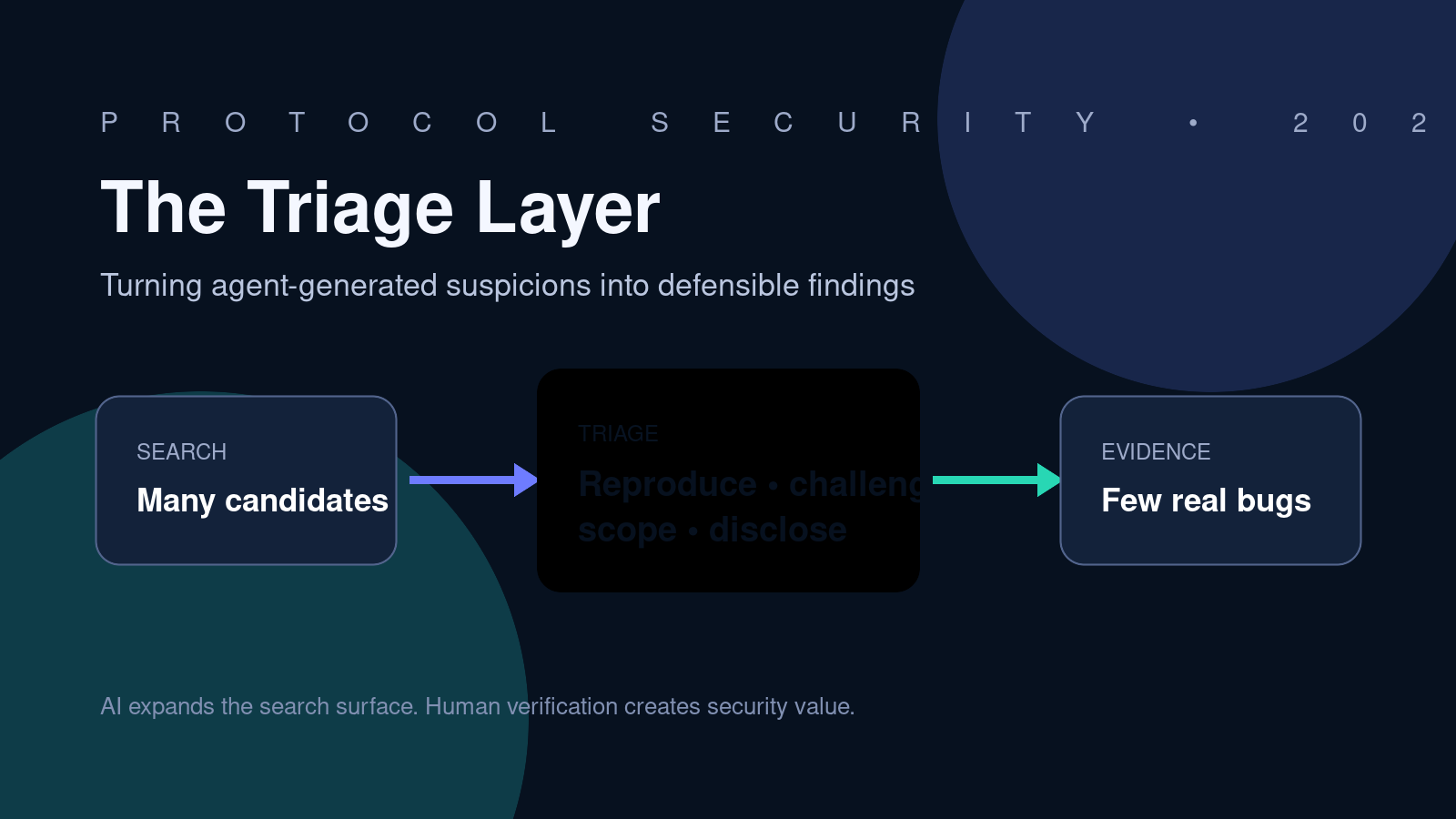
An editorial view of the emerging protocol-security stack: machines widen the search; disciplined verification turns suspicion into evidence.
Executive summary
Ethereum’s most consequential near-term use of autonomous AI may not be agents transacting onchain. It may be agents examining the software that keeps the chain alive. In July 2026, the Ethereum Foundation’s Protocol Security team described coordinated AI agents finding real defects in protocol-adjacent code, including a remotely triggerable panic in Rust libp2p’s Gossipsub implementation. The flaw was patched as version 0.49.4 and published as the high-severity CVE-2026-34219. Yet the Foundation’s central lesson was deliberately unglamorous: discovery was not the bottleneck. Triage was.
That distinction matters to institutions. An agent can cheaply produce a persuasive report, a call path, an impact claim and even a runnable proof of concept. None of those artifacts independently establishes that a defect is reachable in production, materially affects Ethereum clients, survives adversarial review, or warrants a particular severity. As machine-generated candidates become abundant, the scarce asset shifts from code-search capacity to a controlled process for rejecting false positives, reproducing failures, establishing deployment context and coordinating disclosure.
This report’s thesis is that AI security agents should be understood as a new search layer, not an automated assurance layer. Their best current role resembles an adaptive fuzzer with unusually rich hypotheses. The economic benefit comes from exploring more code and generating better test artifacts; the governance burden comes from ensuring that fluent output does not bypass evidentiary gates. Ethereum’s experience offers a practical institutional model: separate exploration from adjudication, demand reproducibility, record rejection reasons, and measure validated findings rather than candidate volume.
A concrete result, and the right lesson to draw
The disclosed case is narrow but important. The GitHub Security Advisory for CVE-2026-34219 describes an unchecked time-arithmetic overflow in libp2p-gossipsub versions before 0.49.4. A network peer could send crafted Gossipsub control data containing an extreme backoff value. The value could be stored, then later overflow when the heartbeat path added a slack duration, causing a panic. GitHub rates the reviewed advisory “High,” with a CVSS score of 8.2, and identifies 0.49.4 as the patched version. The advisory credits the Ethereum Foundation security team.
This was not an esoteric library with no relationship to public networks. Gossipsub is a peer-to-peer publish/subscribe protocol implemented across several libp2p languages; its randomized topic meshes disseminate messages without a central broker. The libp2p specification describes it as a general-purpose pubsub protocol with multiple production implementations. Ethereum consensus clients depend on peer-to-peer gossip to propagate consensus messages, making failures in the networking substrate worthy of serious scrutiny.
Still, precision is essential. A vulnerability in a shared dependency is not proof that every Ethereum client, version or deployment was exploitable in the same way. Reachability depends on the implementation, dependency version, configuration and surrounding failure handling. The responsible inference is that the agent program produced a real, externally validated security contribution in infrastructure relevant to Ethereum—not that an agent “hacked Ethereum,” nor that AI has automated protocol auditing.
flowchart LR
    A[Untrusted network peer] -->|crafted control message| B[Gossipsub message handling]
    B --> C[Extreme backoff retained]
    C -->|later heartbeat| D[Unchecked time addition]
    D --> E[Process panic]
    E --> F[Availability impact]
    G[Patch 0.49.4] -. bounds the operation .-> D
The delayed nature of the failure also illustrates why semantic search helps. The attacker-controlled value enters in one part of the program and becomes dangerous in a later periodic path. Conventional tests can miss such cross-function, time-separated relationships. An agent that can read broadly, form a hypothesis, generate a reproducer and revise its interpretation has a useful advantage. But that same breadth makes it easy to weave plausible yet incorrect stories across unfamiliar code. The capability and the failure mode are two sides of the same feature.
The real product is a verification pipeline
The Foundation’s July account of its program explicitly compares an agent to a search tool such as a fuzzer. The contrast is in the output. A fuzzer generally supplies a crash and a trace; an agent may supply a polished explanation and impact rating alongside its test. The richer package accelerates investigation, but it also creates an authority illusion. Readability is not validity.
The reported operating model therefore uses multiple gates. Candidates are first deduplicated and checked against known issues. Reviewers inspect whether the alleged path is real and whether inputs are attacker-controlled. A proof of concept must run against the actual target rather than a toy rewrite. The team then challenges the claim: is the behavior intended, is the failure prevented elsewhere, and is the impact overstated? Only after reproduction and scope analysis does a candidate become suitable for coordinated disclosure.
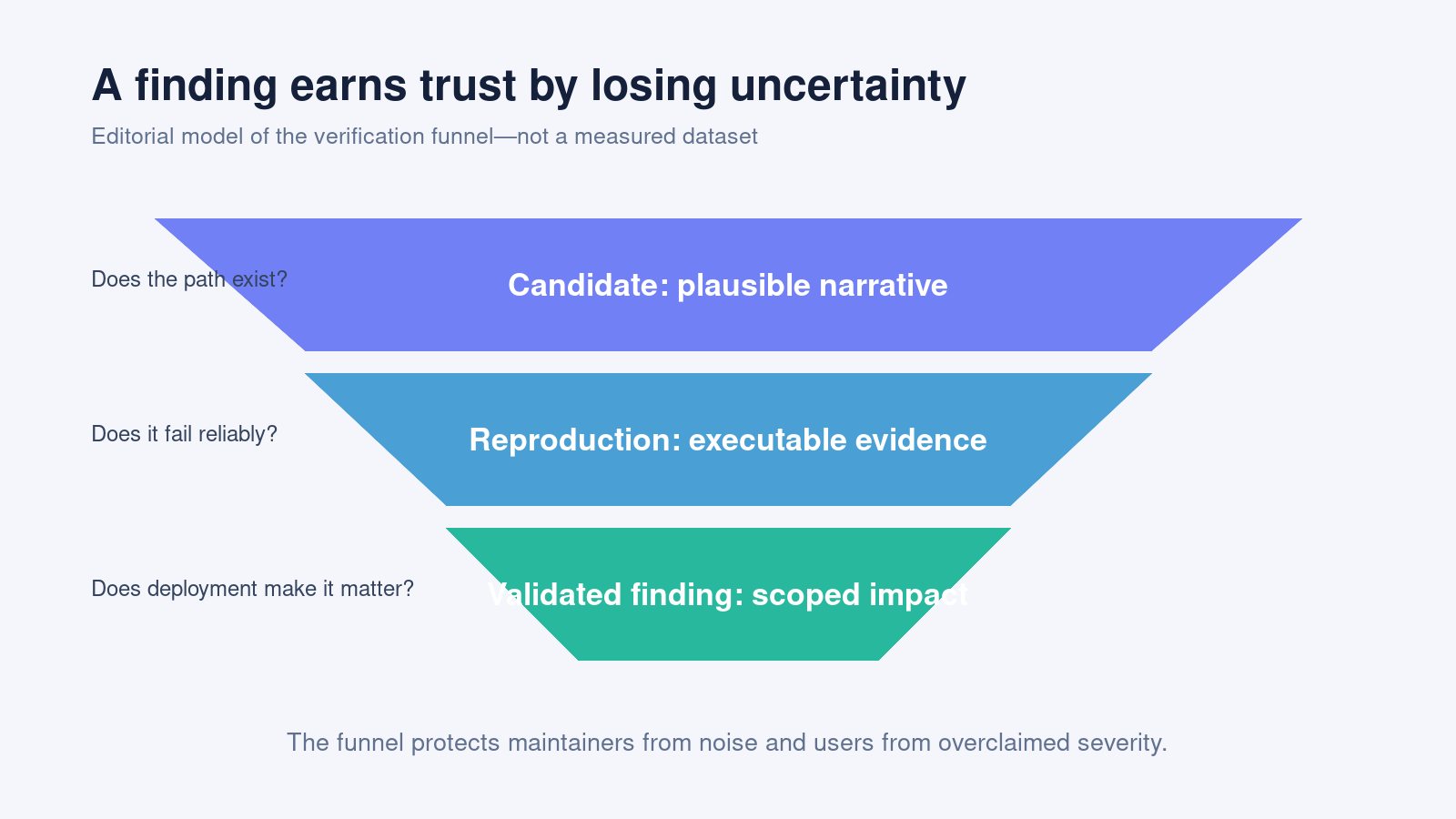
The verification funnel is conceptual rather than quantitative. Its point is institutional: confidence should rise as candidate count falls.
flowchart TD
    S[Agent search across code and tests] --> C[Candidate report]
    C --> D{Duplicate or known?}
    D -->|Yes| X[Archive with reason]
    D -->|No| R{Reproduces on real target?}
    R -->|No| X
    R -->|Yes| P{Reachable in deployment?}
    P -->|No or unclear| H[Hold for more evidence]
    P -->|Yes| I[Independent impact review]
    I --> M[Maintainer coordination]
    M --> F[Patch, advisory, measured disclosure]
This pipeline changes what a security leader should optimize. “Findings per run” rewards noise. “Reports produced” can be gamed by verbosity. Even “proofs of concept generated” is unsafe because a demonstration can encode an unrealistic environment. Better measures include the proportion independently reproduced, reviewer time per validated issue, duplicate rate, time from candidate to maintainer-ready report, and the fraction of severity claims revised during review. Rejections are valuable data: they reveal recurring model confusions and improve future task design.
The workflow also calls for role separation. The system that searches should not be the sole judge of its own success. Independent human review remains the strongest practical check, while a second model can be useful as a critic but not as the final authority. Sensitive candidates need access controls and audit trails because an unpatched vulnerability is hazardous information regardless of whether its author is human or machine.
Why this matters more as Ethereum scales
Ethereum is simultaneously increasing throughput, changing account behavior and hardening its core. The Foundation’s 2026 protocol priorities organize work around Scale, Improve UX and Harden the L1. The agenda includes higher gas limits, data-availability scaling, native account abstraction, interoperability, post-quantum readiness and network resilience. Each improvement creates new interactions across specifications, clients, cryptographic libraries and operational tooling.
That is exactly the environment where search capacity has high marginal value. Mature codebases contain assumptions distributed across modules and repositories. Multiple client implementations reduce monoculture risk, but they also multiply the surfaces auditors must understand. Faster upgrade cadence compresses review windows. AI agents can cheaply revisit old assumptions after dependency or specification changes, generate edge cases, and trace data across boundaries that a narrowly scoped review might overlook.
The institutional consequence is not fewer security engineers. It is a different allocation of their time. Machines can absorb more of the exhaustive traversal and test scaffolding; experts spend more time on threat models, reachability, system context, disclosure and decisions about what evidence is sufficient. The most capable teams will treat agents as force multipliers for judgment, not substitutes for it.
The parallel with other primary research is notable. In January, Anthropic reported an agent that inferred software properties and wrote property-based tests across popular Python packages. Its published methodology used extensive manual validation: three expert reviewers assessed selected candidates, and uncertainty from any reviewer was enough to discard a report. The work found real defects and merged fixes, but it also documented an invalid report involving subtle calendar semantics. That example supports Ethereum’s conclusion: implicit intent is where confident automation is most likely to need maintainers.
What institutions can reasonably conclude now
The evidence supports four conclusions.
First, agent-assisted vulnerability research has crossed the threshold from demonstration to operational usefulness. A publicly disclosed, patched dependency vulnerability is stronger evidence than benchmark performance. It proves that the workflow can create value in real open-source infrastructure.
Second, the public evidence does not establish autonomous assurance. One disclosed success does not reveal the full denominator of attempts, the false-positive rate, total reviewer hours or comparative performance against skilled humans and mature fuzzers. The Foundation itself emphasizes methods rather than a durable tool stack, noting that specific setups age quickly. Procurement claims that promise autonomous audits should therefore be treated as unproven unless accompanied by denominators, independent reproduction and deployment-relevant outcomes.
Third, machine-written artifacts can improve handoffs even when the machine’s conclusion is wrong. A minimal reproducer, environmental record and explicit call path give a reviewer something falsifiable. The key design goal is not to make every narrative sound expert; it is to make every claim cheap to challenge.
Fourth, open-source ecosystems need intake capacity. If many teams deploy agents, maintainers may face a denial-of-service made of plausible reports. Private pre-triage, duplicate detection and a high bar for contacting upstream projects are ecosystem responsibilities, not merely internal efficiency choices.
Risks and counterarguments
The strongest counterargument is that conventional security tools already perform this role with greater determinism. Fuzzers, static analyzers, symbolic execution and formal methods have decades of engineering behind them. Agents may simply wrap these tools in expensive, nondeterministic prose. That criticism is valid when agents are used as undisciplined scanners. Their incremental value must come from composing tools, navigating unfamiliar repositories, proposing non-obvious properties and adapting tests—not from replacing deterministic checks that already work.
There is also a benchmark and disclosure-selection problem. Successful findings are publishable; weeks of unproductive runs are not. Without reporting total candidates, compute, reviewer labor and baseline comparisons, outsiders cannot calculate productivity. CVSS ratings describe a vulnerability, not the efficiency of the system that found it. The correct institutional posture is measured experimentation rather than extrapolation from a compelling case.
Security agents themselves enlarge the attack surface. Repository text, issue content and test fixtures can contain instructions designed to manipulate an agent. Tool-enabled systems may execute code, access private branches or transmit sensitive output. Runs should therefore occur in isolated environments with least-privilege credentials, restricted outbound access, immutable logs and explicit approval gates for disclosure. These controls are part of research integrity, not operational decoration.
Finally, abundance can distort incentives. Teams may optimize for dramatic severity labels, easy-to-demonstrate crashes or public credit while neglecting slow, structural work such as specification clarity and defense in depth. Ethereum’s “Harden the L1” agenda is broader than bug hunting: it includes censorship resistance, testnets, interop testing and post-quantum planning. Agent discovery should complement that portfolio, not consume it.
Implications for protocol governance and capital allocators
For protocol stewards, the immediate investment case is in triage infrastructure: reproducible environments, dependency inventories, private case tracking, reviewer rotation and clear disclosure relationships with upstream maintainers. Funding additional agent runs without funding these bottlenecks may reduce net security by flooding experts with low-quality work.
For client teams, the dependency boundary deserves special attention. The libp2p case shows how a general-purpose networking component can carry chain-relevant availability risk. Software bills of materials and fast dependency-response procedures are therefore part of protocol resilience, even when the defect is not in consensus logic itself.
For investors, insurers and risk committees, the presence of “AI auditing” should not count as a control by itself. Ask what target version was tested, which classes of failure were in scope, how candidates were independently reproduced, who adjudicated severity, how many were rejected, and whether maintainers received actionable reports. Evidence of a functioning funnel is more informative than the model brand.
For the wider open-source community, a useful norm would be to attach provenance to machine-assisted reports: target commit, environment, test artifact, reviewer status and disclosure state. Such metadata lets maintainers prioritize without discriminating against the tool that helped find the issue.
Conclusion
CVE-2026-34219 is valuable evidence precisely because it is modest. It shows an AI-assisted process tracing an attacker-controlled value through a real networking library, producing a reproducible failure, surviving review and ending in a patch and advisory. It does not prove that autonomous agents can certify Ethereum.
The deeper shift is economic. Search is becoming cheaper and suspicion more abundant. Verification, context and accountable disclosure are becoming relatively scarcer. Ethereum’s early experience suggests that the winning security system will not be the one that generates the most findings. It will be the one that most reliably converts uncertain machine output into a small number of claims that maintainers can reproduce, challenge and fix.