Glamsterdam’s Real Bet: Ethereum Is Redesigning the Block Pipeline Before It Raises the Ceiling
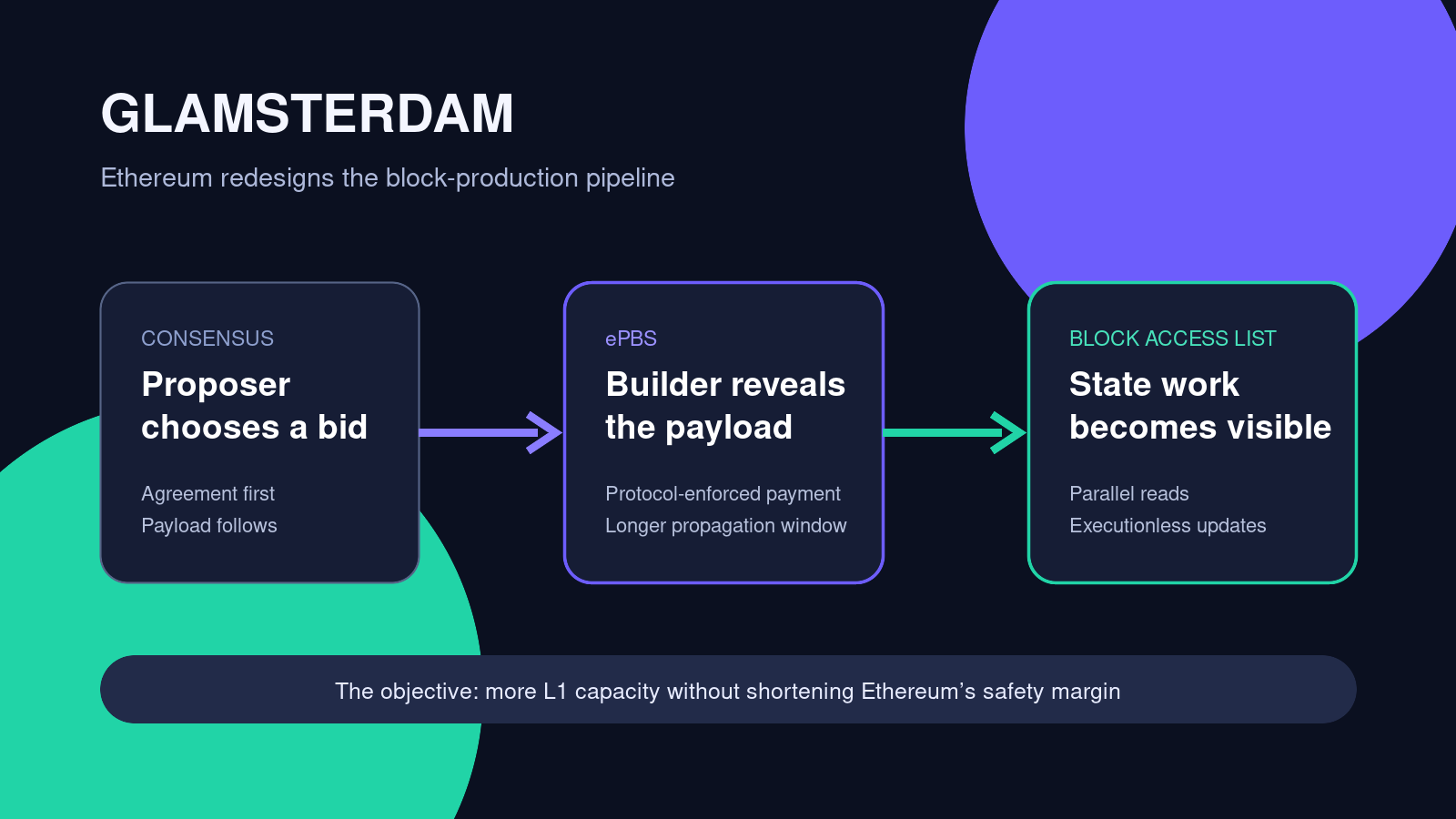
Glamsterdam combines a consensus-layer production pipeline with an execution-layer map of state work. The pairing matters more than any single headline capacity number.
Executive summary
Ethereum’s next planned network upgrade, Glamsterdam, is officially targeted for the second half of 2026. Its importance is easy to misstate. This is not simply another package of cheaper opcodes or a promise that the chain will process a larger number of transactions. Its two headliners—enshrined proposer-builder separation (ePBS, EIP-7732) and block-level access lists (BALs, EIP-7928)—redesign how a block moves from an economic commitment to a widely validated state transition.
The thesis of this report is that Glamsterdam is an architecture-before-capacity upgrade. ePBS separates agreement on a block from propagation and validation of its execution payload, moving a function now commonly mediated by external relays into Ethereum’s consensus rules. BALs make the block’s state footprint explicit, allowing clients to fetch data in parallel and eventually update state without replaying every transaction. One creates time; the other makes computation more schedulable. Together they aim to let Ethereum raise layer-one capacity without simply asking every validator to do the same sequential work faster.
That design has institutional significance. A larger L1 can improve the settlement substrate for rollups and applications; protocol-enforced builder payments can reduce reliance on trusted middleware; and faster synchronization can lower an operational barrier to running infrastructure. But the benefits are not automatic. ePBS adds consensus complexity, changes transaction-confirmation semantics, and creates a “free option” for a builder that may profitably withhold a promised payload in volatile conditions. BALs add bandwidth and validation overhead and only enable parallelism—client implementations must still realize it. The correct posture is therefore neither “Glamsterdam solves scaling” nor “this is invisible plumbing.” It is a consequential refactoring whose success should be judged by resilience, client diversity and reliable payload delivery, not by gas-limit ambition alone.
Why this upgrade, and why now
The official Ethereum roadmap records a sequence of complementary changes: Dencun introduced blob capacity in March 2024; Pectra followed in May 2025; Fusaka went live in December 2025 with PeerDAS and a higher default gas limit; Glamsterdam is in development for H2 2026. This sequencing matters. Rollups have reduced execution costs by batching activity, but rollups still depend on Ethereum for data availability, settlement and credible exit. Scaling blobs increases the quantity of rollup data the network can carry. Scaling L1 execution increases the capacity of the shared settlement layer. Neither is sufficient if propagation and validation remain on a tight critical path.
Ethereum’s current block-building market already separates proposers and builders in practice. Specialized builders construct valuable blocks; proposers often use MEV-Boost and relays to receive bids without seeing the full payload first. This out-of-protocol arrangement is economically important but carries relay availability, trust and censorship dependencies. Glamsterdam’s ePBS does not invent proposer-builder separation. It attempts to make the separation a native, enforceable part of Ethereum.
The second constraint lies inside execution. A node normally discovers which accounts and storage slots a transaction reads or changes by executing it. Because transactions can collide over shared state, this discovery process imposes sequential work and irregular database access. Optional transaction access lists exist, but they are not enforced and may be incomplete. BALs instead require a complete block-level record of accessed state and post-transaction changes. The record turns hidden dependencies into an authenticated input.
flowchart LR
    A[Rollups and L1 users demand capacity] --> B{Current bottleneck}
    B --> C[Short propagation and validation path]
    B --> D[State dependencies discovered during execution]
    C --> E[ePBS separates beacon block and payload]
    D --> F[BAL records accesses and post-state changes]
    E --> G[More time to propagate larger payloads and blobs]
    F --> H[Parallel reads, validation and state updates]
    G --> I[Safer path to higher L1 capacity]
    H --> I
ePBS: creating time by splitting commitment from payload
The EIP-7732 specification introduces protocol-tracked builders, execution-payload bids, a payload envelope and a Payload Timeliness Committee (PTC). In simplified terms, the proposer publishes the consensus block containing a commitment to a builder’s bid; the builder subsequently reveals the execution payload; the PTC attests whether that payload arrived on time. Builder funds held through the beacon chain make payment enforceable without depending on a private relay’s reputation.
This changes the hot path. The official Glamsterdam explainer says the propagation window expands from roughly two seconds to about nine seconds. EIP-7732 explains the mechanism more precisely: the next proposer gets six seconds to validate the payload, while other validators get nine. Validation is delayed rather than eliminated. That distinction is central. Ethereum is not weakening execution rules to gain throughput; it is reorganizing the slot so that full payload validation need not finish before the first consensus message can propagate.
The result is a form of pipelining. While the network is agreeing on one component, another can travel and be checked. Larger execution payloads and more blob data become less likely to overwhelm the same narrow time window. Protocol-native payments also remove a reason for proposers and builders to rely on external relays for fair exchange, although competitive block discovery, order flow and builder concentration remain market-layer questions.
For users, “included” becomes more explicitly staged. A transaction in slot N is not broadly execution-validated until validators process the payload and attest to the following block. Wallets, exchanges and risk engines should distinguish payload publication, chain head, justified and finalized states rather than compressing all of them into a single confirmation label. Glamsterdam does not make probabilistic settlement uniquely problematic; it makes the internal pipeline more visible and slightly more complex.
sequenceDiagram
    participant B as Builder
    participant P as Proposer
    participant N as Consensus network
    participant T as Payload Timeliness Committee
    participant V as Validators
    B->>P: Signed bid and payload commitment
    P->>N: Beacon block selects bid
    B->>N: Reveal execution payload
    T->>N: Attest payload arrived on time
    V->>V: Execute and validate payload
    V->>N: Vote on the next head
    Note over P,V: Agreement and execution validation are pipelined, not discarded
BALs: making execution’s hidden work legible
The EIP-7928 specification requires a block access list to record every account and storage location accessed during block execution, together with relevant post-execution values. A hash commitment is placed in the block header. Missing or spurious entries can invalidate a block; the list is therefore consensus-critical data, not advisory metadata.
This supports three different improvements that are often blurred together. First, clients can prefetch accounts and storage in parallel instead of waiting for execution to discover each database read. Second, transactions with non-overlapping state footprints can eventually be validated concurrently. Third, a syncing node can apply authenticated post-state changes without re-executing every historical transaction—an “executionless” state update—while retaining the ability to verify commitments and re-execute where necessary.
The network layer must deliver these lists. EIP-8159 defines the eth/71 peer-to-peer messages through which clients request and serve BALs and verify them against the header commitment. That companion proposal illustrates a recurring truth about protocol scaling: a useful data structure is not enough. It needs propagation rules, retention policy, denial-of-service limits and interoperable client implementations.
BALs do not flip a switch that makes the EVM fully parallel. Conflicting transactions still need ordering, and client teams must engineer parallel storage reads, state-root computation and execution around the new information. The immediate benefit may therefore show up first as more predictable validation and synchronization rather than a dramatic benchmark. That is still valuable. Database latency and state growth are operational constraints, and reducing unpredictable I/O can make higher gas limits safer.
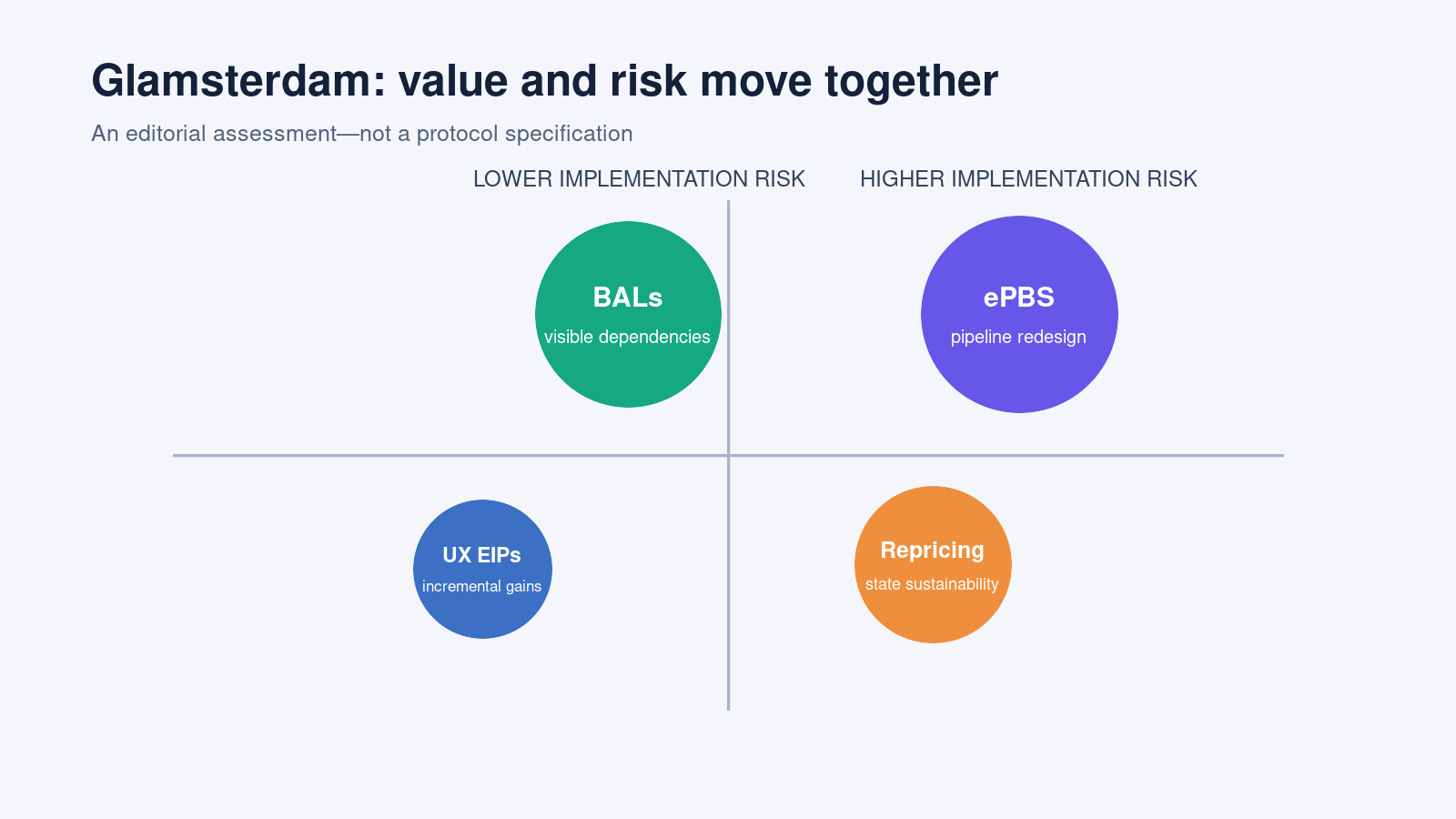
The two headliners offer the largest system value, but ePBS also carries the largest consensus and market-design burden. Positioning is qualitative and editorial.
The combined flywheel—and what institutions should measure
The two headliners reinforce one another. ePBS creates a longer interval for data to propagate and be validated. BALs structure the state data that accompanies larger execution workloads. Higher capacity then becomes a product of better scheduling rather than brute-force hardware escalation alone. The Ethereum Foundation’s 2026 protocol priorities explicitly couple scaling with “Harden the L1,” including state repricing, history expiry and longer-term statelessness. Glamsterdam should be read inside that discipline: capacity that erodes solo operation or client diversity would be a poor trade.
Institutional observers should consequently use a broader scorecard than transactions per second:
Question | Evidence to monitor | Why it matters |
|---|---|---|
Does pipelining work under stress? | Payload arrival rates, missed/empty slots, propagation tails | Average latency can conceal failures during volatility |
Are BALs operationally efficient? | BAL size, bandwidth, validation time, sync performance | Additional consensus data must earn its cost |
Is implementation diverse? | Feature parity and incidents across execution and consensus clients | A common architecture is safer when software failure modes differ |
Is builder access competitive? | Builder concentration, deposits, bid distribution, relay dependence after launch | Enshrining a market interface can harden market structure as well as rules |
Does L1 remain accessible? | Node hardware, bandwidth and storage requirements | Capacity is not neutral if independent verification becomes uneconomic |
This framing also prevents a category error in valuation. A higher gas limit does not mechanically create fee revenue, ETH demand or application growth. Capacity is supply; demand depends on useful applications, rollup economics and user experience. Moreover, cheaper blockspace can reduce fee pressure even as activity rises. Glamsterdam’s investment relevance lies in improving Ethereum’s option set and reliability envelope, not in a guaranteed short-term monetary outcome.
Risks, counterarguments and unresolved design pressure
The strongest counterargument is complexity. ePBS adds builders to beacon state, new messages and timing committees, asynchronous execution-payload handling, and additional fork-choice cases such as full, empty and skipped slots. The Ethereum Foundation’s April 2026 Checkpoint #9 described ePBS implementation as trickier than anticipated. The May Soldøgn interop recap documented intensive cross-client work, while the official roadmap continues to say H2 2026 rather than promise a block height. That is healthy uncertainty: coordinating a hard fork across independent clients is not a product launch with a unilateral ship date.
The most important economic risk is the free-option problem. A builder commits to a payload before revealing it. If market conditions change sharply, withholding may sometimes be more profitable than delivery, producing an empty slot and harming users precisely during volatile periods. EIP-7732 acknowledges that simulated occurrences may be noticeable. Research on dynamic penalties argues that escalating penalties can deter most strategic failures, but also concedes that extreme cases may remain profitable. This is not proof that ePBS is unsound; it is evidence that protocol-enforced exchange replaces one trust model with a mechanism-design problem that must be monitored in production.
Builder centralization is another ambiguity. Lower relay dependence is a genuine decentralization gain, but builders still benefit from sophisticated infrastructure, private order flow and capital. Requiring stake can improve accountability while raising entry barriers. Enshrining an interface does not guarantee a diverse market on the other side of it.
BALs bring their own costs. Lists consume bandwidth and storage, must be retained for a defined synchronization horizon, and create new malformed-data and availability surfaces. Their size is constrained through gas-linked limits, but worst-case behavior matters more than typical blocks. Executionless updates also change trust and verification choices: a node can update quickly from authenticated diffs, yet high-assurance operators may still prefer periodic or continuous re-execution. Faster sync is not identical to independently reproducing every computation.
Finally, scheduled features can change. EIPs may remain in Draft or Review, parameters can be revised, and devnet findings can alter scope. The EIP repository’s status definitions are explicit that Draft and Review are not Final. Readers should treat this report as a dated assessment—18 August 2026—not a guarantee of final mainnet contents.
Implications
For rollups, a successful ePBS deployment expands the safe envelope for blob throughput because payload and data propagation have more room. For L1 applications, BAL-enabled parallel I/O and sustainable gas repricing create a route toward more capacity, though realized fees and latency will depend on client adoption and later parameter increases. For infrastructure operators, the upgrade means meaningful work: both consensus and execution clients must implement a more complex cross-layer handshake and new data availability paths.
For regulated intermediaries, the most immediate action is conceptual rather than technical. Confirmation policies should map to the new staged pipeline. Operational due diligence should include builder delivery, PTC behavior and client-specific performance. Service-level agreements that promise “one block” finality already overstate Ethereum’s guarantees; after ePBS, they become even less informative.
For Ethereum governance, Glamsterdam tests whether a decentralized protocol can internalize a widely used middleware function without freezing today’s builder market or overburdening consensus. That is a harder and more valuable test than reaching a symbolic gas target.
Conclusion
Glamsterdam’s central idea is coordination leverage. Ethereum can scale more safely if it gives block data longer to travel and gives execution clients a reliable map of the state work ahead. ePBS and BALs attack different bottlenecks, and their combination is the reason the upgrade is structurally significant.
The prudent conclusion is conditional. If cross-client testing demonstrates reliable payload delivery, BAL overhead stays bounded, node requirements remain broadly accessible and builder competition does not deteriorate, Glamsterdam will have built a credible foundation for the next phase of L1 scaling. If those conditions fail, a larger nominal capacity ceiling would be a distraction. Ethereum’s institutional value comes from independently verifiable settlement under stress. The upgrade should be judged by how well it preserves that property while making more room above it.
Direct sources
Research cutoff: 18 August 2026. Upgrade scope, parameters and timing remain subject to the Ethereum governance and testing process.