Ethereum’s Quantum Clock Has Started—But It Is a Migration Clock, Not a Doomsday Clock
The lead illustration frames post-quantum security as a coordinated transition already in motion, not an overnight rupture.
Executive summary
Ethereum’s post-quantum problem became materially easier to quantify in 2026, but not imminent. In March, a Google Quantum AI–led research team estimated that a circuit implementing Shor’s algorithm could solve the 256-bit elliptic-curve discrete-logarithm problem with either fewer than 1,200 logical qubits and 90 million Toffoli gates, or fewer than 1,450 logical qubits and 70 million gates. Under an explicit set of assumptions, the researchers further estimated that a fast-clock, superconducting cryptographically relevant quantum computer could run such a circuit in minutes with fewer than 500,000 physical qubits. That is an engineering estimate for a machine that does not exist—not evidence that Ethereum can be broken today. Google described the physical-qubit estimate as about a twentyfold reduction from prior work.
The important development is therefore not a countdown to theft. It is the narrowing of an uncertain planning window. Ethereum cannot replace a single library and declare itself safe: elliptic-curve assumptions sit in account ownership, validator consensus, data-availability commitments and many application-layer zero-knowledge systems. Each surface has different performance constraints, dependencies and migration politics. A successful transition must keep a live, permissionless financial network operating while its cryptographic foundations change underneath it.
Ethereum has moved from abstract concern to organized preparation. The Ethereum Foundation formed a dedicated Post-Quantum Security team in January 2026; the current ethereum.org roadmap says weekly interoperability devnets involve more than ten client teams and identifies hash-based validator signatures, a minimal proof virtual machine, native account abstraction and quantum-safe state structures as active work. Core infrastructure milestones target roughly 2029, explicitly as planning targets rather than guarantees. Meanwhile, the U.S. National Institute of Standards and Technology (NIST) finalized its first three principal post-quantum standards in 2024 and says organizations should begin migration now.
Our thesis is that quantum readiness should be evaluated as operational resilience, not as a binary claim that a chain is “quantum safe.” The decisive institutional questions are whether Ethereum can inventory vulnerable dependencies, introduce signature agility, rehearse cross-client transitions, define treatment of dormant assets and preserve credible neutrality during an emergency. The network’s early start is meaningful. It is not the same as completion.
What changed in 2026
The headline number—1,200 logical qubits—needs context. A logical qubit is an error-corrected computational unit assembled from many noisy physical qubits. The Google analysis does not say that a current 1,200-qubit device can take an Ethereum key. Its superconducting scenario assumes error-corrected hardware at enormous scale, a physical error rate of 10^-3, planar connectivity and other architectural conditions. The paper’s “minutes” result depends on fast-clock hardware; slower architectures face a different runtime constraint. No cryptographically relevant quantum computer of the specified capability exists today.
Yet dismissing the estimate because the machine is hypothetical would miss the policy signal. Resource estimates have improved repeatedly, and cryptographic migrations are slow. Public blockchains add constraints absent from centrally operated services: legacy keys cannot be silently rotated; users may be offline for years; contracts and bridges can embed old verification logic; validators and clients must remain interoperable; and any rule for stranded assets creates winners, losers and a profound legitimacy test.
This produces an asymmetric decision. Preparing early costs engineering effort and may introduce complexity. Preparing late could force a rushed fork when an adversary has a credible capability. Because the costs of premature research are bounded while the consequences of a disorderly migration are potentially systemic, the rational threshold for beginning work is far below certainty that a quantum attack is near.
flowchart LR
    A[Better quantum algorithms<br/>and hardware evidence] --> B[Lower estimated attack resources]
    B --> C{Cryptographically relevant<br/>machine exists?}
    C -->|No, today| D[Research, standardize,<br/>test and inventory]
    C -->|Credible warning| E[Accelerate wallet and<br/>protocol migration]
    D --> F[Signature agility and<br/>rehearsed upgrade paths]
    F --> G[Lower emergency-fork risk]
    E --> G
The diagram captures the key distinction: new research changes the preparation case before it changes the present threat state. That is why Google can simultaneously say the risk is not currently executable and urge cryptocurrency communities to migrate without delay.
Four surfaces, not one broken lock
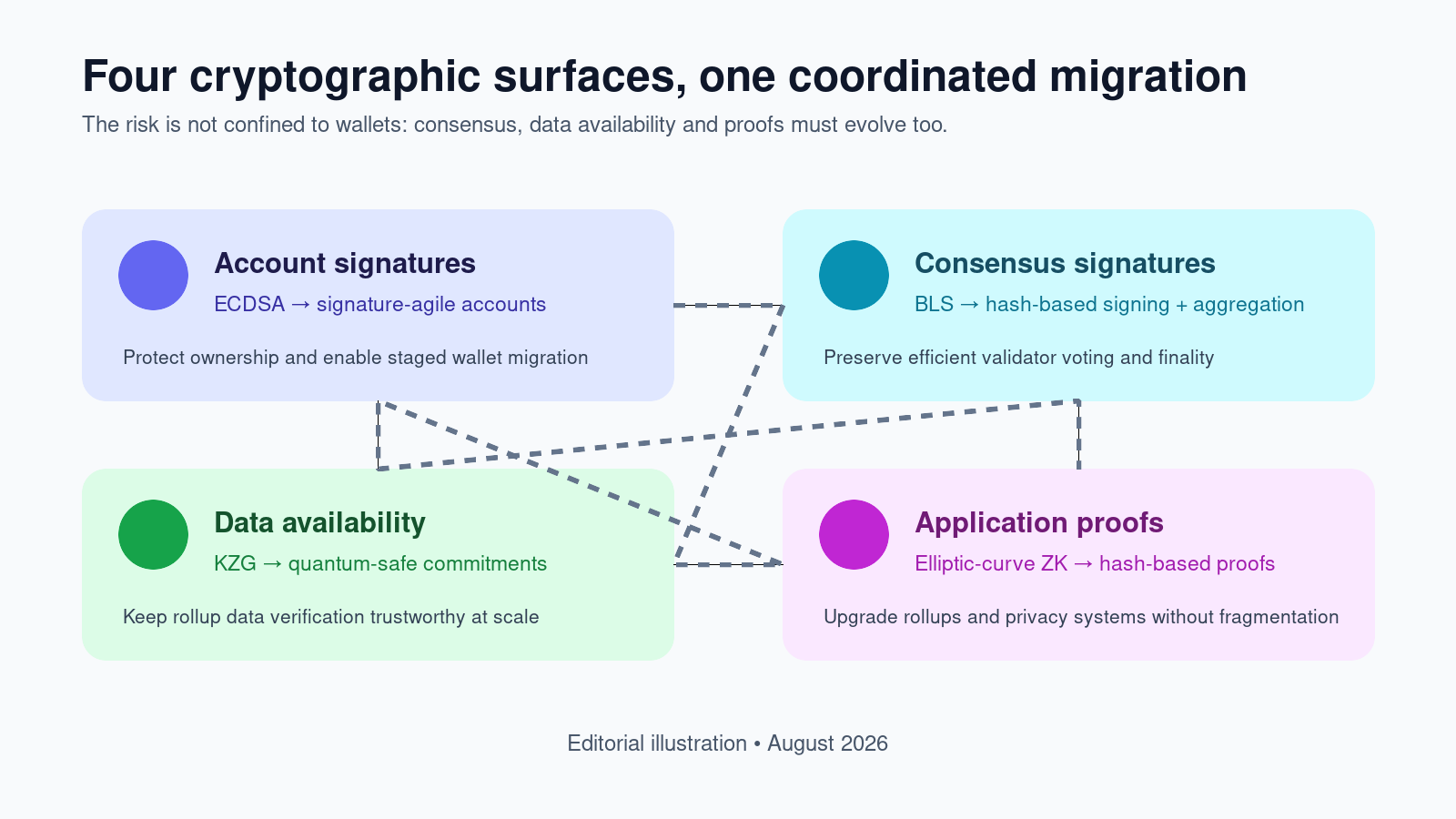
Account ownership is only one quadrant; consensus, rollup data and proof systems expand the coordination problem.
The current Ethereum roadmap names four cryptographic surfaces requiring upgrades.
Surface | Present role | Quantum-era failure mode | Direction of travel |
|---|---|---|---|
Account signatures | ECDSA authenticates externally owned account transactions | Shor’s algorithm could recover a private key from an exposed public key | Native account abstraction and quantum-resistant signature verification |
Consensus signatures | BLS efficiently aggregates validator votes | Forged validator signatures could compromise consensus | Hash-based validator signatures such as leanXMSS, with proof aggregation |
Data availability | KZG commitments support efficient blob and rollup data checks | Pairing-based commitments rely on quantum-vulnerable curve assumptions | Quantum-safe, hash-based commitment structures |
Application proofs | Many rollups and privacy applications use elliptic-curve ZK systems | Proof soundness can depend on vulnerable algebraic assumptions | Hash-based proof systems and application-specific migration |
The account problem is the easiest to explain and the most politically sensitive. In ordinary Ethereum transactions, the signature reveals enough information to recover the public key. A sufficiently capable quantum attacker could, in principle, derive the private key and race to spend the funds. Accounts whose public keys are already inferable—because they have transacted or reused keys—deserve particular migration attention. But users should not interpret that as a reason to move funds impulsively today: ethereum.org is explicit that no existing quantum computer can break Ethereum’s cryptography and that wallets should guide users when migration mechanisms are available.
Native account abstraction is important because it separates an account’s identity and behavior from a permanently fixed authentication scheme. Ethereum’s 2025 Pectra upgrade delivered EIP-7702, an intermediate step that lets externally owned accounts delegate to code. The more ambitious EIP-8141 proposal would embed smart-account logic more directly in the protocol. The current roadmap lists it as under consideration for Hegotá, now targeted for 2027. That status matters: it is neither deployed nor guaranteed for that upgrade. If adopted, signature-agile accounts could migrate individually instead of waiting for one universal flag day.
Consensus is harder. Ethereum uses BLS signatures because many validator attestations can be aggregated efficiently. Quantum-resistant signatures are generally larger and more expensive to verify. The roadmap describes leanXMSS, a hash-based validator-signature design, paired with leanVM, a minimal zero-knowledge virtual machine intended to aggregate the resulting signatures efficiently. This is not merely swapping algorithms; it is rebalancing bandwidth, proof generation, verification and validator operations while keeping finality dependable.
Data availability and application proofs broaden the blast radius. KZG commitments—central to Ethereum’s blob-based rollup scaling—use elliptic-curve pairings. Many succinct proofs used by rollups also depend on quantum-vulnerable algebra. Ethereum therefore cannot protect wallets while leaving its scaling stack untouched. The direction toward hash-based commitments and proofs may offer cleaner assumptions, but it brings performance costs and implementation risk. Applications also have their own upgrade authorities and timelines, so L1 readiness does not automatically make the broader ecosystem ready.
The migration sequence matters more than a date
NIST’s standards provide a useful baseline but not a turnkey Ethereum design. In August 2024, NIST finalized ML-KEM for key encapsulation, ML-DSA for lattice-based digital signatures and SLH-DSA for stateless hash-based signatures. NIST’s updated project guidance says these standards can and should be used now, and its transition planning anticipates deprecating and ultimately removing quantum-vulnerable algorithms from NIST standards by 2035, with higher-risk systems moving earlier.
Public blockchains differ from enterprise networks. Ethereum primarily needs signatures and commitment/proof systems rather than only confidential key exchange. Transaction size, onchain verification cost, aggregation, state growth and denial-of-service resistance all constrain algorithm choice. Standardization reduces cryptographic uncertainty; it does not remove protocol engineering.
sequenceDiagram
    participant R as Researchers and standards bodies
    participant P as Ethereum protocol and clients
    participant W as Wallets and custodians
    participant A as Applications and rollups
    participant U as Users and institutions
    R->>P: Validate algorithms and resource estimates
    P->>P: Run multi-client interop devnets
    P->>W: Introduce signature-agile account paths
    P->>A: Stabilize quantum-safe commitments and proofs
    W->>U: Offer tested migration and recovery flows
    A->>U: Upgrade contracts, bridges and proof systems
    U->>U: Rotate active and long-dormant holdings
    Note over P,U: Legacy rules and emergency procedures require social consensus
The safest sequence begins with crypto-agility: inventory the dependency graph, make authentication replaceable, benchmark alternatives, test them across independently implemented clients, and only then ask millions of users to move. Wallets and custodians need recovery paths, hardware support, clear signing and auditability. Rollups and bridges need synchronized upgrade plans. Institutions need policies for key rotation and proof that service providers can execute it. A nominally secure algorithm deployed through confusing interfaces could increase ordinary theft long before it reduces quantum risk.
Ethereum’s weekly post-quantum interop devnets are consequential for this reason. Multi-client testing turns a research claim into evidence about network coordination. The Ethereum Foundation’s approximate 2029 infrastructure target also aligns conceptually with Google’s own 2029 migration timeline, but neither should be read as a forecast of quantum capability or a binding Ethereum delivery date. They are management horizons.
The dormant-asset governance trap
The most difficult issue may not be cryptographic. It is deciding what happens to funds that do not migrate. Lost-key coins, forgotten wallets, estates in probate and long-term cold storage can remain under vulnerable public keys after an upgrade path exists. Once an attacker can derive old private keys, should the protocol freeze those assets, permit anyone to claim them, destroy them, or recognize some recovery procedure?
Every option violates a plausible principle. Allowing quantum theft honors old signature rules but rewards the attacker. Freezing assets protects value but gives protocol governance power over property. “Digital salvage” may return dormant value to circulation but creates identity, evidence and jurisdiction problems. Burning vulnerable coins avoids enrichment but changes supply and harms legitimate owners. An emergency fork after theft may restore balances while undermining finality and predictable settlement.
This is why a long voluntary migration window is more than technical caution: it improves legitimacy. Clear notice, repeated wallet prompts, institutional outreach and transparent deadlines reduce the number of ambiguous cases. Governance should define emergency thresholds and evidentiary standards before a crisis, when participants can still deliberate without a live attacker setting the clock.
Institutional implications
For asset managers, custodians and treasury operators, “Is Ethereum quantum safe?” is the wrong diligence question. Better questions are concrete and observable:
Which key types, smart contracts, bridges and settlement providers expose elliptic-curve dependencies?
Can the custody stack adopt a new signature scheme without changing beneficial ownership or creating an unaudited recovery channel?
Does the provider test migration across hot, warm and deep-cold storage, including inactive client accounts?
What contractual rules govern assets that fail to migrate before a protocol deadline?
Are rollup settlement and bridge security covered, or only the L1 wallet key?
The answer should become a living cryptographic inventory, much like a software bill of materials. Institutions should monitor official roadmap status rather than market rumors; proposals under consideration are not shipped features. They should also distinguish routine key hygiene from quantum-specific action. Avoiding unnecessary key reuse and maintaining recoverable, current wallet software are sensible, but panic transfers to untested “quantum-safe” products could create immediate conventional risk.
For Ethereum, post-quantum work can generate benefits before a quantum computer arrives. Native account abstraction can improve recovery and authentication choice. Hash-based structures can reduce reliance on specialized algebraic assumptions. Better client interoperability tests strengthen ordinary upgrade safety. The investment is therefore partly an option on resilience, not only insurance against one exotic threat.
Risks and counterarguments
The strongest counterargument is opportunity cost. Ethereum is already pursuing scaling, censorship resistance, simpler state structures and better user experience. Post-quantum primitives can impose large signatures, heavier proofs and new code paths. Over-prioritizing a distant risk could slow improvements that users need now or add vulnerabilities through immature cryptography.
That argument is valid against premature activation, but weaker against research, crypto-agility and rehearsal. The roadmap appropriately separates active experimentation from scheduled deployment. The current page labels the roughly 2029 milestone as a target that may shift and EIP-8141 as merely being considered for Hegotá. Responsible reporting must preserve those qualifiers.
A second risk is monoculture. NIST standards are important, but no single family should become an unquestioned dependency. Ethereum’s environment rewards minimal assumptions, multiple implementations and adversarial review. Hash-based approaches have attractive quantum-resistance properties, yet operational details—state management, signature sizes, proof systems and aggregation—still matter.
A third risk is false precision. Quantum timelines are notoriously uncertain. The Google paper improves a resource estimate; it does not predict when error-corrected machines with the assumed scale and performance will exist. Conversely, a lack of a reliable date does not imply infinite time. Planning should be milestone-driven: track logical-qubit quality, error-correction overhead, clock speed, demonstrated circuit depth, protocol benchmarks and migration coverage rather than repeating a single year.
Finally, migration itself is an attack surface. Phishing campaigns will exploit quantum headlines. Fake wallet upgrades, malicious signature modules and rushed bridge changes may steal more than quantum computers for years. Clear signing, authenticated release channels, reproducible software and conservative defaults belong inside the post-quantum program, not beside it.
Conclusion
Ethereum is not facing a quantum break in August 2026. It is facing a coordination deadline whose exact date is unknowable. The March resource estimates strengthen the case for starting early because they reduce one dimension of required hardware while leaving formidable engineering barriers intact. Ethereum’s response—dedicated staffing, public research, weekly multi-client devnets, signature-agility proposals and work on hash-based consensus and state structures—is credible evidence of preparation. It is not evidence that the migration is finished.
The benchmark for success should be graceful change: users can adopt new authentication without surrendering ownership; validators can change signatures without destabilizing finality; rollups can replace commitments and proofs without fragmenting liquidity; and the community has legitimate rules for assets that remain behind. If those capabilities exist before quantum hardware forces the issue, Ethereum will have converted an unpredictable cryptographic threat into a managed operational transition. That is the real meaning of post-quantum readiness.
Sources
Ethereum.org — A more secure Ethereum (current roadmap, updated in 2026)
Google Research — Safeguarding cryptocurrency by disclosing quantum vulnerabilities responsibly
Google Research — Securing Elliptic Curve Cryptocurrencies against Quantum Vulnerabilities
NIST — Stateless Hash-Based Digital Signature Standard, FIPS 205