Glamsterdam’s Capacity Bargain: Ethereum Tries to Scale Without Hiding the Bill
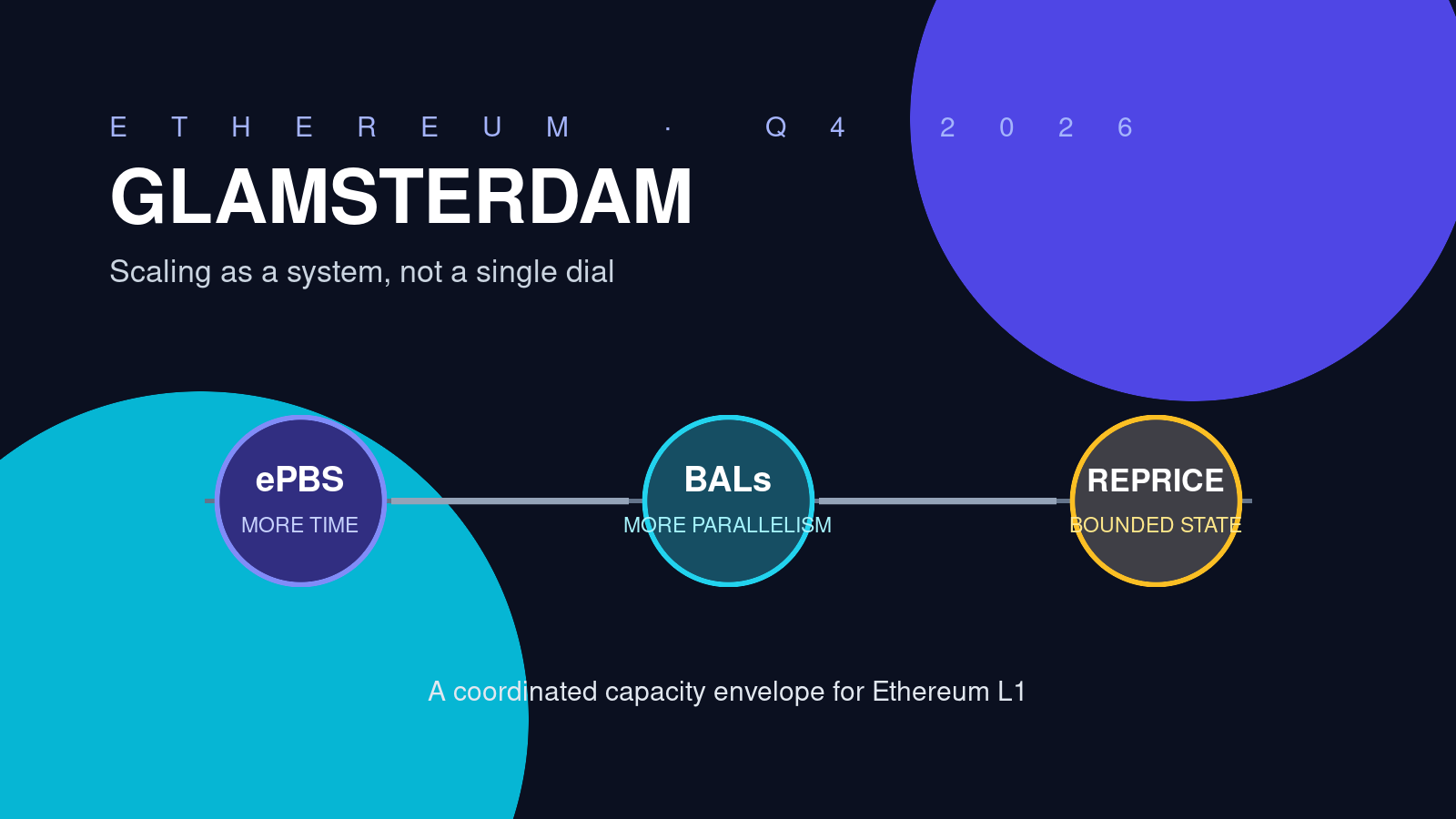
Lead image: Glamsterdam links more propagation time, parallel-ready execution and sustainable state pricing; none is sufficient alone.
Research date: 12 August 2026
Executive summary
Ethereum’s next upgrade is best understood not as a promise of “faster Ethereum,” but as a renegotiation of the constraints under which Layer 1 capacity can safely grow. The official Ethereum roadmap, updated on 6 August, now places Glamsterdam in Q4 2026. Its two headline changes—enshrined proposer-builder separation (ePBS) and Block-Level Access Lists (BALs)—are complemented by a repricing of state creation. Together they address three different bottlenecks: insufficient time to propagate and validate large payloads, inefficient discovery of execution dependencies, and the permanent storage burden created when higher throughput expands Ethereum’s state.
The thesis of this report is that Glamsterdam matters institutionally because it turns scaling from a one-dimensional gas-limit debate into an explicit capacity bargain. ePBS moves a critical builder–proposer exchange into consensus and extends the useful payload propagation window from roughly two seconds to about nine. BALs attach an authenticated map of block-level state accesses and resulting values, allowing parallel reads and preparing clients for parallel execution and faster synchronization. EIP-8037 raises and regularizes the price of creating state, with the stated design target of limiting worst-case state growth to 120 GiB per year. The Ethereum Foundation’s May interop report said these three strands supported a credible 200 million post-Glamsterdam gas-limit floor, versus the 60 million baseline cited in its April update. That is an engineering target, not a mainnet promise or throughput guarantee.
For asset managers, payment firms, rollups, exchanges and infrastructure providers, the relevant outcome is therefore not a headline transactions-per-second number. It is a potentially larger and more predictable settlement envelope, paired with fewer off-protocol trust dependencies—but also a more complex slot, a new builder collateral and payment mechanism, higher state-creation costs for some applications, and substantial client and operational change. The investment-grade stance is constructive but conditional: treat Q4 and 200 million as milestones to monitor, not assumptions to capitalize in advance.
Why the upgrade is timely
Ethereum has spent several upgrades separating different kinds of scaling work. Pectra arrived in May 2025; Fusaka followed in December 2025 and introduced PeerDAS, allowing validators to sample blob data rather than download all of it. Blob-only parameter forks then raised the target and maximum blob counts without requiring another full feature fork. Glamsterdam turns attention back to the execution and block-production envelope of Layer 1.
That shift matters because merely raising the gas limit can transfer costs to the least visible part of the system: the operators who must receive, execute, store and serve the resulting chain. Ethereum’s decentralization claim depends partly on multiple independent client implementations and the ability of non-industrial operators to verify the chain. Capacity that works only on the fastest client, on premium hardware, or behind a small number of middleware providers is not equivalent to broadly verifiable capacity.
The official Glamsterdam overview describes three goals: parallelization, expanded capacity and sustainable database growth. This framing is more useful than treating the named EIPs as isolated features. The Soldøgn interop recap reports that more than 100 core contributors stress-tested multi-client implementations and converged on a 200 million gas-limit floor as credible after the upgrade. More recently, an ethPandaOps investigation examined how consensus clients emitted the new ePBS-related event types on glamsterdam-devnet-6 from 25 June through 9 July. That is evidence of increasingly concrete interoperability work, not proof of production readiness.
timeline
    title Ethereum's route to the Glamsterdam capacity envelope
    2025-05 : Pectra activates
            : Account and validator improvements
    2025-12 : Fusaka activates
            : PeerDAS changes blob data handling
    2026-01 : Second blob-parameter fork
            : Target 14, maximum 21 blobs per block
    2026-05 : Soldøgn multi-client interop
            : 200M post-upgrade floor judged credible
    2026-06 : Glamsterdam devnet-6 begins
            : ePBS event behavior observed across clients
    2026-Q4 : Official target window
            : Mainnet date still requires testing and client readiness
The three-part engineering bargain
1. ePBS buys time and internalizes a trust boundary
Ethereum block production already separates economic roles. Specialized builders assemble valuable execution payloads, while the validator selected as proposer chooses a bid and proposes the consensus block. Today, much of that exchange is coordinated through MEV-Boost and relays outside the core protocol. This arrangement has helped create a competitive block-building market, but it puts a consequential hand-off—and its liveness and trust assumptions—into middleware.
EIP-7732 enshrines that separation. The proposer can include a builder’s commitment, the builder later reveals the execution payload, and a Payload Timeliness Committee attests whether it arrived on time. Payments and failure cases become consensus concerns. Ethereum.org says the revised slot structure expands the payload propagation window from roughly two seconds to about nine seconds, giving clients more time to handle larger execution payloads and blob data.
This is not the abolition of builders, auctions or relays. Specialized order flow and richer auction services can remain outside the protocol. The narrower achievement is to make the minimum exchange of payload for payment trustless at the protocol layer. For institutions, that reduces reliance on a middleware layer in the critical path, but it does not eliminate block-building concentration, private order flow or censorship risk.
flowchart LR
    U[Users and applications] --> M[Public or private order flow]
    M --> B[Builder assembles execution payload]
    B -->|Bid and commitment| P[Selected proposer]
    P --> C[Consensus block]
    B -->|Payload reveal| E[Execution payload]
    C --> A[Validators attest to consensus]
    E --> T[Payload Timeliness Committee]
    T --> F{Payload timely?}
    F -->|Yes| S[Protocol settles builder payment]
    F -->|No| R[Protocol applies failure path]
The extra structure creates new failure modes as well as removing old ones. The April Checkpoint #9 called ePBS a major sticking point because every client must reason about partial blocks and a two-party sequence inside consensus. At Soldøgn, teams still debated how a low-collateral builder design could resist peer-to-peer Sybil attacks. By August, ePBS is materially more mature, but the correct conclusion is “hardening in progress,” not “risk solved.”
2. BALs turn execution from discovery into scheduling
Ethereum execution is difficult to parallelize because a node normally discovers which accounts and storage slots a transaction touches only by executing it. Two apparently unrelated transactions may contend for the same state. Speculative execution is possible, but conflicts create wasted work and implementation complexity.
EIP-7928 requires each block to carry a block-level access list: an authenticated record of the accounts and storage locations read or written, together with relevant post-execution results. Once nodes have that map, they can preload state, perform disk reads concurrently, identify non-conflicting work and calculate parts of the state transition in parallel. A companion networking change lets peers exchange these lists.
BALs should not be confused with instant, unlimited parallel execution. The near-term benefit includes parallel I/O and more deterministic scheduling; client implementations still have to convert the information into reliable performance. Their strategic value is that they make dependencies explicit at the protocol boundary. This also supports “executionless” state synchronization, in which a syncing node can apply authenticated results rather than replay every historical transaction, while the consensus rules still require validation of the commitment.
For an institution operating its own node or relying on several providers, faster and more predictable synchronization can matter as much as raw transaction throughput. Recovery time, failover capacity and the ability to diversify RPC or custody infrastructure are operational risk variables. BALs potentially improve those variables, but they also enlarge block data and introduce a new consensus-critical artifact whose construction and verification must agree across clients.
3. State repricing makes permanent storage visible
Higher gas limits permit more computation, but not all gas has the same long-run cost. A transient calculation disappears after execution; a new account, storage slot or contract adds to the state that nodes must retain. If prices undercharge permanent state creation, increasing throughput accelerates database growth and silently raises hardware requirements.
EIP-8037 addresses this mismatch with a fixed cost per state byte and a separate accounting reservoir. The current official overview says the parameters target a maximum state-growth rate of 120 GiB per year. Soldøgn participants abandoned a dynamic price linked to the block gas limit because it multiplied testing combinations; future adjustments would instead occur at fork boundaries. That choice favors determinism and auditability over automatic adaptation.
This is the least marketable and perhaps most consequential part of the package. State repricing means some deployments and state-heavy applications can become more expensive even while ordinary transfers may become cheaper under another scheduled proposal, EIP-2780. “More capacity” therefore does not mean every operation falls in price. The protocol is attempting to make prices more truthful: cheaper where work is overcharged, dearer where permanent externalities are undercharged.
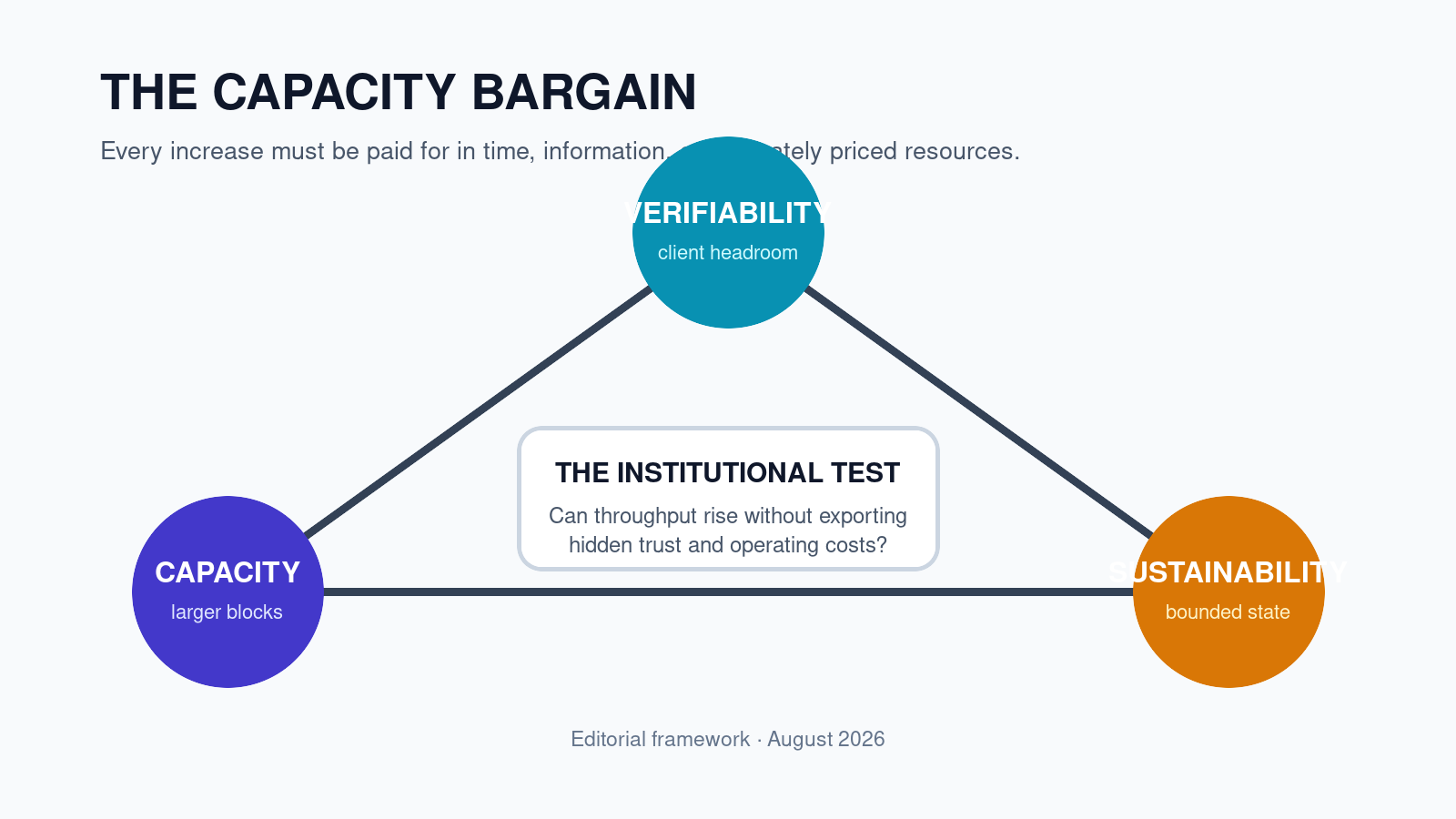
Editorial framework: a credible gas-limit increase must balance user capacity with client headroom and bounded long-term state growth.
What changes for institutions and the rollup economy
The most direct institutional benefit is more headroom for settlement, issuance and high-value execution on Layer 1. A larger gas envelope can absorb bursts of demand with less fee pressure, while the longer propagation window reduces the odds that only exceptionally well-connected operators can keep up. Greater L1 capacity also helps rollups indirectly: they settle proofs, manage bridges and publish certain transactions on L1 even when their bulk data uses blobs.
The second benefit is architectural. Enshrining the minimum proposer-builder exchange reduces a relay trust dependency at the base layer. Institutions evaluating Ethereum as neutral infrastructure should care about who can interrupt inclusion and which relationships are contractual, social or enforced by consensus. ePBS moves one important relationship into the last category.
The third is operational predictability. BALs and more accurate gas pricing create better information about what blocks touch and what state costs. That can improve node performance and fee modeling. Yet adoption will not be frictionless. Validators must update both execution and consensus clients; staking pools may need changes to monitor builder behavior and handle the revised slot. Exchanges, custodians and RPC providers will need conservative maintenance windows and diversified client testing.
For rollups, the signal is nuanced. Glamsterdam does not reverse the rollup-centric roadmap, and PeerDAS remains the data-availability foundation for blob scaling. More L1 execution capacity could make mainnet economically usable for a broader set of transactions, but L2s retain structural advantages for high-frequency and application-specific execution. The likely effect is complementarity: a roomier settlement layer beneath a larger rollup economy, not a winner-takes-all migration back to L1.
Risks, counterarguments and what would falsify the thesis
Schedule risk. Q4 2026 is a target, not an activation date. Ethereum’s process requires stable devnets, client releases, security review and public testnets before mainnet scheduling. The official roadmap itself warns that development is community-driven and subject to change. Any capital or operational plan that assumes a specific quarter should include slippage.
Complexity risk. ePBS adds protocol machinery for commitments, reveal timing, payment and partial-block failure. BALs add data and cross-client consensus requirements. Each feature solves a real bottleneck, but their interaction enlarges the testing surface. A delay caused by safety work would be evidence of responsible engineering, though it would still postpone economic benefits.
Centralization may move rather than disappear. Protocol-level PBS can remove dependence on trusted relays for the basic exchange without decentralizing builder market share or private order flow. Larger blocks may still favor high-performance operators. The thesis would weaken if post-upgrade measurements showed rising missed slots, worsening client concentration, or a durable advantage for data-center nodes despite the longer window.
The 200 million figure can be misunderstood. Soldøgn described a credible post-upgrade floor, and the latest ethereum.org page notes that state pricing is currently derived using a 150 million reference block. Neither is an unconditional mainnet setting. Gas limit changes ultimately depend on validator behavior and observed safety margins. Users should track finalized parameters and production telemetry rather than multiply today’s activity by a headline ratio.
State pricing has distributional effects. EIP-8037 protects node sustainability by charging permanent state more accurately, but state-heavy protocols and contract deployment bear more of the cost. Developers may compress storage, use events or move activity to L2; poorly designed applications may simply pass costs to users. Sustainability is a system benefit with identifiable losers at the application layer.
Monitoring framework
Before treating Glamsterdam as delivered, institutional observers should watch four gates. First, do diverse execution and consensus clients maintain stable interoperability under adversarial and high-load tests? Second, does the final mainnet scope preserve the three-way balance between slot time, parallel-ready execution and state control? Third, after activation, do missed-slot rates, reorg behavior, node resource use and builder concentration remain acceptable? Fourth, do fee and capacity benefits appear during real demand spikes rather than only in synthetic benchmarks?
The current evidence clears an important but intermediate bar. Glamsterdam has moved beyond paper specifications: the May interop week produced multi-client pipelines and benchmarking, June’s devnet-6 supported observation across implementations, and the August roadmap names the scheduled features and Q4 window. It has not cleared the production bar because no final activation date or post-mainnet operating record exists.
Conclusion
Glamsterdam’s central idea is disciplined abundance. Ethereum can raise capacity only if it creates more time for payloads, more information for clients and a more honest price for permanent state. ePBS, BALs and EIP-8037 are therefore interdependent pieces of a capacity envelope, not three unrelated upgrades.
If the package works as intended, Ethereum will have done more than raise a number: it will have internalized a critical trust boundary, prepared execution for parallelism and bounded an externality that otherwise accumulates on every node. That is meaningful for institutions because neutral settlement infrastructure is valuable only when its verification costs and failure dependencies remain intelligible. The counterweight is equally clear. Q4 is a target, 200 million is an engineering judgment, and new consensus machinery must earn trust in production.
The appropriate conclusion on 12 August 2026 is neither hype nor dismissal. Glamsterdam is one of Ethereum’s most consequential scaling redesigns since the rollup roadmap took shape, and the implementation evidence is advancing. Its success should be judged not by peak throughput alone, but by whether Ethereum can increase useful capacity without making independent verification, client diversity or credible neutrality the hidden bill.