Britain’s Stablecoin Bet: A £40 Billion Test of Private Money with a Central-Bank Anchor
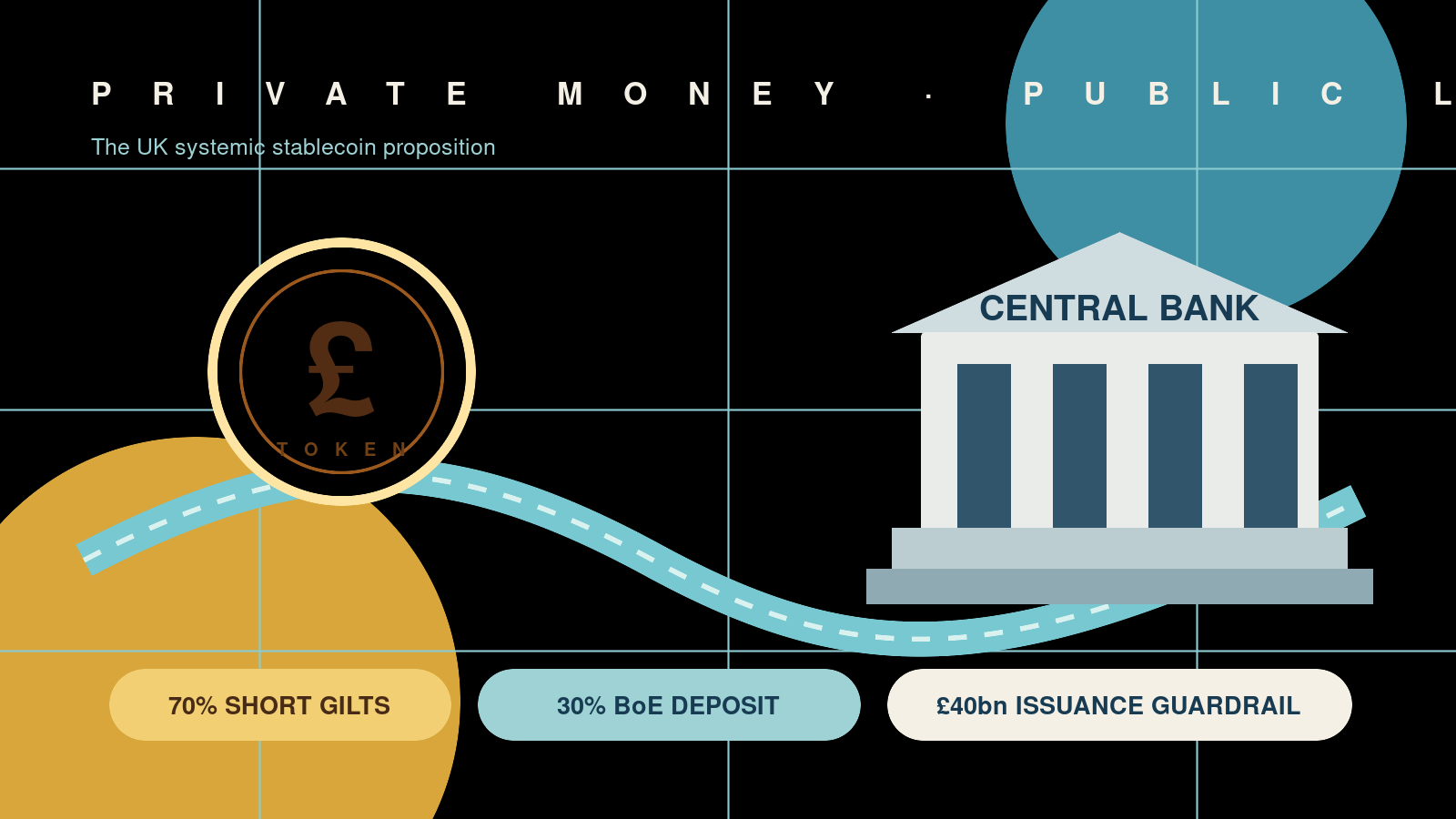
Britain’s proposed model places programmable private money on top of a deliberately conservative reserve and redemption structure. Editorial illustration.
Published 11 August 2026 — Research report
Executive summary
The United Kingdom is no longer debating stablecoins as a peripheral crypto product. It is designing the conditions under which a sterling token could become money used at systemic scale. The Bank of England’s June 2026 policy statement and draft Code of Practice make that ambition unusually concrete: each systemic stablecoin would be backed one-for-one, in steady state, by 70% short-term UK government debt and 30% unremunerated deposits at the Bank; valid redemption requests would be completed in real time where possible and otherwise within a rolling 24-hour window; and each coin would initially face a £40 billion issuance guardrail. Responses are due by 22 September, with final rules intended by year-end.
The decisive change from the Bank’s 2025 consultation is not simply numerical. The Bank abandoned proposed per-user holding limits—£20,000 for individuals and £10 million for businesses—in favour of a cap on the aggregate issuance of each systemic coin. That transfers complexity away from wallets and payment applications and onto issuers and supervisors. Households and businesses could use the instrument without balance policing, while the authorities retain a macroprudential brake on the migration of deposits out of banks.
Our thesis is that the UK is attempting a difficult synthesis: make stablecoins behave like competitive, programmable private money in normal times, while giving them a public-money liquidity anchor in stress. The architecture is more coherent than treating stablecoins only as investment products. It is also commercially exacting. Thirty percent of backing would earn no return, issuers may not pay interest to holders, and direct payment-system access, operational resilience, trust arrangements and capital resources add substantial fixed costs. The regime may therefore produce credible sterling money without necessarily producing a large sterling stablecoin market.
That distinction matters. Success should not be measured only by issuance. A smaller but interoperable sterling instrument could improve cross-border settlement, merchant payments and tokenised-asset cash legs. Conversely, a high market capitalisation achieved without reliable convertibility would be the wrong victory. The policy’s real test is whether par redemption remains unquestioned across a 24/7 token network and a banking system with operating hours, compliance gates and finite liquidity.
What the Bank is actually building
The legal perimeter is layered. The Financial Conduct Authority regulates UK issuance, custody and admission to trading of qualifying stablecoins. When HM Treasury recognises a payment system as systemic—because disruption could threaten financial stability or have serious economic consequences—the issuer enters joint Bank–FCA supervision. The Bank’s remit is therefore not every stablecoin used by a UK customer. It is the subset that becomes widely used as money and consequential to the financial system. Crypto trading, still the predominant stablecoin use according to the Bank, remains outside this systemic layer.
This is best understood as a conversion promise. A holder accepts a token at £1 because the issuer owes £1, segregates the assets supporting that obligation and can turn those assets into settlement money quickly. Technology supplies transferability and programmability; the legal claim, reserve pool and redemption mechanism supply monetary credibility.
flowchart LR
    U[Household or business] -->|£1 subscription| I[Systemic stablecoin issuer]
    I -->|mints 1 token| U
    I --> G[70% short-term UK government debt<br/>residual maturity up to 6 months]
    I --> B[30% unremunerated<br/>Bank of England deposit]
    U -->|token payment, 24/7| M[Merchant or counterparty]
    M -->|valid redemption request| I
    B -->|central-bank settlement liquidity| I
    G -->|sale or permitted repo liquidity| I
    I -->|face-value sterling, normally ≤24 hours| M
The 70/30 reserve split is the regime’s economic centre. It replaces the 60/40 split proposed in 2025 and is calibrated, the Bank says, against historical liquidity stress. Eligible government debt must have no more than six months’ residual maturity. Overnight repo and reverse repo are permitted within defined safeguards, but commercial-bank deposits are excluded from systemic backing because they could transmit stress between an issuer and the banking sector. The central-bank deposit portion remains unremunerated because the Bank sees the token as a payment instrument, not a savings product or channel of monetary-policy transmission.
The result resembles neither a narrow bank nor a conventional money-market fund. It has no loan book, must maintain one-to-one backing, and cannot promise yield to holders. Yet it is more operationally ambitious than a fund share: it is expected to circulate, settle continuously and redeem at face value. Activity-based rewards can be allowed, but payments tied to how long a holder retains the coin are prohibited.
From wallet limits to a system-level brake
The most consequential revision is the replacement of individual limits with an issuance guardrail. Under the 2025 proposal, an issuer and its distribution network would have needed to identify holdings across wallets and enforce limits in a pseudonymous, multi-chain environment. Industry respondents warned that this was costly, difficult to operate and liable to push demand toward non-sterling coins. A user could also spread balances among addresses or custodians unless identity and holdings were continuously reconciled across the ecosystem.
The £40 billion guardrail is simpler because the issuer already knows total tokens outstanding. It is initially applied per systemic stablecoin, reviewed regularly and intended to disappear after risks to credit provision are addressed. The Bank says it was sized to preserve the same policy objective as holding limits: slow a potentially disruptive shift from commercial-bank deposits into stablecoins while the financial system adapts.
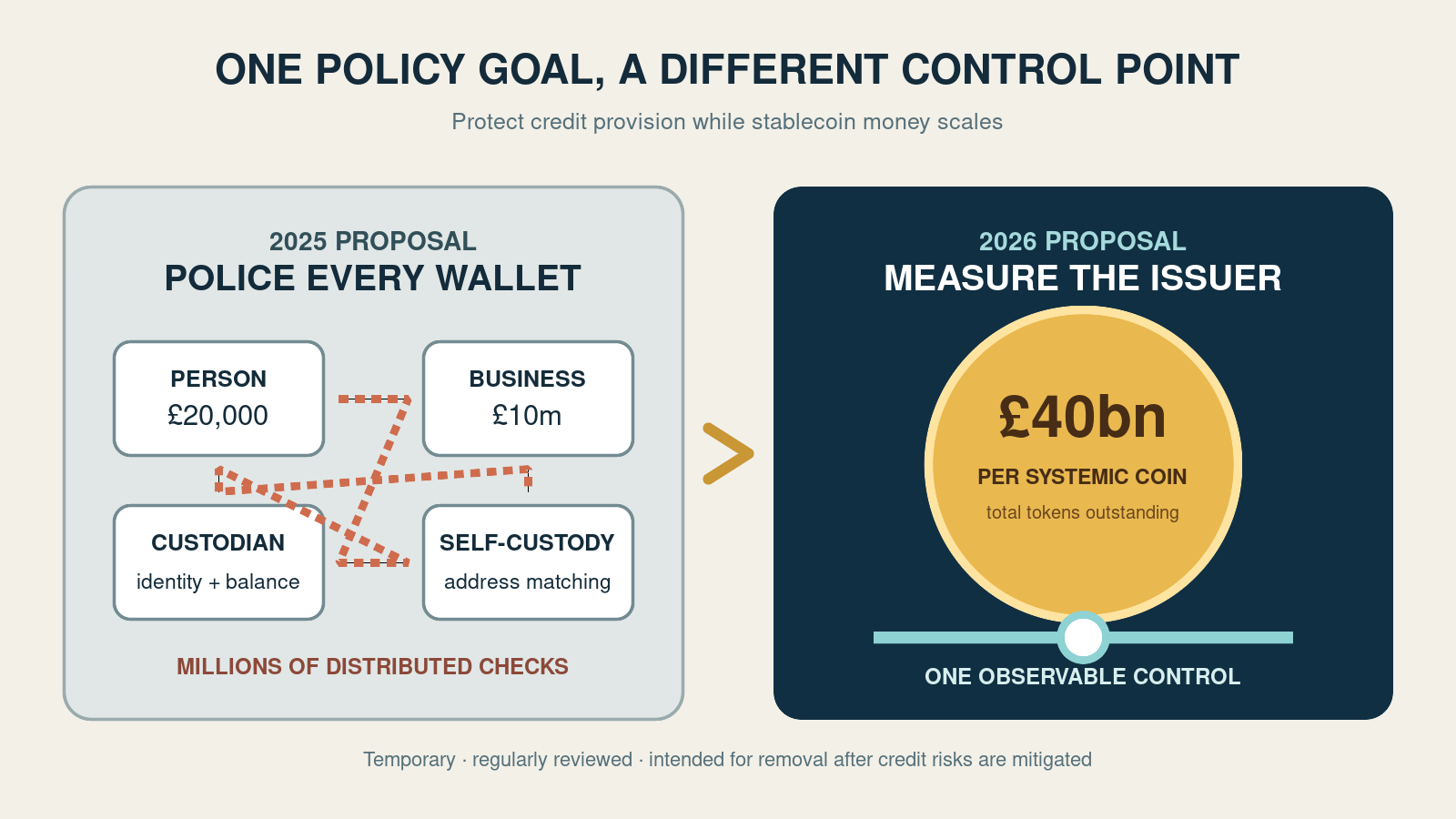
The policy moved enforcement from millions of user balances to one observable quantity at each issuer: total issuance. Editorial illustration.
That is a meaningful improvement in design, but not a neutral one. A per-coin cap could encourage a fragmented market in which several issuers each approach £40 billion, although recognition decisions and future calibration give supervisors tools to respond. It also creates a threshold effect for successful issuers. Once close to the ceiling, a coin may need waiting lists, controlled minting or secondary-market price incentives. If demand cannot be met through new issuance, the token could trade above par—even though the policy is intended to protect par convertibility.
The guardrail also targets only one transmission channel. Deposit migration can reduce bank funding and potentially constrain credit, but the effect depends on where reserve cash ultimately lands. Purchases of Treasury bills may recycle funds through government accounts and markets; central-bank deposits change the composition of central-bank liabilities; banks can replace deposits with wholesale funding, albeit often at a higher price. The £40 billion figure is thus a prudential boundary, not a forecast that the forty-billion-and-first pound would mechanically remove credit from the economy.
Redemption is the product
For users, a stablecoin’s apparent product is instant token transfer. For the monetary system, the product is dependable conversion at par. The draft framework requires issuers to process a complete redemption in real time where possible and otherwise within 24 hours on a rolling basis. The clock begins only after the request is received, anti-money-laundering and know-your-customer checks are complete, and the coins have reached the issuer’s wallet. It stops when the issuer sends a valid payment order to the holder’s account.
This definition is operationally honest but exposes the seam between two worlds. On-chain transfers can run continuously; bank screening, account access and payment rails may not. The headline “24 hours” therefore does not measure the user’s entire elapsed experience if compliance checks delay completion. Nor does it ensure the receiving bank immediately credits funds. Institutions should examine the full service-level chain, not only the regulated stopwatch.
The Bank expects systemic issuers to obtain direct access to payment systems rather than depend indefinitely on a sponsoring bank. Combined with a Bank of England deposit account, direct access reduces intermediary risk and gives issuers settlement liquidity for redemptions. A planned central-bank liquidity facility would provide a backstop against eligible collateral. This is a striking policy choice: private issuers receive infrastructure associated with trusted money, but only after accepting narrow assets, supervision and failure-planning obligations.
sequenceDiagram
    participant H as Holder
    participant W as Wallet or intermediary
    participant I as Issuer
    participant C as Compliance checks
    participant P as UK payment system
    participant R as Receiving bank
    H->>W: Submit redemption and tokens
    W->>I: Forward request
    I->>C: Complete AML/KYC validation
    C-->>I: Full request confirmed
    Note over I,P: Rolling 24-hour regulatory clock starts
    I->>P: Send valid sterling payment order
    Note over I,P: Regulatory clock stops
    P->>R: Settle in central-bank money
    R-->>H: Credit account
Safeguarding is the other half of redemption. The Bank proposes two statutory trusts: one protecting the coinholders’ backing assets and another supporting orderly wind-down and return of funds. Backing pools may contain a 5% excess. Separate capital for general business risk must equal the higher of six months’ operating expenses or the cost of recovery and orderly wind-down, excluding the wind-down reserve. These layers aim to prevent an operating-company failure from consuming assets owed to holders.
A regime arriving as payment rails converge
The rules are timely because stablecoin settlement is moving from crypto-native venues into multi-rail payment businesses. In May, Corpay said it had added JPMorgan’s Kinexys private blockchain and BVNK stablecoin interoperability to a platform already spanning SWIFT, local real-time schemes and proprietary rails. In June, Visa and Brale announced a proof of concept using a dollar-backed stablecoin on the privacy-focused Canton Network for institutional settlement. These are not proof that stablecoins will displace cards or bank deposits. They are evidence that established payment firms increasingly treat tokenised settlement as one route among several.
An IMF working paper published in March offers stronger but carefully bounded evidence. Studying listed payment companies’ share-price response around the decisive US congressional vote on the GENIUS Act, the authors estimate that legislation supportive of stablecoins reduced incumbent payment firms’ market value by 18%, or roughly $300 billion. The estimated effect was larger for cross-border specialists and smaller for firms protected by network effects or already engaged with crypto. This is an inference from financial-market expectations, not observed displacement or a forecast of stablecoin revenue. Still, it supports the proposition that regulatory credibility can change competitive expectations before payment volumes move.
The international comparison highlights the UK’s distinctive bargain. The US GENIUS framework requires one-to-one reserves and allows a broader set that includes insured-bank deposits, short-dated Treasuries, qualifying repos and government money-market funds; it also prohibits issuer-paid interest. Britain’s systemic tier is narrower in reserve composition and uniquely embeds a substantial unremunerated central-bank balance. The UK is accepting a lower issuer margin in exchange for stronger immediate liquidity and a cleaner separation from commercial-bank risk.
Design question | UK systemic proposal | Strategic implication |
|---|---|---|
Who supervises? | Bank of England and FCA after HM Treasury recognition | Conduct and financial-stability oversight converge as scale rises |
What backs the coin? | 70% short-term UK government debt; 30% unremunerated BoE deposits | High liquidity, but a structural drag on issuer economics |
How is growth constrained? | Temporary £40bn issuance guardrail per systemic coin | Simple to monitor; may create fragmentation or scarcity near the cap |
What can holders earn? | No issuer-paid holding-period interest; activity rewards permitted | Positions the token as transactional money rather than savings |
How fast is redemption? | Real time where possible; otherwise within 24 hours after a full request | Strong promise, with compliance and banking seams still material |
Implications for institutions
For banks, the framework is both defensive and enabling. Deposit substitution could raise funding costs, which motivates the guardrail. Yet banks can serve as custodians, distributors, compliance providers and gateways between token and account money. The firms best positioned may be those that treat stablecoins as part of a routing stack rather than as a standalone product.
For issuers, scale alone will not repair weak unit economics. The interest earned on 70% of reserves must fund technology, compliance, trust administration, liquidity, capital, distribution and potentially rewards, while 30% sits unremunerated. When rates fall, gross reserve income falls too. A viable model may require merchant services, foreign-exchange conversion, programmable treasury tools or distribution partnerships rather than reliance on reserve yield.
For corporate treasurers, the key questions are legal and operational: who holds the direct claim, how quickly does a complete redemption become bank money, what happens when an intermediary fails, which chain governs finality, and can balances be reconciled across weekends? “Regulated” should not be treated as a substitute for counterparty, chain and workflow due diligence.
For the gilt market, systemic issuance could create a new source of demand for bills of six months or less. The Bank notes that HM Treasury and the Debt Management Office are considering how stablecoin demand may inform bill issuance and secondary-market liquidity. But the guardrail bounds this channel initially, and actual demand will depend on sterling adoption rather than regulatory capacity.
Risks and counterarguments
The strongest counterargument is that the regime may be safe enough to be irrelevant. Dollar stablecoins already benefit from global liquidity, exchange integration and network effects. A sterling issuer facing a 30% zero-yield allocation and UK-specific infrastructure costs must persuade users to switch without paying holding interest. Regulatory prestige does not create distribution.
Second, central-bank support can blur the public–private boundary. Access to deposits and a future liquidity facility strengthens confidence, but it may also encourage users to assume a guarantee that does not exist. Clear disclosures and credible failure execution must prevent “central-bank eligible” from being read as “state insured.”
Third, operational risk does not disappear with safe assets. Smart-contract defects, compromised keys, chain outages, sanctions screening, fraud disputes and outsourced wallet failures can interrupt the conversion promise. The issuer remains responsible for outsourced redemptions, but responsibility after failure is not the same as uninterrupted service during failure.
Finally, a national framework cannot by itself solve cross-border interoperability. A sterling token may move globally, but local licensing, data rules, foreign-exchange liquidity and wallet standards still determine whether a recipient can use it. Privacy requirements are especially important for institutional payments: Visa’s Canton experiment underscores that public verifiability and commercial confidentiality must be reconciled, not assumed.
Conclusion
Britain’s proposal is an attempt to define what a systemic stablecoin must be before one exists at systemic sterling scale. Its central insight is sound: credible digital money is not created by a peg declaration but by a legal claim, segregated low-risk assets, immediate liquidity and a tested route back to central-bank money. Replacing user holding limits with an issuer-level guardrail removes a major practical obstacle and makes the policy easier to supervise.
The remaining question is economic. The same features that make the instrument trustworthy—unremunerated central-bank reserves, no holder interest, direct access requirements, capital and two trust layers—make issuance costly. That is not necessarily a flaw. Payments infrastructure should be judged by resilience as well as growth. But it means the UK’s stablecoin bet will be won only if issuers find real payment utility that users value enough to overcome dollar network effects and thin margins.
The consultation ending 22 September is therefore more than a calibration exercise. It is the last major opportunity to test whether the proposed balance between public liquidity and private innovation can work under stress and as a business. If it can, Britain will have built a credible bridge between token networks and sovereign money. If it cannot, the architecture may remain exemplary on paper while settlement activity chooses other currencies and rails.
Sources
Bank of England, “Sterling-denominated systemic stablecoins” policy statement and draft Code of Practice, 22 June 2026.
Bank of England, news release on the draft systemic-stablecoin rules, 22 June 2026.
FCA, joint approach to regulation of systemic stablecoin issuers, 30 June 2026.
FCA, PS26/10: Stablecoin issuance, 30 June 2026.
HM Revenue & Customs, Taxation of Stablecoins: government response, updated 13 July 2026.
US Congress / Congressional Research Service, GENIUS Act overview, updated July 2025.
IMF, “Stablecoins and the Future of Payments: Evidence from Financial Markets”, Working Paper 26/52, March 2026.
Visa, Visa and Brale private stablecoin settlement proof of concept, 4 June 2026.
Corpay, blockchain infrastructure agreements with JPMorgan and BVNK, 5 May 2026.