Ethereum’s Quantum Migration Has Become a Governance Test
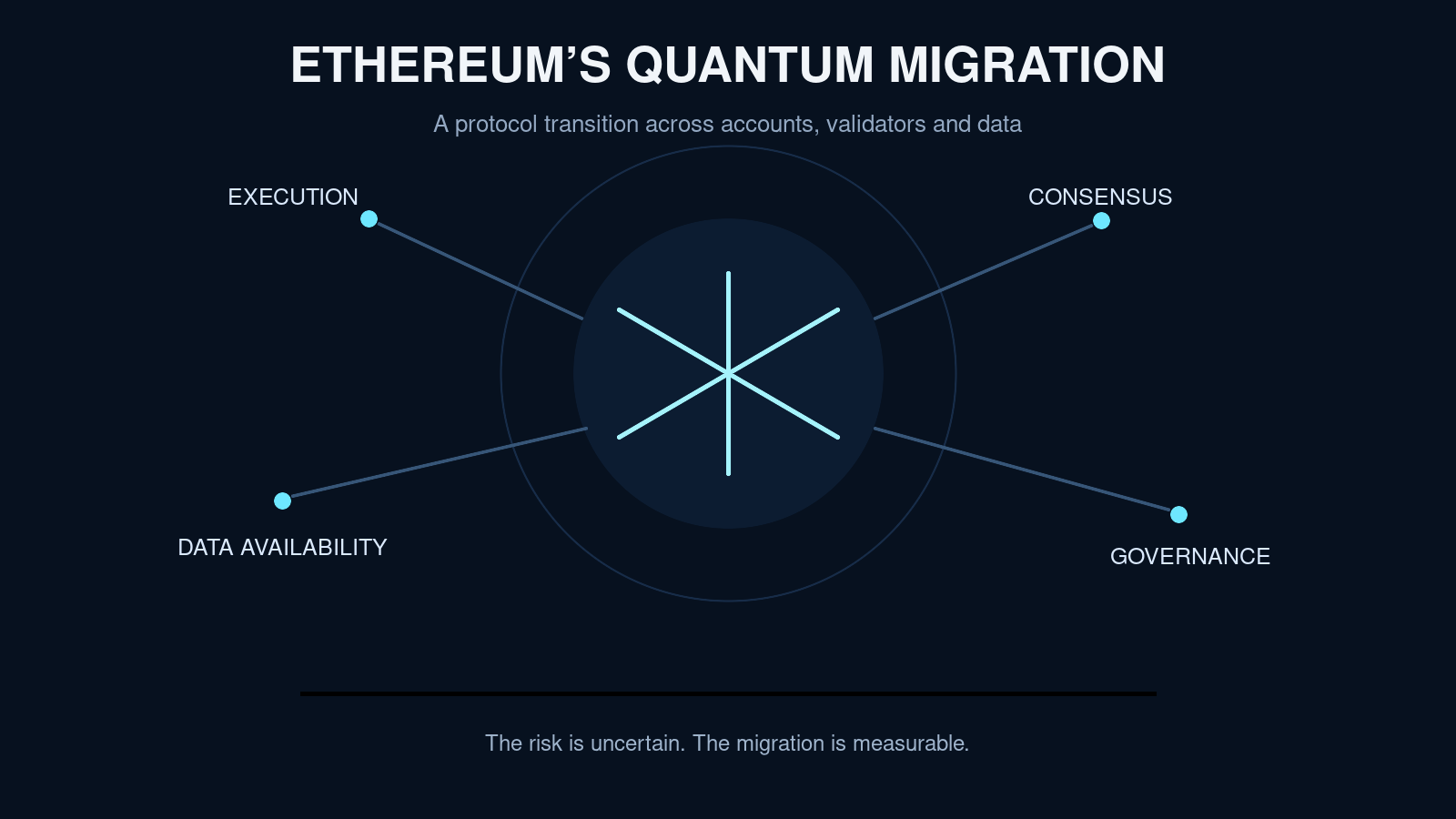
The quantum threat is uncertain; the work required to make Ethereum resilient is already legible. Original editorial illustration.
Executive summary
Ethereum does not face an imminent, demonstrated quantum break. It does face a credible migration problem whose cost grows if the network waits for certainty. That distinction is the central fact for investors, builders and institutions assessing the chain in 2026.
A March 2026 research paper co-authored by researchers affiliated with Google Quantum AI, the Ethereum Foundation and Stanford reduced the estimated resources for solving a 256-bit elliptic-curve discrete logarithm problem: one circuit uses fewer than 1,200 logical qubits and 90 million Toffoli gates; another trades more qubits—fewer than 1,450—for fewer than 70 million gates. The paper is a resource estimate, not a report that such a fault-tolerant machine exists. Its importance lies elsewhere: it compresses a planning assumption and demonstrates that algorithmic improvements can move the risk boundary before hardware arrives. (Research paper)
Ethereum’s answer is no longer a generic promise to “become quantum-safe.” The Ethereum Foundation’s dedicated post-quantum site describes a multi-layer roadmap: quantum-safe authentication and verification at the execution layer; replacement of BLS validator signatures with hash-based leanXMSS at the consensus layer; and post-quantum treatment of data availability. A minimal zero-knowledge virtual machine, leanVM, is intended to recover efficiency through proof aggregation. Yet the roadmap explicitly represents rough directional consensus within EF Architecture, remains subject to change, and must pass Ethereum’s open governance processes. (Post-Quantum Ethereum)
Our thesis is that quantum readiness should now be evaluated as an institutional execution problem, not a prediction contest about “Q-Day.” The relevant questions are whether Ethereum can inventory every vulnerable cryptographic dependency, standardize replacements, make migration usable for ordinary accounts and validators, test recovery paths, and coordinate adoption without creating a coercive or politically contentious fork. Progress is real. Completion is not.
What changed in 2026
Quantum computers threaten public-key systems through Shor’s algorithm, which could solve the mathematical problems underlying elliptic-curve and RSA cryptography on a sufficiently capable fault-tolerant machine. Hash functions are affected differently; Grover’s algorithm offers a quadratic rather than exponential speedup, allowing parameter choices and hash-based constructions to remain useful. This is why Ethereum’s response combines new signature schemes with hash-heavy proof systems rather than replacing one curve with another.
The phrase “1,200 logical qubits” needs careful handling. Logical qubits are error-corrected computational units, not the noisy physical qubits advertised in present-day machine counts. Sustaining thousands of them through tens of millions of non-Clifford operations would demand error correction, control and runtime capabilities far beyond a simple comparison with today’s raw qubit totals. The 2026 paper therefore does not date a viable attack. It does, however, undermine complacency based on older, larger resource estimates.
The institutional comparison is instructive. NIST finalized its first three principal post-quantum standards in August 2024: ML-KEM for key establishment, ML-DSA for signatures and the hash-based SLH-DSA signature standard. NIST now says organizations should begin migration and sets a transition path under which quantum-vulnerable algorithms are deprecated and ultimately removed from its standards by 2035, with high-risk systems moving earlier. (NIST PQC program) Ethereum cannot simply import that timetable or those algorithms: a public blockchain has global consensus bandwidth, verification cost, persistent accounts and adversarial mempools. But NIST’s posture establishes the broader governance norm: standards migration begins before the threat machine exists.
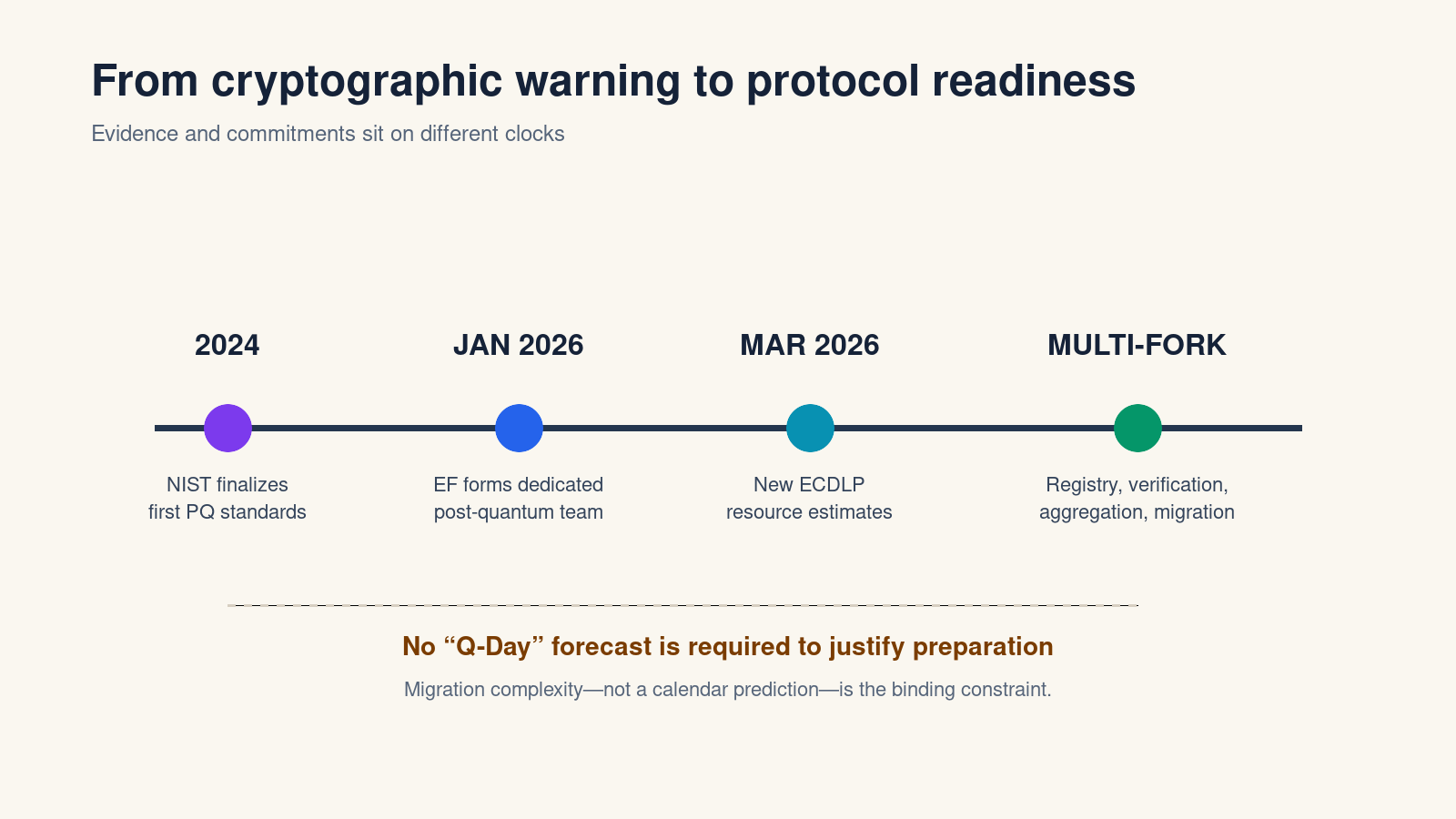
Standards, threat estimates and protocol delivery move on separate clocks. Original editorial illustration.
timeline
    title From standardisation to Ethereum migration
    2024 : NIST finalises ML-KEM, ML-DSA and SLH-DSA
    January 2026 : Ethereum Foundation forms a dedicated post-quantum team
    March 2026 : New ECDLP resource estimates sharpen the planning case
    Near-term forks : Key registry and signature-verification primitives
    Later forks : PQ attestations, aggregation, blobs and transactions
    Longer term : Full multi-layer post-quantum consensus
This sequence should not be read as a promised release calendar. Ethereum’s own page labels milestones with provisional fork markers—such as I*, J*, L* and M*—rather than fixed dates. That honesty matters. A security roadmap is more credible when it distinguishes active engineering from approved consensus changes.
Four cryptographic surfaces, not one wallet problem
The popular account of quantum risk focuses on stolen wallet keys. Ethereum’s exposure is broader. The official roadmap identifies four primary areas requiring upgrades: user account signatures, validator consensus signatures, polynomial commitments used for data availability, and zero-knowledge proof systems. These surfaces fail differently and demand different transitions. (Ethereum future-proofing overview)
At the execution layer, externally owned accounts generally authorize transactions with ECDSA. A sufficiently powerful quantum attacker who obtains a public key could derive the corresponding private key. Ethereum addresses are hashes of public keys, so an account that has never revealed its public key has some additional shielding, but this is not a complete migration strategy: spending reveals the key; modern account behavior is varied; and long-lived or inactive assets may never voluntarily move. Treating “unexposed” accounts as safe also ignores contract authorization systems and operational key reuse.
Ethereum’s proposed advantage is programmability. Account abstraction can let users adopt different authentication logic and recovery policies without requiring every account to change on one day. Pectra’s EIP-7702, activated in May 2025, allowed externally owned accounts to delegate behavior to smart-contract code, creating a stepping stone toward broader account abstraction. The Foundation’s 2026 protocol priorities connect native account abstraction directly to post-quantum readiness and also point to more gas-efficient verification of quantum-resistant signatures. (2026 protocol priorities)
Consensus is harder. Ethereum validators use BLS signatures because they aggregate efficiently: many votes can be represented compactly. Post-quantum signatures are generally much larger and do not inherit BLS’s convenient native aggregation. The current Ethereum research direction pairs leanXMSS, a stateful hash-based signature design, with leanVM, a minimal zkVM that proves batches of signature checks. Ethereum.org says this aggregation could compress quantum-safe signature data by about 250 times, but that figure should be treated as a design claim to validate under production workloads, not guaranteed realized capacity.
Data availability adds another dependency. Ethereum’s rollup-centric scaling strategy relies on blobs and cryptographic commitments so nodes can verify that data is available without every participant downloading everything. Fusaka, deployed in December 2025, introduced PeerDAS and made this architecture more central to scaling. A post-quantum transition must therefore protect not just who signed a transaction but the commitments and proofs that make the rollup settlement model trustworthy. (Fusaka overview)
Finally, proof systems are both part of the problem and part of the proposed answer. Some zero-knowledge systems rely on cryptographic assumptions that require reassessment in a quantum setting. At the same time, succinct proofs may aggregate expensive post-quantum verification. The architecture is recursive in a productive but demanding sense: Ethereum wants proof machinery to make bulkier quantum-safe primitives affordable, while also ensuring that the proof machinery itself rests on suitable assumptions.
flowchart LR
    Q[Cryptographically relevant quantum computer] --> E[Execution risk]
    Q --> C[Consensus risk]
    Q --> D[Data-availability risk]
    Q --> Z[Proof-system risk]
    E --> A[Account abstraction and PQ verification]
    C --> X[leanXMSS validator signatures]
    D --> B[PQ blob commitments and sampling]
    Z --> V[Reassessed proof assumptions]
    X --> L[leanVM aggregation]
    A --> M[Gradual opt-in migration]
    B --> R[Multi-fork protocol transition]
    V --> R
    L --> R
    M --> R
The migration is a coordination problem
The technical literature can make the transition appear to be a menu of algorithms. In practice it is a coordination exercise across client teams, validators, wallet vendors, custodians, smart-contract protocols, rollups, hardware signers, exchanges and users who may not be reachable. Each actor has a different upgrade cycle and different liability.
For institutions, custody is the immediate planning surface. A custodian must know which keys have exposed public keys, which policies can authorize a migration, whether hardware security modules support candidate schemes, and how dual-signature or recovery periods affect controls. A protocol-level feature is not equivalent to operational readiness. Audit trails, policy engines and incident procedures have to recognize the new authorization method before funds move.
For validators, stateful hash-based signatures introduce an operational hazard: some designs must never reuse a one-time signing state. Distributed validator setups, failover machines, backups and slashing-protection databases already require disciplined state management. A migration that improves quantum security while creating avoidable state-reuse failures would merely exchange one tail risk for another. Interoperability testing across more than ten client teams, reported by Ethereum.org, is consequently more important than a polished cryptographic benchmark.
For governance, stranded assets are the most politically difficult issue. If quantum-capable theft becomes credible while old accounts remain unmigrated, the community could face choices ranging from allowing legacy signatures, to restricting them, to freezing or recovering vulnerable funds. Every option affects property expectations and chain neutrality. Precommitting to transparent triggers and narrowly defined procedures would reduce the chance that emergency governance becomes arbitrary. It would not eliminate controversy.
How to read the roadmap
The roadmap is best understood through three gates rather than one deadline.
Gate | Evidence of progress | What remains unresolved |
|---|---|---|
Cryptographic viability | Public work on leanXMSS, leanVM and hash-based multisignatures | Security review, parameter stability, state management and proof assumptions |
Protocol viability | Layer-specific milestones and recurring interoperability work | Final EIPs, fork inclusion, bandwidth and latency under adversarial conditions |
Ecosystem migration | Account abstraction offers an opt-in path | Wallet, custodian, validator and dormant-account adoption; emergency policy |
This framing avoids two common analytical errors. The first is alarmism: taking a resource estimate as evidence that funds can be stolen today. There is no such evidence. The second is dismissal: assuming uncertain hardware timelines permit indefinite delay. Large cryptographic migrations historically consume years because standards, software, hardware and users do not move together.
The roadmap also contains sequencing risk. A key registry or verification precompile delivered early creates optionality, but optionality is not safety until users and validators enroll. Aggregation can lower bandwidth, but it introduces dependence on proving infrastructure and implementation quality. Faster upgrade cadence can accelerate preparation, but increases testing and coordination load. Each advance carries a new operational surface.
Counterarguments and risk balance
One counterargument is that quantum investment distracts from present threats: smart-contract exploits, compromised front ends, validator concentration and key-management failures cause losses now. That is correct as a budget warning. It is not an argument for inaction. Post-quantum work can be staged through reusable primitives, inventories and testnets while existing security programs continue. Native account abstraction and better recovery may also reduce present-day key risk.
A second objection is algorithm uncertainty. Standardized schemes may not fit Ethereum’s tight consensus constraints, while newer constructions carry less cryptanalytic maturity. Ethereum’s experimentation with hash-based signatures reflects a conservative assumption base, but statefulness and signature size are real costs. The appropriate response is crypto agility—multiple reviewed options and replaceable verification paths—not premature lock-in.
A third objection is governance credibility. The Ethereum Foundation coordinates research but cannot decree a fork. The post-quantum site explicitly acknowledges this boundary: final direction emerges through open processes such as All Core Devs. This makes delivery slower than a centralized software update, yet it also creates public evidence. Institutional analysts should track accepted specifications, independent audits, multi-client implementations and testnet behavior rather than treating an EF roadmap as a binding commitment.
Implications for investors and institutions
Quantum readiness is becoming a component of protocol quality. It should not be reduced to a token-price catalyst or a binary “safe/unsafe” label. A stronger assessment asks whether a chain has mapped its dependencies, funded sustained research, built migration primitives, preserved multiple implementations and confronted dormant-asset governance before an emergency.
Ethereum currently scores well on visibility: it has a dedicated team formed in January 2026, public repositories, an explicit layer-by-layer map and regular interop work. It also benefits from upgrades already shipped—Pectra’s account delegation and Fusaka’s data-availability architecture provide concrete substrates for the next transition. But visibility is not completion. The roadmap is provisional, important primitives remain under development, and ecosystem adoption will be the longest phase.
For risk committees, the sensible posture is to add quantum migration to long-horizon operational due diligence now. Relevant indicators include the appearance of final EIPs; audited verification primitives; client diversity on post-quantum devnets; measured signature, proof and bandwidth overhead; wallet and HSM support; validator key-rotation drills; and publicly debated policy for legacy accounts. None requires forecasting the arrival date of a cryptographically relevant quantum computer.
Conclusion
The 2026 resource estimates changed the burden of proof. Skeptics no longer need to believe a quantum break is near; proponents of delay must explain why a global, multi-layer cryptographic migration should wait when its components take years to standardize, implement and adopt.
Ethereum has moved beyond slogans. Its proposed architecture recognizes that account signatures, validator consensus, data availability and proof systems are interconnected, and that efficiency must be rebuilt through aggregation rather than wished away. That is substantive progress. The decisive test, however, is governance: converting research into reviewed standards, coordinated forks and humane migration paths without manufacturing an emergency.
The institutional conclusion is measured. Ethereum is not quantum-safe today, and it is not under demonstrated quantum attack. It is building the machinery to navigate the space between those statements. In 2026, that machinery—and the openness with which its limits are disclosed—is the signal worth watching.
Direct sources
Babbush et al.: Securing Elliptic Curve Cryptocurrencies against Quantum Vulnerabilities
NIST FIPS 205: Stateless Hash-Based Digital Signature Standard
Research cutoff: 5 August 2026. Roadmap milestones are proposals and directional plans unless explicitly described as deployed.