The Stablecoin Control Plane: What Visa’s New Platform Actually Changes
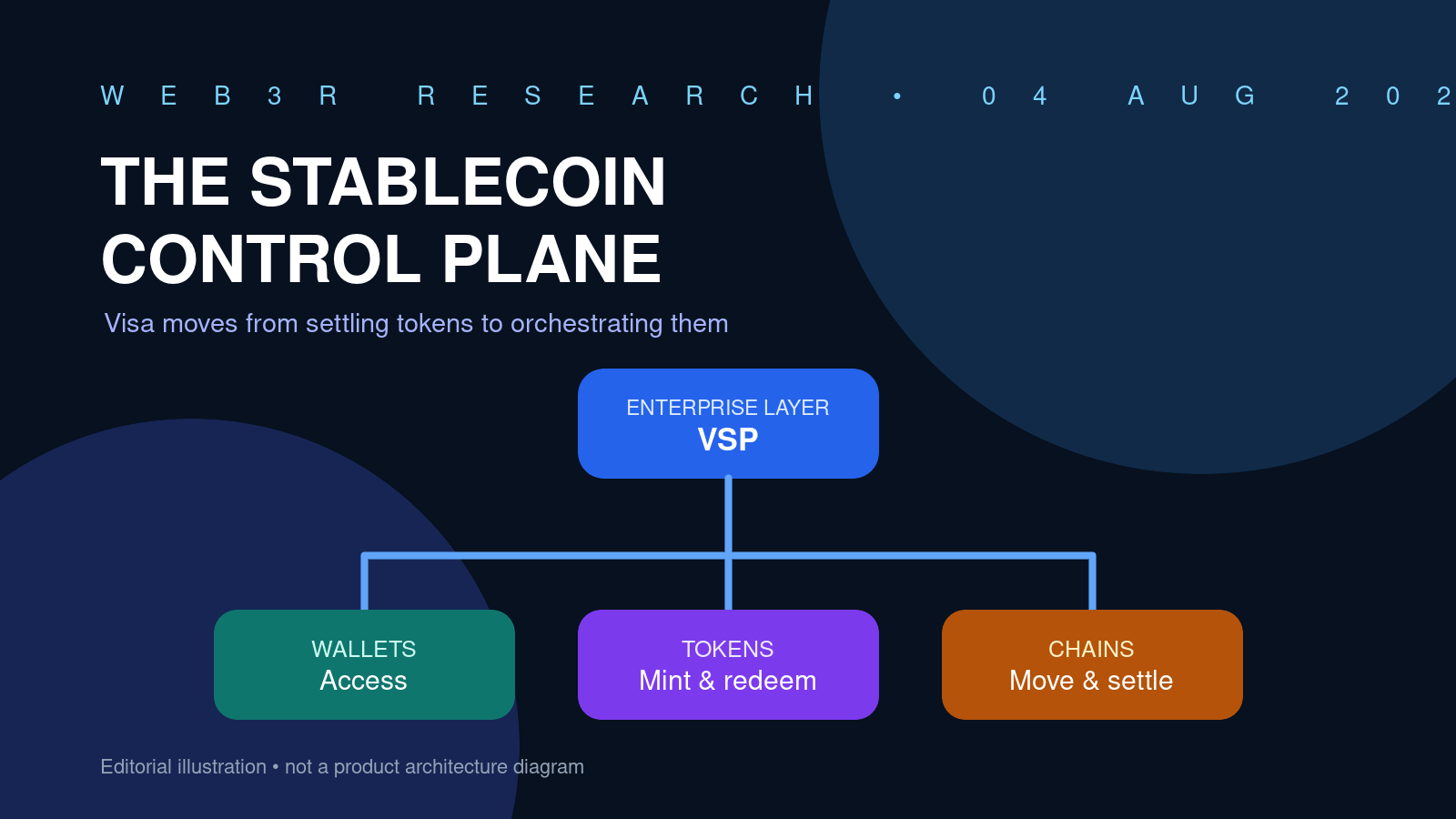
Lead image: stablecoin competition is moving upward—from individual tokens and chains to the enterprise layer that coordinates them. Original editorial illustration.
Executive summary
Visa’s July 16 launch of the Visa Stablecoin Platform (VSP) is best read not as another corporate experiment with crypto, but as an attempt to own the control plane through which regulated institutions use tokenized money. The limited-beta platform brings wallet infrastructure, onchain connectivity, and mint-and-burn access into a single Visa-managed environment. It begins with Open USD (OUSD), an announced dollar stablecoin from the new Open Standard consortium, and is designed to connect stablecoin operations with payment and treasury workflows. Those facts matter more than the familiar promise of faster settlement: Visa is productizing the operational layer between a bank’s systems and public blockchain rails.
The timing is deliberate. Stablecoins have become a roughly $307 billion market, yet supply is overwhelmingly concentrated in USDT and USDC. At the same time, reserve income has made scale unusually valuable to issuers, while businesses that distribute and use the tokens typically receive little of that economics. Open USD proposes a different bargain: no mint or redemption fees or volume caps for participating businesses, shared governance, and “nearly all” reserve economics returned to companies that drive adoption, after a management fee. VSP packages access to that new asset. Together, the two initiatives attack both the technical cost of integration and the commercial incentive problem.
Our thesis is that VSP shifts the competitive question from which blockchain or stablecoin wins to which intermediary becomes the trusted orchestration layer across wallets, issuers, compliance regimes, and settlement networks. Visa has distribution, risk controls, and existing institutional relationships; public chains supply programmability and 24/7 transfer. Combining them could accelerate enterprise adoption without requiring treasury teams to become crypto operators. But announcement is not adoption. OUSD had not launched as of this report, VSP is in limited beta, final governance and reserve details remain incomplete in public materials, and the incumbent tokens retain formidable liquidity and network effects.
The event: a platform, not merely another settlement pilot
Visa’s official announcement says VSP gives financial institutions, fintechs, and crypto-native companies one environment to access, store, and redeem stablecoins. Its initial capabilities include wallet-as-a-service, connectivity to existing onchain wallets, and access to minting and burning. Visa says the product is being rolled out to a select group of beta clients and that lessons from testing will inform broader availability. The first supported asset is Open USD.
This is a meaningful extension of Visa’s earlier stablecoin work. The company already supports stablecoin settlement and stablecoin-linked cards. In a May 2026 interview, Visa said its settlement program supported nine blockchains; its current stablecoin overview spans card spending, settlement, cross-border movement, and developer tooling. VSP turns those separate touchpoints into an enterprise product surface. Rather than asking a bank to assemble custody, wallets, issuer connections, chain integrations, reconciliation, and policy controls on its own, Visa is offering a managed abstraction.
flowchart LR
    A[Bank or fintech treasury] --> B[VSP enterprise control plane]
    B --> C[Wallet provisioning and policy]
    B --> D[Mint and redeem access]
    B --> E[Onchain movement]
    C --> F[Customer or corporate wallets]
    D --> G[Stablecoin issuer and reserves]
    E --> H[Supported public blockchains]
    F --> I[Payments, payouts, settlement]
    G --> I
    H --> I
The strategic distinction is between a rail and a control plane. A public blockchain can transfer a token; an issuer can create and redeem it. An enterprise still needs permissions, operational controls, liquidity management, accounting, exception handling, and a legally accountable service relationship. That layer is where established payment networks can remain relevant even if the underlying settlement instrument changes. VSP is therefore both an accommodation to stablecoins and a defense of Visa’s role in money movement.
The market backdrop: scale without diversity
The market VSP enters is large enough to matter but far from mature. DefiLlama’s stablecoin dashboard showed total supply of $307.423 billion when accessed on August 4, 2026. USDT accounted for $183.224 billion, or 59.6% of the total; USDC accounted for $71.963 billion. Together they represented about 83.0% of tracked stablecoin capitalization. The next-largest asset shown, USDS, stood at $6.557 billion. These are point-in-time dashboard values and can change continuously.
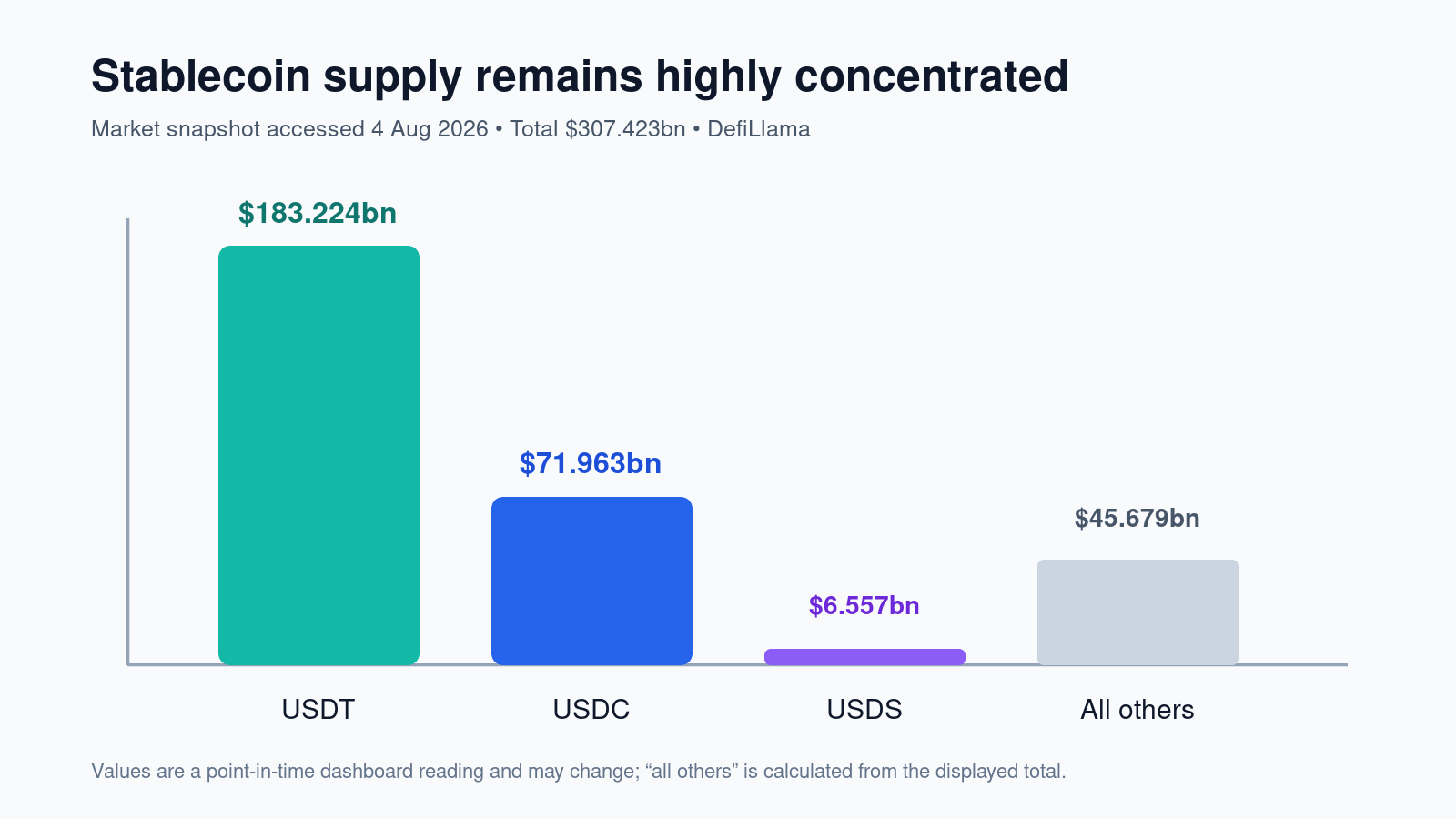
Market snapshot: USDT and USDC together represented about 83% of tracked stablecoin supply on August 4. Source: DefiLlama; “all others” is calculated from the displayed total.
The Bank for International Settlements’ 2026 Annual Economic Report supplies useful perspective. It put stablecoin capitalization at around $320 billion at end-May and estimated 2025 transaction value at $28 trillion—but noted that the latter was equivalent to less than three business weeks of settlement at the largest US wholesale payment systems, and that adjusted economic volume is materially lower. The BIS also observed that actual use remains centered on crypto trading and, to a lesser extent, offshore stores of value in vulnerable currencies; cross-border payment performance becomes mixed after spreads and on/off-ramp costs.
That tension is essential. Stablecoins are simultaneously too significant for payment incumbents to ignore and too operationally incomplete for many institutions to adopt unaided. A market dominated by two tokens also creates a commercial opening: entrants need not beat the incumbents solely on peg quality or chain coverage if they can alter distribution incentives and lower institutional integration costs.
Signal | Evidence as of August 4, 2026 | Why it matters |
|---|---|---|
Total tracked supply | $307.423bn | A material pool of onchain dollar liquidity |
USDT + USDC share | ~83.0% | Liquidity and trust are highly concentrated |
VSP status | Limited beta | Product-market fit is not yet established |
OUSD status | Announced; launch expected later in 2026 | No live supply or redemption record yet |
Visa settlement coverage | Nine supported blockchains, per Visa in May | Existing multi-chain experience can support abstraction |
Open USD changes the economic bargain
VSP’s choice of first asset is not incidental. Open Standard describes Open USD as a shared stablecoin for global financial activity. Its public proposition is designed around complaints from distributors: zero mint and redemption fees, no volume limits, collective influence over the roadmap, and nearly all reserve economics shared with companies that grow adoption. More than 140 organizations are presented as supporters across banking, payments, technology, commerce, and crypto infrastructure.
The model challenges the issuer-centric economics that made stablecoins attractive businesses. A fiat-backed issuer receives dollars, holds permitted liquid reserves, and earns yield on those assets while the token circulates. Circle’s last reported comparable quarter illustrates the importance of this engine: in Q2 2025, it reported $658 million of total revenue and reserve income, up 53% year over year, with $61.3 billion of USDC in circulation at quarter-end. That is historical context, not a forecast for either Circle or OUSD; Circle’s Q2 2026 results are scheduled for August 5, after this report’s cutoff.
Open USD proposes to redirect much of the reserve economics toward the businesses that create circulation. In theory, that turns stablecoin distribution from a cost center into a revenue-sharing network: wallets, payment processors, merchants, and financial institutions have a direct reason to make one token more useful. It resembles a coalition trying to manufacture network effects through aligned economics rather than waiting for organic liquidity alone.
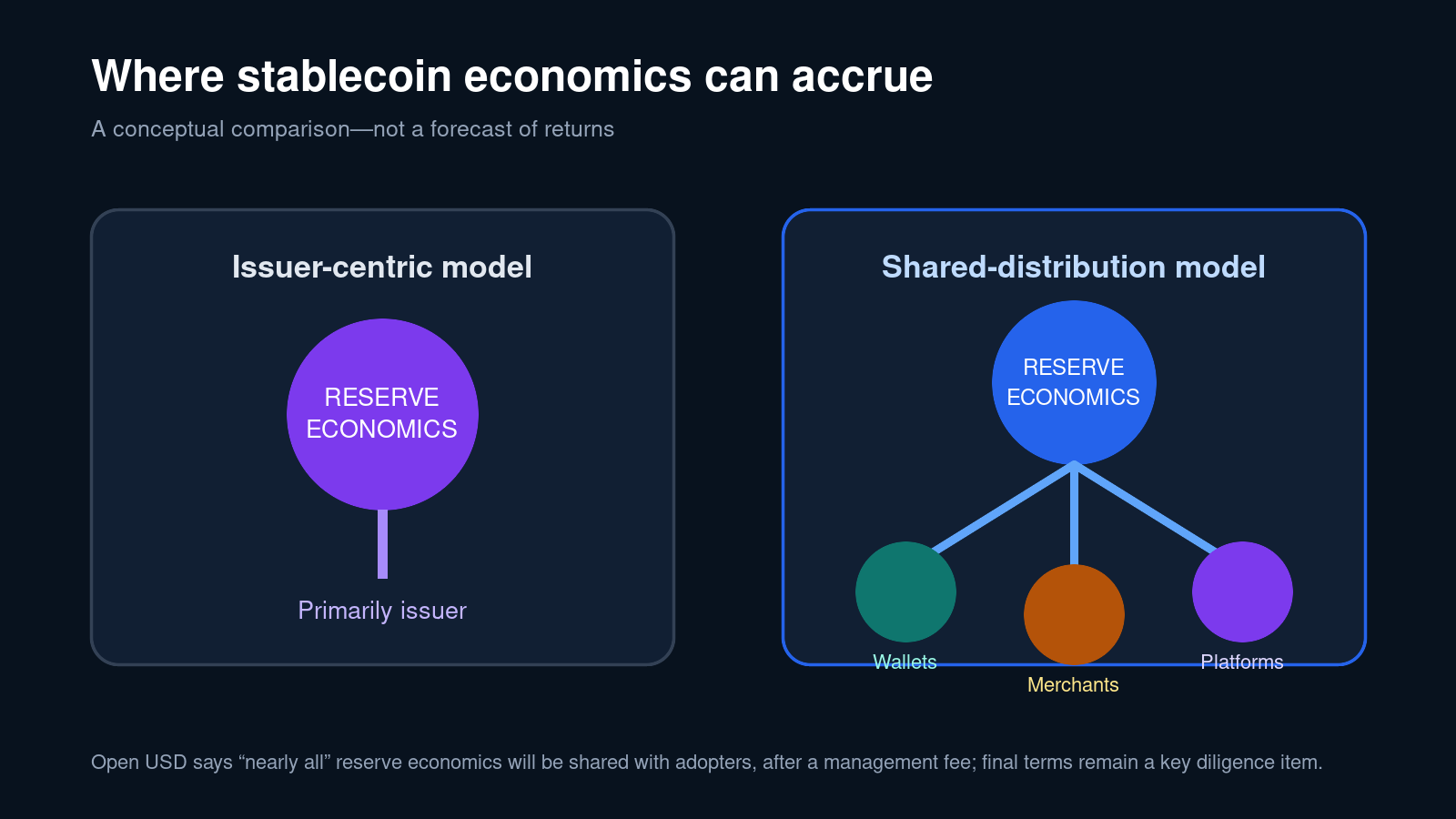
Economic design: Open USD says nearly all reserve economics will be shared with businesses growing adoption, after a management fee. The diagram is conceptual; final commercial terms and realized returns remain unproven.
This does not make OUSD automatically superior. Reserve yield is not free value; it compensates an ecosystem while creating governance, liquidity, and possibly regulatory complexity. The consortium must decide who qualifies, how contribution is measured, whether incentives favor volume over durable use, and how conflicts are resolved. A broad coalition can provide distribution, but it can also slow decisions. The product’s official site gives a clear commercial promise, not yet the full diligence package an institution would need.
Why the control plane may be more defensible than the coin
Tokens are increasingly multi-chain, and institutions are pursuing more than one form of digital money. The same organization may need a regulated stablecoin for cross-border payouts, tokenized deposits for intragroup settlement, and conventional bank money at either end. In that environment, the durable position may belong to the service that applies policy and routes value—not necessarily the issuer of the largest token.
VSP lets Visa pursue that position. If the platform eventually supports multiple stablecoins and networks, Visa can benefit from stablecoin adoption without correctly predicting a single winner. Its moat would derive from integration into banks’ treasury and payment operations, accumulated compliance tooling, and the cost of replacing a trusted operational layer. The token and chain become selectable components below it.
flowchart TD
    A[Enterprise chooses digital money workflow] --> B{Primary need}
    B -->|Global reach and liquidity| C[Use established stablecoin]
    B -->|Shared economics and influence| D[Evaluate Open USD]
    B -->|Bank balance-sheet money| E[Evaluate tokenized deposits]
    C --> F{Can internal systems operate it safely?}
    D --> F
    E --> F
    F -->|Yes| G[Direct integration]
    F -->|No or costly| H[Managed control plane such as VSP]
    H --> I[Policy, wallets, routing, reconciliation]
    G --> J[Measure cost, liquidity and risk]
    I --> J
There is a strategic catch. A control plane that supports only its affiliated or preferred token is less an abstraction layer than a distribution channel. Visa’s announcement begins with OUSD but does not yet provide a complete public roadmap for additional assets. Institutional users should therefore evaluate VSP on neutrality: supported issuers and chains, portability of wallets and data, pricing, redemption access during stress, and the ability to exit without operational disruption.
Regulation is enabling—and constraining—the model
The US policy environment has become more legible. As summarized by the BIS, the GENIUS Act requires identifiable one-for-one reserves comprising specified high-quality assets, including cash, Federal Reserve balances, insured deposits, short-dated Treasuries, certain Treasury-backed repos, and qualifying government money-market instruments, with strict limits on rehypothecation. This supports the institutional premise that a payment stablecoin should be a narrow, redeemable liability rather than a leveraged investment product.
Clearer rules lower one barrier to entry but raise the importance of operational accountability. A stablecoin arrangement divides responsibility across issuer, reserve custodian, wallet operator, blockchain, distribution partner, and user-facing institution. A managed platform can centralize controls and reporting, yet it also concentrates dependency. If Visa is the interface through which a bank reaches several onchain systems, an outage, policy error, cyber incident, or abrupt change in supported assets could have effects across multiple payment corridors.
The BIS’s critique also deserves weight. Its report argues that stablecoins can deliver programmability and faster payments but still fall short of the “singleness,” elasticity, and integrity associated with sovereign money. It warns that large-scale adoption could affect deposit funding, Treasury markets, monetary sovereignty, and illicit-finance controls. A polished enterprise interface does not eliminate those balance-sheet and public-policy questions; it can simply make adoption easier and therefore more urgent to address.
Institutional implications
For banks and fintechs, VSP may compress the time and specialized talent required to launch a stablecoin product. The more important opportunity is modularity: institutions could treat wallets, token access, and chain connectivity as managed capabilities while keeping customer relationships and product design. That can make small pilots economical and allow firms to compare assets before committing to a single issuer.
For stablecoin issuers, the platform cuts both ways. It can expand distribution, but it also makes the token more interchangeable. If enterprise users encounter stablecoins through a common interface, differentiation shifts toward redemption reliability, reserve transparency, liquidity, regulatory footprint, and economic terms. Incumbents retain deep advantages: broad exchange support, DeFi integrations, market-maker inventory, and years of operating history cannot be replicated by a partner list.
For public blockchains, enterprise abstraction could bring volume while weakening chain-level brand visibility. Users may care less whether settlement occurs on one network or another if VSP manages routing. Chains will compete on finality, cost, uptime, liquidity, compliance compatibility, and the quality of their developer ecosystems. The winner may be plural: several networks can sit beneath one enterprise service.
For investors, the development reframes stablecoin value capture. Reserve income may migrate away from a single issuer toward distributors, orchestration platforms, custodians, and liquidity providers. Yet shared economics can also compress margins for the whole category. The key variables are not headline transaction volume alone, but net economic volume, average balances, interest rates, payout formulas, partner costs, and customer acquisition efficiency.
Risks, counterarguments, and what would falsify the thesis
First, liquidity can defeat incentive design. Businesses may prefer a token with established redemption, exchange depth, and customer demand over a new asset that offers revenue sharing. OUSD’s coalition is a distribution hypothesis until balances remain outstanding and circulate between independent users.
Second, the platform may add rather than remove intermediaries. Stablecoins promise direct, programmable transfer. Routing them through a global payment company could recreate fees, permissioning, and platform dependence. VSP must demonstrate that operational savings outweigh its charges and constraints.
Third, consortium governance is untested. The interests of banks, card networks, merchants, crypto venues, and technology platforms are not identical. Public details about voting, reserve managers, bankruptcy remoteness, attestations, redemption priority, and dispute resolution will determine whether “shared” means resilient or merely diffuse.
Fourth, concentration risk moves rather than disappears. Multi-chain access through one interface diversifies underlying ledgers but concentrates operational reliance on the orchestrator. Institutions need independent reconciliation, contingency routes, and clear recovery procedures.
Finally, the real economy may remain secondary. The BIS evidence cautions against equating raw onchain volume with useful payment activity. VSP’s strongest validation would be recurring business payments with measurable reductions in end-to-end cost and settlement time—not token issuance, partner counts, or transfers between affiliated wallets.
The control-plane thesis would weaken if VSP remains tied to one token, if OUSD fails to develop secondary liquidity, if beta clients do not progress to production, or if direct issuer APIs become standardized enough that enterprises no longer value a managed intermediary. Conversely, support for multiple independent stablecoins, disclosed production clients, sustained external OUSD balances, and transparent service-level performance would strengthen it.
Conclusion
Visa is not conceding payments to blockchains; it is positioning itself above them. VSP translates fragmented onchain components into an enterprise service, while Open USD attempts to recruit distribution by sharing the economics of reserves. The combination addresses two genuine bottlenecks—operational complexity and misaligned incentives—and therefore deserves more attention than another settlement pilot.
But the institutional verdict must remain provisional. As of August 4, VSP is a limited beta and OUSD is an announced asset without a live record. The incumbents control roughly five-sixths of stablecoin supply, and the unresolved questions around governance, liquidity, neutrality, and risk are material. The development to watch is not whether Visa can mint a token. It is whether Visa can make multiple forms of tokenized money feel like safe, interchangeable enterprise infrastructure—while preserving enough openness that the control plane does not become the next point of lock-in.
Direct sources and methodology
Market values are point-in-time readings accessed August 4, 2026. Calculated shares use displayed, rounded values and may not sum perfectly. Company claims are attributed as such; no announced capability, partnership, or launch schedule is treated as proof of production usage.