The Transatlantic Stablecoin Bridge: Recognition Is the Breakthrough—and the Risk
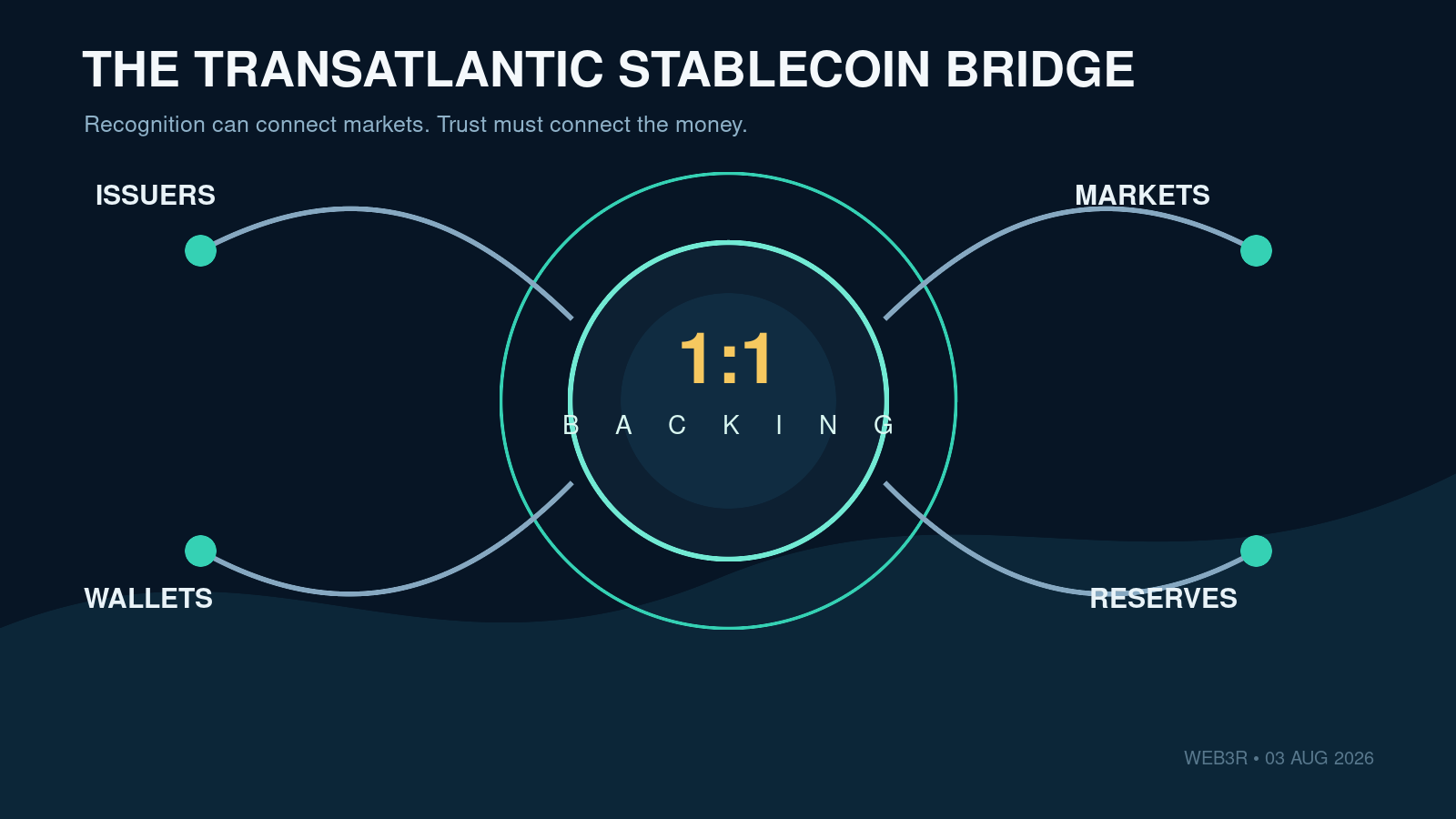
A common policy direction can connect two financial centres; it cannot, by itself, make private money trustworthy.
Research date: 3 August 2026
Executive summary
The United Kingdom and United States have moved stablecoin policy from parallel domestic projects toward a transatlantic market design. Their 14 July joint statement does not create a passport, a licence or a binding treaty. It does something more preliminary but potentially more consequential: it commits both governments to explore a pathway by which a stablecoin issued under one regime can access the other, while aligning around one-to-one backing, liquid reserves, timely redemption, segregated assets, protected claims in insolvency and proportionate supervision.
The thesis of this report is that cross-border recognition—not another local stablecoin rulebook—is now the decisive policy variable for institutional adoption. If implemented credibly, recognition could let one regulated token circulate across two of the world’s deepest capital markets, reducing duplicated reserve pools and legal entities and making stablecoins more useful for round-the-clock settlement, collateral mobility and cross-border payments. The statement also advances a “multi-money” model in which stablecoins, tokenised deposits and other digital money coexist rather than one form being selected by the state.
But recognition multiplies dependencies. A token may cross borders in seconds while redemption rights, reserve custody, sanctions obligations and insolvency proceedings remain jurisdiction-bound. The governments’ emphasis on avoiding excessive local ring-fencing improves capital efficiency, yet it also concentrates the test of confidence in cross-border cooperation. The policy must therefore be judged less by how many issuers gain access than by whether a holder can redeem at par during stress, which supervisor acts first, and whether identical-looking tokens really confer identical legal rights.
The scale is large enough to matter but small enough to govern before it becomes systemic. The Bank for International Settlements (BIS) put stablecoin market capitalisation at about $320 billion at end-May 2026 and estimated $28 trillion of gross transaction volume in 2025, while warning that activity net of transfers between wallets controlled by the same party is far lower. It also found 99.4% of fiat-backed stablecoins by value were pegged to the US dollar. Those facts make the initiative simultaneously a market-infrastructure project and a geopolitical project: UK recognition may widen the distribution of regulated dollar tokens even as London seeks room for sterling-denominated innovation.
What changed on 14 July
The UK–US Joint Statement on Stablecoins contains ten shared positions. Four form the economic core. Stablecoins represented as money should be backed at least one-to-one by high-quality liquid assets; reserves should be segregated and safeguarded for holders; redemption should be timely and rights clearly disclosed; and holders should have a clear, protected claim on reserves, with priority over other creditors, if an issuer fails. A fifth position supplies the strategic leap: both governments intend to explore a clear route for stablecoins issued in either jurisdiction to enter the other’s market.
The statement is careful. It seeks “comparable outcomes for comparable risks,” not identical statutes. It says convergence should occur where appropriate and explicitly avoids prejudging domestic regulatory processes. This is not mutual recognition today. It is a political commitment to design it.
That distinction matters. A press release cannot resolve whether a UK-authorised issuer needs a US affiliate, which reserve assets qualify in each country, how redemption timing is measured, or who leads a cross-border resolution. Yet policy direction influences investment before rules take effect. Issuers, custodians, banks and tokenisation platforms can now plan around the possibility of a transatlantic addressable market rather than two sealed national markets.
flowchart LR
    A[Issuer authorised in home jurisdiction] --> B[One-to-one liquid reserve pool]
    B --> C[Token issued on approved rails]
    C --> D{Cross-border recognition pathway}
    D -->|UK to US| E[US payments and capital markets]
    D -->|US to UK| F[UK payments and capital markets]
    E --> G[Holder redemption at par]
    F --> G
    G --> B
    H[Home and host supervisors] -. oversight, information and crisis coordination .-> D
The intended loop: home authorisation supports cross-border circulation, but confidence closes only when redemption returns the holder to sovereign money.
The accompanying Transatlantic Taskforce recommendations broaden the context. UK and US authorities plan to seek common approaches to settlement finality and to the potential use of stablecoins and tokenised money-market funds as margin collateral at central counterparties. A private-sector group is to test cross-border tokenised-asset use cases for one year. This connects stablecoin policy to wholesale market plumbing, where legal certainty and operational continuity matter more than consumer novelty.
Why recognition changes the economics
Stablecoins have a network-economics problem. A token is useful when counterparties accept it, exchanges quote it, wallets support it, banks provide on- and off-ramps, and holders believe they can redeem it. A domestic authorisation can establish standards, but it cannot create cross-border liquidity on its own. If every jurisdiction requires a separate issuer, reserve pool and token, compliance may be local while liquidity fragments globally.
Recognition offers a different route. One properly supervised arrangement could reach more users and venues without duplicating every balance-sheet component. Market makers could concentrate liquidity; businesses could reduce the number of tokens they hold for transatlantic flows; and tokenised securities platforms could settle outside banking hours with an asset governed by legible claims. This is why the statement’s language on avoiding “inappropriately high” locally ring-fenced resources is commercially important. Excess ring-fencing can trap liquidity and create multiple versions of nominally the same money.
The trade-off is that efficiency comes from shared exposure. If reserves sit mainly in one country while tokens circulate in both, host-market users rely on foreign custody, courts and supervisors. A failure becomes a cross-border coordination event. The optimal framework must prevent duplicative capital from destroying the business model without allowing an issuer to shop for the weakest rules.
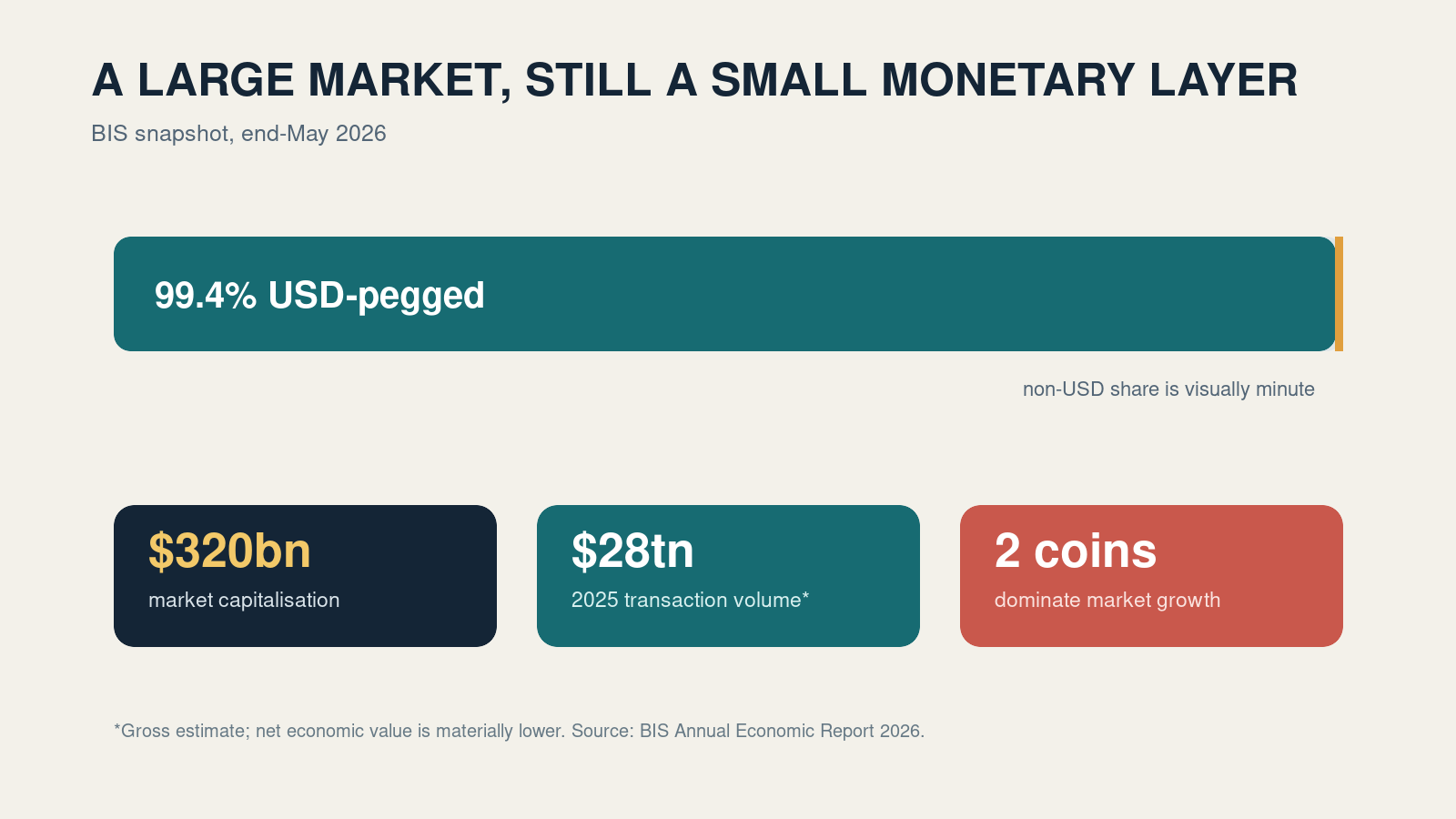
Scale without diversity: the market is economically significant, yet currency and issuer concentration remain structural features. Source: BIS, end-May 2026 snapshot.
The evidence: consequential, concentrated, and still crypto-led
The BIS Annual Economic Report 2026 supplies three useful correctives to exuberant payment narratives.
First, stablecoins are significant but not yet equivalent to mainstream money. The BIS’s roughly $320 billion market-cap estimate is dwarfed by bank deposits. Its $28 trillion estimate for 2025 transaction volume is gross, and the report cautions that net values excluding same-owner wallet transfers are much lower. Volume should not be confused with final demand or merchant adoption.
Second, usage remains concentrated in on-chain trading. Payments and tokenised-asset settlement exist, but crypto-market intermediation remains the principal activity. Cross-border recognition could change the mix, especially if regulated stablecoins become eligible settlement or collateral assets, but the statement expresses an ambition rather than evidence that this transition has occurred.
Third, the system is effectively dollarised. The BIS reports that 99.4% of fiat-backed stablecoin value is pegged to the US dollar. Non-dollar products remain minute even where robust local regulation exists. The likely near-term effect of transatlantic access is therefore not a balanced digital currency area; it is broader distribution of dollar-linked liabilities, potentially alongside a smaller class of sterling tokens.
This concentration reaches beyond crypto. An IMF working paper on stablecoin shocks finds that a shock corresponding to a 1% increase in combined USDT and USDC market capitalisation lowered the one-month US Treasury bill yield by approximately 1.9 basis points at its estimated trough around week 24. The authors identify effects using stablecoin-specific news events and stress that systematic causal evidence remains limited. The result should not be mechanically extrapolated. It does show, however, that reserve demand can transmit stablecoin adoption into sovereign money markets. Regulation of the token is also regulation of a growing buyer of short-dated public debt.
Evidence | Latest cited observation | Institutional interpretation |
|---|---|---|
Market capitalisation | About $320bn at end-May 2026 | Material, but still small beside bank money |
Transaction volume | Estimated $28tn gross in 2025 | High velocity; net economic flow is lower |
Currency composition | 99.4% of fiat-backed value linked to USD | Recognition may reinforce dollar reach |
Main use | Predominantly on-chain trading | Payments thesis remains partly prospective |
Treasury transmission | 1% USDT/USDC shock associated with ~1.9bp lower 1-month bill yield at trough | Reserve allocation can affect traditional markets |
From reserve quality to an end-to-end trust chain
One-to-one backing is necessary but incomplete. A holder needs to know what the reserve contains, where it is held, whether it is insulated from the issuer’s creditors, who can redeem directly, at what price, and on what timetable. “High-quality liquid assets” can behave differently under stress; a Treasury bill and a bank deposit are not operationally identical. Even a solvent reserve can fail to deliver par redemption if payment rails, custodians or banking partners are unavailable.
The statement recognises several links by addressing custody, segregation, disclosure and insolvency priority. Its real test will be whether rules make those links comparable across jurisdictions. If a retail holder has only a contractual claim against an intermediary while an institutional customer has a direct claim against the issuer, the same token can embody different practical moneyness. Clear disclosure is valuable, but standardised rights are more valuable.
flowchart TD
    A[Par promise] --> B[Eligible reserve assets]
    B --> C[Independent custody and segregation]
    C --> D[Continuous liquidity management]
    D --> E[Operational redemption channel]
    E --> F[Protected legal claim in insolvency]
    F --> G[Cross-border supervisory coordination]
    G --> H[Confidence under stress]
    X[Chain outage or bridge failure] -. can interrupt .-> E
    Y[Bank or custodian failure] -. can impair .-> C
    Z[Sanctions and AML conflict] -. can delay .-> G
A stablecoin’s par value is a chain of institutional and technical promises, not a property created by the smart contract alone.
Implications for institutions and Web3 markets
For banks, the policy is both opportunity and competitive pressure. Banks can provide reserve custody, cash management, distribution and redemption services; they can also issue tokenised deposits that compete with stablecoins. The governments’ multi-money framing avoids forcing an early winner. The practical dividing line may be reach: tokenised deposits retain a direct relationship to a bank’s balance sheet, while bearer-like stablecoins can circulate widely on open networks.
For asset managers and trading venues, stablecoin eligibility as collateral could reduce settlement gaps, but only if haircuts, legal finality and operational controls are explicit. A stablecoin with rapid transfer but uncertain recovery is not superior collateral. Central counterparties will care about concentrated issuer exposure and correlated reserve liquidation during stress, not merely the token’s historical price stability.
For Web3 protocols, regulatory recognition can improve access to institutional liquidity while also raising expectations. Issuers may be able to freeze or burn balances, and regulated intermediaries will screen activity. The Financial Action Task Force’s March 2026 report says stablecoins represented 84% of illicit virtual-asset transaction volume in 2025, citing Chainalysis, and highlights risks involving unhosted wallets and cross-chain activity. That statistic describes the composition of identified illicit crypto volume, not the share of stablecoin activity that is illicit—a crucial distinction. FATF recommends risk-based controls, stronger supervisory technology and rapid international information exchange.
For the UK, recognition is also a currency-policy question. Access to well-regulated dollar stablecoins may improve market choice and cross-border settlement, but it can deepen digital dollar use in sterling’s home market. The response need not be protectionism. It requires monitoring whether sterling-denominated instruments can achieve sufficient liquidity and whether households understand the currency exposure embedded in a “stable” token.
Risks and counterarguments
The announcement may outrun implementation. The statement is non-binding and domestic processes remain open. Political alignment can weaken, agencies can interpret comparable outcomes differently, and a recognition route can take years. Firms should distinguish policy optionality from present authorisation.
Mutual access may become regulatory arbitrage. If issuers can select the lighter home regime while marketing into the stricter host, recognition lowers standards. The remedy is not identical rules but measurable outcomes: reserve composition, liquidity, redemption performance, audit or attestation quality, operational resilience and enforceable holder priority.
Ring-fencing is inefficient until a crisis makes it useful. Shared reserves economise capital in normal conditions; locally available assets can protect host-market holders when foreign courts or payment systems become bottlenecks. A credible framework needs pre-agreed cooperation, data access and resolution playbooks—not faith that supervisors will improvise smoothly.
Open-chain interoperability remains a technical risk. The BIS notes that the same issuer’s tokens on different chains effectively behave as distinct assets and that bridges introduce cost and security challenges. Legal recognition does not eliminate chain outages, bridge exploits or liquidity fragmentation. “Same issuer” does not mean “same operational risk.”
Compliance can fracture fungibility. Freezes and deny-lists can disrupt criminal flows, but inconsistent sanctions or AML decisions can make a token spendable in one venue and blocked in another. The tension between bearer-like circulation and intermediary-style controls is not solved by reserve backing.
Finally, critics may argue that tokenised central-bank or commercial-bank money offers firmer institutional foundations. The BIS itself questions whether stablecoins can deliver singleness of money across issuers and chains. That challenge is serious. Yet it does not erase market demand for programmable, widely accessible settlement assets. The relevant policy comparison is not a flawless public alternative versus a flawed private token; it is which architecture delivers useful innovation while preserving par redemption, integrity and financial stability.
What to watch next
The most informative milestones will be concrete rather than rhetorical:
publication of eligibility criteria for foreign-issued stablecoins and the allocation of home-versus-host supervision;
common definitions for reserve quality, segregation, redemption timing and holder priority;
a cross-border insolvency and operational-resolution protocol tested before an issuer fails;
results from the Taskforce’s one-year private-sector experimentation group, particularly genuine settlement use rather than circular on-chain volume;
decisions on stablecoins as margin collateral and the haircuts or concentration limits applied; and
evidence that sterling products or tokenised deposits can coexist without liquidity being absorbed entirely by dollar incumbents.
Conclusion
The UK–US statement marks a shift from regulating stablecoins as local crypto products toward governing them as cross-border monetary infrastructure. Its most important idea is not one-to-one backing, already a familiar regulatory anchor, but the prospect that compliant issuance in one major jurisdiction can obtain structured access to the other. That can enlarge liquidity, reduce duplication and make tokenised markets more coherent.
The same bridge can transmit failure. Recognition makes the quality of reserves, redemption operations, legal claims and supervisory cooperation more—not less—important. Policymakers should measure success by the resilience of the full trust chain under stress, not by token supply or headline transaction volume. If the two governments turn comparable outcomes into enforceable rights and rehearsed crisis coordination, they could establish a template for international private digital money. If they stop at market access, they will have connected the rails without securing the settlement asset.